If you click on a link and make a purchase we may receive a small commission. Read our editorial policy.
"Where else are they gonna go?": The culture clash at the heart of ComiXology and Amazon
According to insiders, there has been tension between Amazon and ComiXology since the latter was purchased nine years ago

In January 2023, Amazon’s digital comics platform ComiXology was hit by significant layoffs as part of wider budget cuts at the parent company, with what was considered at the time to be somewhere between 50 and 75% of the roughly 100-strong workforce let go in one fell swoop. It was seen by many former staffers and customers alike as the beginning of the end for the company — but, as Popverse has discovered through conversations with multiple sources, the reality is far more complicated.
ComiXology: From origin to Amazon
ComiXology was founded in 2007 by David Steinberger, John D. Roberts, and Peter Jaffe. The company wasn’t originally in the business of selling digital comics; that element, which would come to define the brand, wasn’t part of things for the first couple of years of its existence, with the company originally focusing on digital tools for fans and retailers alike to manage their current and future purchases.
Nonetheless, it was its digital comics market and delivery system ('Comics by ComiXology,' as it was originally marketed when introduced in 2009) that captured both users’ attention — especially when major publishers like DC and Marvel allowed the platform to sell digital editions on the same day that print editions hit stores in 2011 — and Amazon’s. It’s easy to see why Amazon would be interested; digital sales exploded initially, with sales jumping significantly year-on-year, with the growing success of tablets like the iPad, which debuted a year after ComiXology started selling digital releases, driving much of that initial growth. (2012’s sales were more than twice 2011’s, according to a 2013 New York Times story.) Meanwhile, its own attempt to push into the comic market, had seemingly stalled.
The digital retail giant’s purchase of ComiXology was announced on April 10, 2014, with CEO Steinberger penning a letter to customers promising that “ComiXology will retain its identity as an Amazon subsidiary and we’re not anywhere near done 'taking comics further.' We are confident that – with Amazon by our side, who shares our desire for innovation and a relentless focus on customers – we’ve only just begun.”
This, perhaps, was the actual beginning of the end.
ComiXology to Amazon's ComiXology: "From day one"
Okay, that might be more than a tad melodramatic — certainly, both parties entered into the sale with good faith and grand ambitions, with sources close to the situation telling Popverse that plans were swiftly made to integrate technology between teams, giving Kindle access to ComiXology’s patented Guided View option, while ComiXology would have access to multiple new sales and distribution tools. (Even by 2014, ComiXology’s tech was feeling its age, says insiders who were with the company at the time.) However, things were already changing inside ComiXology, with the first of the company’s three founders departing the company when Peter Jaffe left a year after the sale. John Roberts was also on the move, transitioning to a director of special projects role, where he was in charge of integration between ComiXology and Kindle. (He would move out of ComiXology entirely by 2019, and left Amazon in 2021.)

Steinberger stayed in place as CEO of ComiXology, a fact that multiple people who were inside the company at the time cite as a necessary decision that allowed the platform to survive in the form that it did for as long as it did. Inside Amazon’s corporate structure, ComiXology belongs to what’s known internally as the Book Group, headed by Charles Kronbach, a longtime Amazon staffer who’d worked his way up from financial planning to his current VP position.
It’s the opinion of multiple people inside the company that the Book Group (and Kronbach in particular) misunderstood the nature of ComiXology’s core userbase, and the comic market as a whole, initiating a culture clash between ComiXology and its parent company. According to one person who spoke to under the condition of anonymity, Amazon was making requests of ComiXology that were turned down “from day one.”
Progress integrating ComiXology and Amazon was slow, in part because of Amazon’s approach to rolling out new technology: all new features have to work on all Amazon devices, meaning they had to be backwards compatible all the way back to first generation Kindles, as made in 2007, if at all possible. As a result, it took two years for Kindles to adopt ComiXology’s Guided View technology, while the original intention for ComiXology to migrate to the code base of Amazon’s Kindle proved to be a far bigger project than any had initially intended.
That’s not to say that there weren’t successes: subscription service ComiXology Unlimited’s very existence is directly tied to Kindle Unlimited, for example, with the former based on the coding and experience of the latter, say insiders. Nonetheless, a tension between Amazon executives and ComiXology appeared to be present from the very start of their relationship, with David Steinberger seen by many inside the latter as the lone voice of reason protecting the digital comics company from its new owners.
ComiXology and the flawed Kindle integration
Although, to some, the February 2022 integration of ComiXology into Amazon Kindle was seen as a sign that ComiXology was no more, it was actually the culmination of literally years of planning and effort by both teams. That much was somewhat public; the integration had been announced six months earlier before being officially delayed a couple of months after that due to what was described at the time as “feedback we received from our community.”
That feedback had been, in the public space at least, almost uniformly negative. There was considerable suspicion from fans about the decision to shutter the standalone ComiXology website and redirect all purchases through the Amazon.com web portal, as well as the choice that required users to merge ComiXology accounts with Amazon accounts in order to maintain access to purchases. That the initial September 1 2021 announcement of the integration promised vague “exciting changes” to be unveiled in “the next couple of weeks” with no follow-up left customers even more suspicious, and more relieved when the November 1 delay was announced.
The true reason for the delay was likely more to do with the integration not being ready behind the scenes. Former ComiXology employees told Popverse that Amazon was pushing for the integration to take place despite internal feelings that the technology wasn’t ready, and hadn’t been tested internally to an appropriate degree. Such concerns were seemingly ignored by Amazon executives, with senior figures inside the Book Group reportedly viewing ComiXology customers as a captive audience due to their existing purchases and the lack of any serious competition in the digital comics marketplace; one figure with knowledge of the situation summed up the attitude as one of dismissing complaints by asking, “Where else are they gonna go?”
The traditional firewall between ComiXology staff and Amazon executives was crumbling at this point, with CEO David Steinberger’s departure from the company already in the works; although it wouldn’t become official until March 2022, one month after the eventual integration taking place, sources who spoke to Popverse for this piece revealed that his attentions were already elsewhere to enough of a degree during this period that he was not pushing back against Amazon executives to the degree that he had previously.
As a result, the integration finally took place in February 2022, and was a public relations disaster. Multiple outlets wrote about how poorly it had gone, with everything from usability seemingly disappearing to back catalogs taking a significant time to import into the new system being very visible. Additionally, the shopping cart was dropped as every purchase became a one-click effort, subscriptions ceased to work, and Guided View seemingly ceased to work (an error that was quickly fixed, not a feature, as it happened).
Customers were, bluntly, very angry about what had happened, and very vocal about that anger. That prompted more turmoil inside ComiXology, as that team’s initial plans for a public response — using the social media channels to reply to customers and update them on workarounds and updates that would address many of the complaints — ran up against the Amazon culture, which is to, essentially, hold fast and wait for the next update, with the Amazon attitude prevailing… leaving many formerly loyal ComiXology customers looking for alternatives seriously for the first time in more than a decade. ComiXology, as they knew it, was dead. Why stick around?
A year that changed ComiXology forever
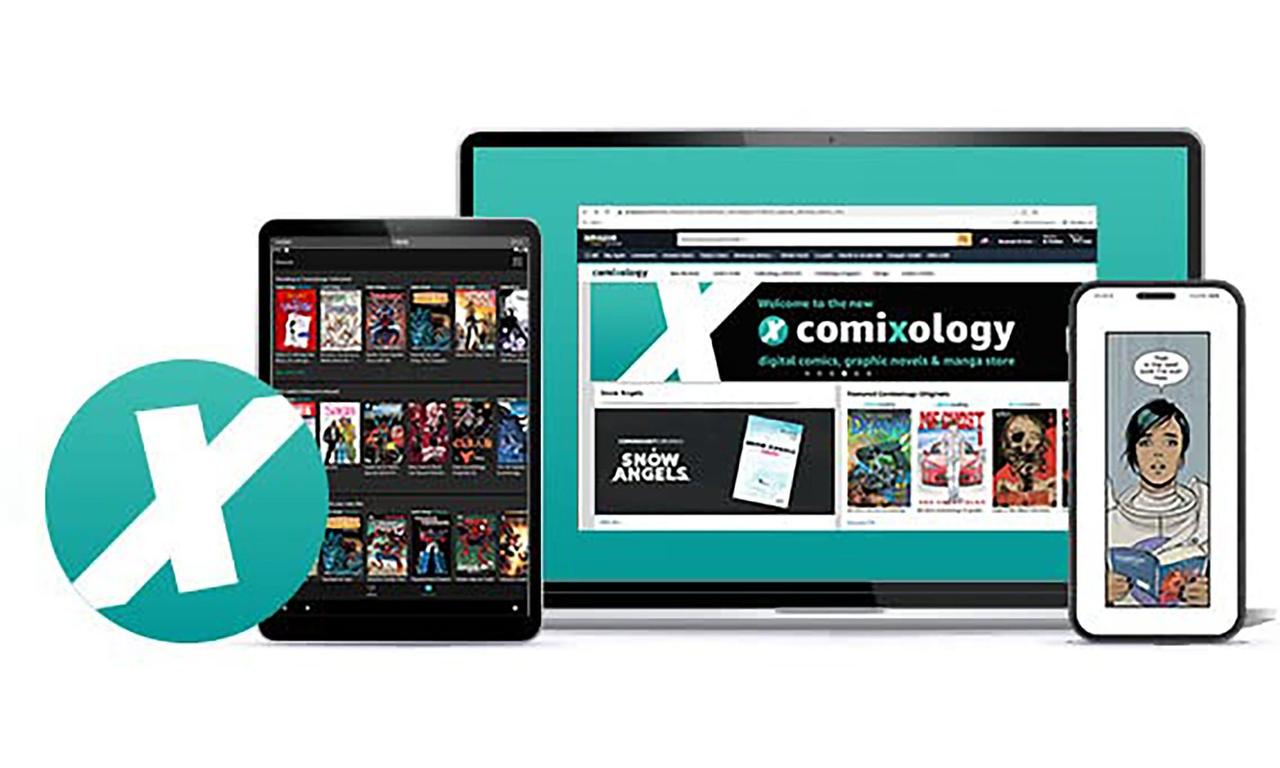
Steinberger left ComiXology in March 2022 to head up “a new Amazon-wide initiative that’s too good an opportunity not to take,” as he announced on Twitter, leaving two long-term staffers — Tom Ashley and Jeff DiBartolomeo — in charge. In a sign of the increasing hold of Amazon culture inside ComiXology, the two do no interviews to talk about their new positions.
Just three months later, Steinberger would exit Amazon completely, just days after longterm ComiXology staffer Chip Mosher’s departure; the two were already planning what would become DSTLRY, although it would be almost a year before those plans came to light.
Their departure leave a noticeable void at ComiXology, both internally and externally. Steinberger and Mosher were the two most public faces at the company prior to their departure, both active on social media promoting ComiXology and responding to user complaints and concerns; in their absence, no other executive stepped up to perform a similar service. Combined with the Amazon-led repurposing of the ComiXology social media accounts as purely promotional engines, it cut off a line of communication between ComiXology and its customer base, underscoring (intentionally or otherwise) the impression that the company had become more impersonal and less approachable since the Kindle integration.
Inside the company, Popverse has heard that ComiXology had lost important figures to champion comics as an artform and an individual medium; anecdotally, we were told that the majority of staffers inside ComiXology are unfamiliar with comics as readers or fans, instead knowing them primarily as units to be worked upon and looked at as product. That difference is at once minor — why should it matter to them? Not everyone has to be a comic fan — and significant, when it comes to understanding how ComiXology users use the service, and what they’re looking for from the service. If the people responsible for building a digital comics service aren’t comic fans themselves, how can they truly comprehend what comic fans are looking for a digital comic service?
Such existential questions took a backseat in January of this year, when the layoffs hit ComiXology. As stated previously, it was originally believed that somewhere between 50 and 75% of staffers were laid off as a result of the Amazon-wide cutbacks, although the final figure looks somewhere closer to 80 percent. The scale of the layoffs across all of Amazon was such that some former ComiXology staffers only received severance paperwork in the last month, while others were actually approached to be rehired by the company after it was discovered that they were necessary to carry out essential functions in order to keep ComiXology running.
The layoffs also pushed ComiXology to rethink its focus in terms of its priorities: April’s announcement of the shuttering of the standalone Marvel Comics app after more than a decade on June 2 was triggered by ComiXology, sources close to the decision have shared.
As this story was being finalized, news broke that another high-profile figure was leaving the company: Bryce Gold, who had replaced Chip Mosher as the Head of Content at ComiXology Originals was leaving, to take over the comics division of Kickstarter. His departure leaves a gap at the top of that program, with no replacement announced so far. What that means for ComiXology Originals as a whole remains to be seen, although the ComiXology Twitter account promised, "we're keeping the content coming with dozens of series and 100+ new issues happening this year" in the wake of Gold's departure.
What's next for ComiXology?

There is, from multiple accounts, deep uncertainty inside ComiXology about the longterm future of the company, and of the ComiXology brand as a whole — an uncertainty that is matched by those outside of the company, as well. In the immediate aftermath of the January layoffs, a number of ComiXology staffers were switched from full-time ongoing contracts to limited time contracts, with a number of them expiring this summer. (Exactly when this summer is unclear; Popverse has been unable to pin that down, hearing estimates of June, July, and even further out from different people.) Additionally, Popverse has been told that a further round of layoffs could be set for the fall, further bringing down the number of official ComiXology staffers.
There is a suspicion shared by current and former ComiXology staffers, as well as figures inside comic publishers who work with the company, that the brand known as ComiXology might be shuttered in the medium to long term, with all digital comics sales being folded inside of Kindle proper. It’s worth remembering that, in the immediate aftermath of the ComiXology/Amazon integration in 2022, the branding used was “Kindle Comics” not “ComiXology.” That was an error, according to people with knowledge of the situation, but it might also have been an accidental portent of things to come.
For publishers, the prospect of the ComiXology team being either released or folded into the larger Kindle team is viewed with some suspicion, although there is also a tacit acceptance that the current ComiXology is itself a shade of what the company was a couple of years ago in terms of both communication and support. That last point seems to be shared by ComiXology customers, as well, judging by social media commentary about the brand.
And yet… there is something, sadly, to the sentiment attributed to Amazon executives about ComiXology’s publishing partners and customers alike: where else is anybody supposed to go, at this point? There is no credible alternative to ComiXology/Amazon, in terms of digital distribution and sales at this point, no competition with anything close to a comparable reach, nor a similar relationship with publishers.
For years before this point, the comics industry en masse was comfortable allowing ComiXology to become the only digital game in town — outside of publisher-led subscription services, which are a very different beast altogether — so that, when things changed, as they were always likely to do eventually, things wouldn’t be left as they currently are.
For its part, Amazon declined to answer specific questions for this story. Instead, in a statement to Popverse, Amazon spokesperson Lindsay Hamilton said, “We will continue to serve our digital comics customers with a dedicated Comixology team. We’ve made a number of updates to our reading and shopping experience in the last year, and are always looking for ways to further enhance the experience.”
For members, read Popverse's in-depth coverage of the recent IDW layoffs and "reset".
Follow Popverse for upcoming event coverage and news
Find out how we conduct our review by reading our review policy
Let Popverse be your tour guide through the wilderness of pop culture
Sign in and let us help you find your new favorite thing.









Comments
Want to join the discussion? Please activate your account first.
Visit Reedpop ID if you need to resend the confirmation email.