If you click on a link and make a purchase we may receive a small commission. Read our editorial policy.
Geoff Johns dishes on the machinations of DC and his future with Ghost Machine
In an interview with Popverse, Geoff Johns reflects on restoring DC history with DC Rebirth and charts a new future with Ghost Machine
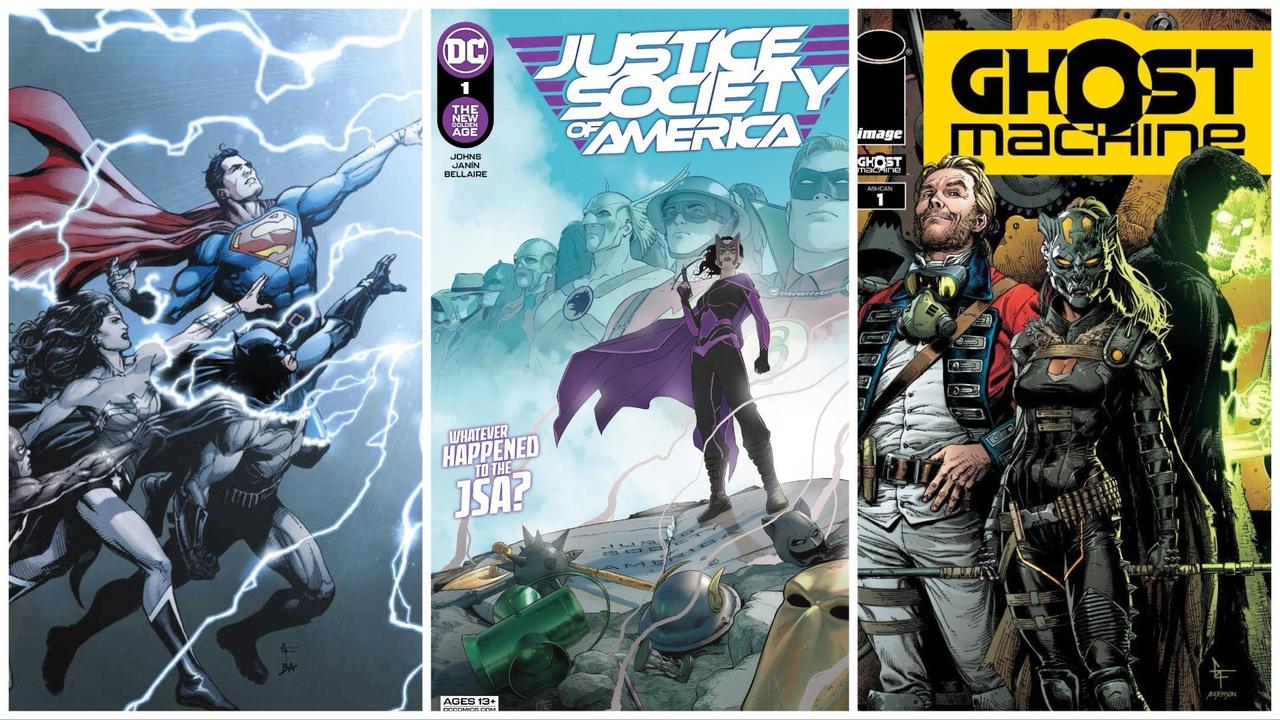
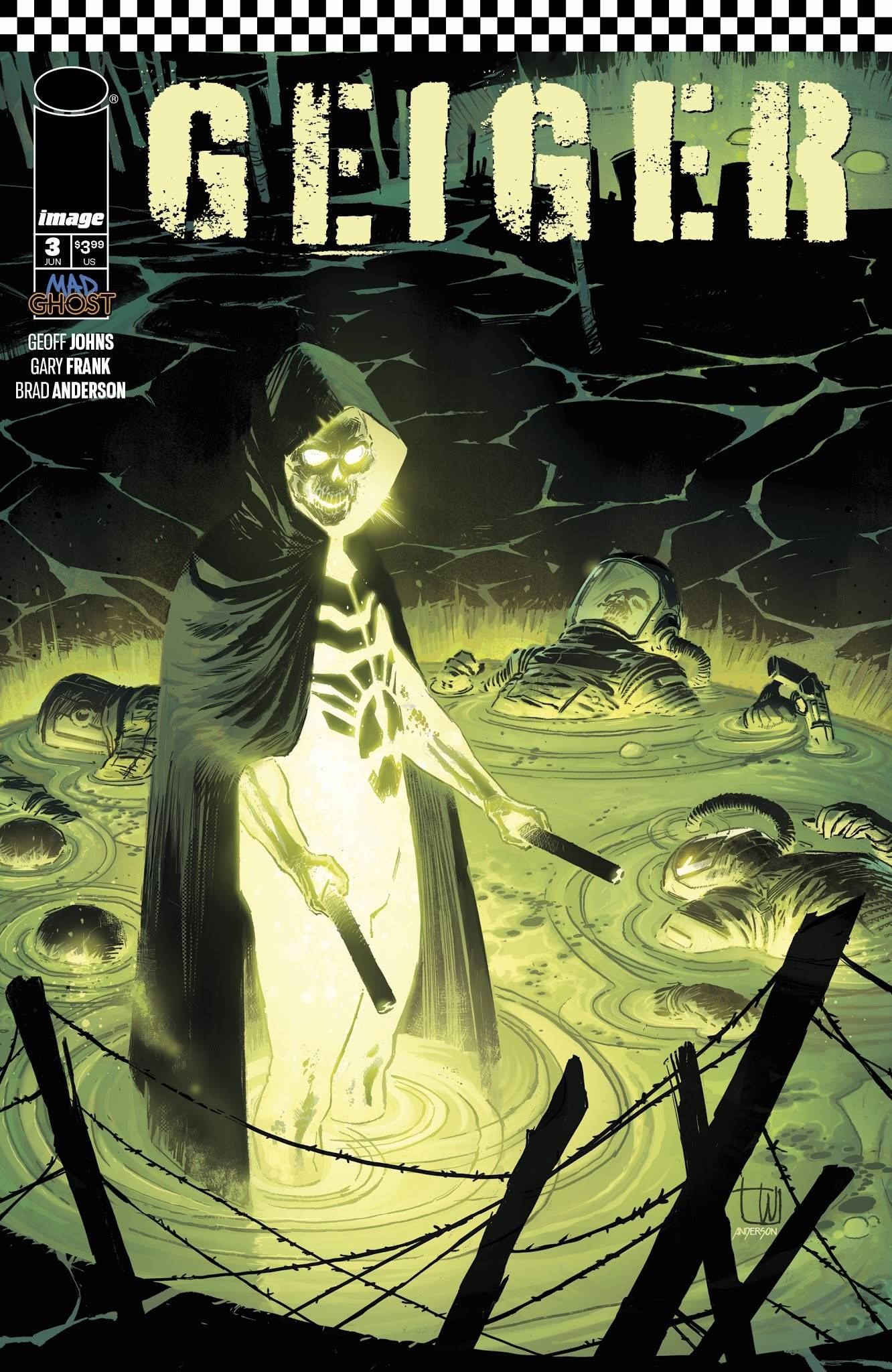
This is something of an understatement, but prolific comic book creator, screenwriter, and producer Geoff Johns is a very busy man. In addition to overseeing the New Golden Age line of comics at DC, including the relaunched Justice Society of America series he helms with artist Mikel Janin, Johns has launched his own multimedia company Ghost Machine, with a whole host of superstar comics creators. With comic titles published through Image Comics, Ghost Machine spins out of Johns’ recent work with Gary Frank on their inaugural creator-owned titles Geiger and Junkyard Joe as part of a shared universe of comics across a variety of genres.
Ghost Machine launches in earnest in January 2024, starting with the Ghost Machine #1 oversized one-shot showcasing the new characters, stories, and titles readers can expect to roll out throughout the year. Meanwhile, at DC, Johns continues to celebrate the DC Universe’s extensive history while finding new directions and characters to add to its ongoing tapestry, including the Golden Age characters he has written for decades. This Golden Age resurgence comes after Johns oversaw 2016’s DC Rebirth publishing initiative, which restored much of the DCU’s classic history while elevating the iconic characters in new ways.
In an interview with Popverse, Geoff Johns reflects on the origins and legacy of DC Rebirth, shares his plans for the New Golden Age as the line moves into its second year with an expanding number of titles, and teases what fans can expect from him and the rest of the Ghost Machine team as the eagerly anticipated company starts off 2024 with a bang.
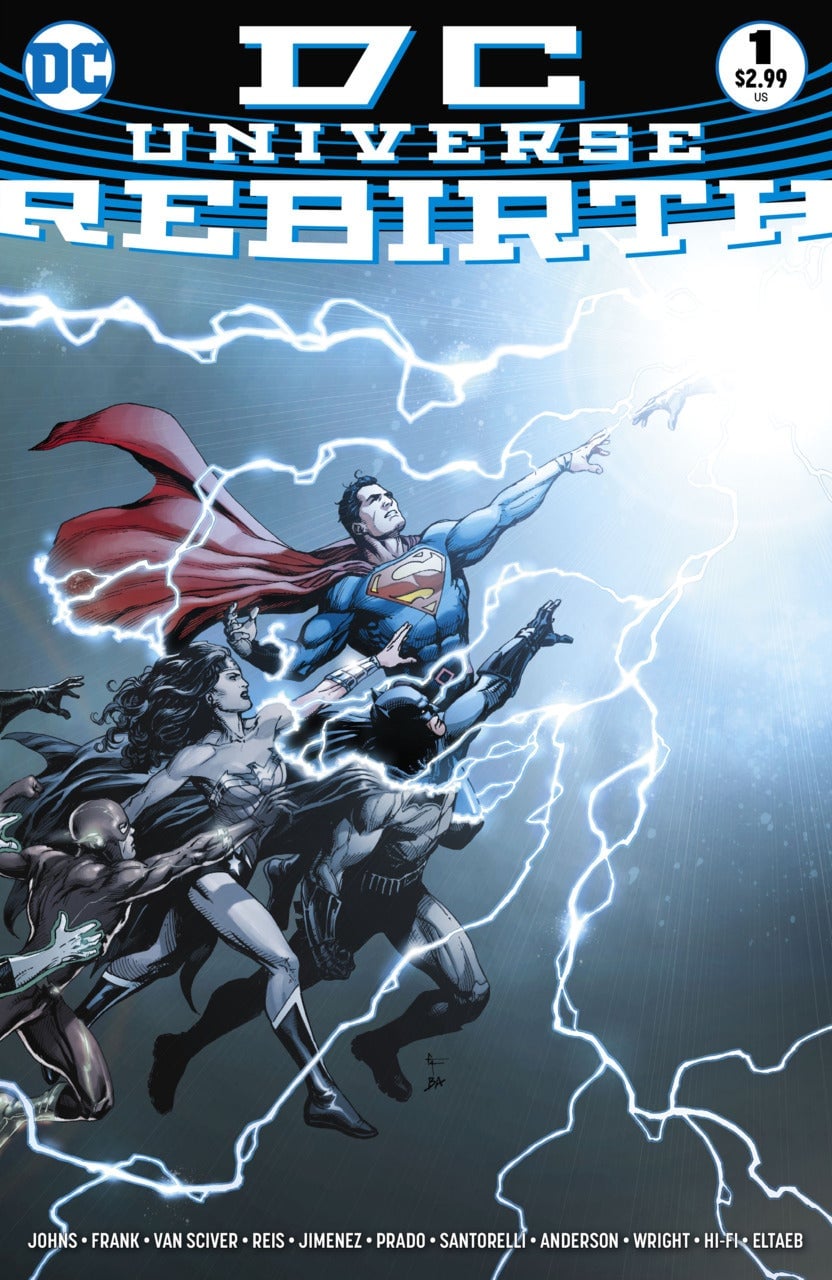
Popverse: Geoff, do you remember the origins of 'DC Rebirth' and how the end of the 'New 52' came about?
Geoff Johns: There were a lot of wonderful things about the New 52, like Snyder and Capullo’s Batman, which was amazing. You had the work on Animal Man and a lot of other characters, but there was also some that was missing from the prior version of the DC Universe. Dan [Didio] had come to me and asked me about using the theme of Rebirth and trying not to do a reset, but a new starting point for readers because the sales had gotten soft and, I think on some level, the creatives were confused of what counted and what didn’t, which always happens with these half reboots.
We talked about it and Dan had used the word “Rebirth” and I said, “Dan, if Rebirth is going to be a theme, I want to go back to the original goals of Green Lantern: Rebirth were.” It’s not just about going back-to-basics, it’s about going back-to-basics and finding that emotional center of the character and then expressing that in a big, bombastic way externally, the best way comic books can.
You have an emotional story at the heart of it, you focus back in on what the character is all about, what the character represents, what the character explores, the thematics, the metaphors, the storytelling, the reason the character resonates for decades and decades in some cases. It was really important to do that.
The heart of the DCU that was missing at the time was legacy because the legacies had been erased, the JSA didn’t exist, there were a lot of relationships that no longer existed. It was an emotional void that I think a lot of people felt and, in some cases, readers had their proverbial umbilical cord cut with the New 52 and they felt it still and felt it even more.
I just went back and thought “Why do I love the DC Universe? What makes me so emotionally attached to these characters and this universe?” Ultimately, my favorite character growing up was Wally West. The idea of a Wally West Flash, of a legacy character, was completely gone, Wally West hadn’t appeared. I wanted to use Wally West as the starting gun for the return of the DC continuity, essentially. DC continuity, to me, is not just about the events, stories, costume changes, and all those things. That’s all fine, but those things come and go.
It’s really about the emotional relationships and stories that affect the characters emotionally, that’s what’s important. For instance, Green Arrow and Black Canary had such a deep, wonderful history and emotional relationship that had been completely erased by the New 52. That was what I was missing more than specific events necessarily that had been gone because, a lot of times, an event happens and then you move on, it’s not as at the forefront of the title. But the emotionality and heartbeat, for me, was missing and it was all about relationships, people, families, and friends that cared about each other.
What represented family, legacy, hope, history, joy, and optimism at DC was Wally West, it was about bringing Wally West back. He was the first sidekick that graduated into becoming the Flash, he was my Flash growing up. I love him and wrote him for three years. I just sat there and thought about what I was missing and feeling as a long-term reader and what was missing was that heartbeat. Wally West represents the heart of the DC Universe to me, as does the Flash, in general, in so many ways, since Showcase #4, Crisis on Infinite Earths, and Wally West becoming the Flash.
It always feels like the Flash is at the forefront of these events. I sat down and wanted to write a story about Wally West, use that story and have that story be everything I love about the DC Universe. The thing I loved about it – Phil Jimenez illustrated it and I have that page where Barry and Wally hug – I knew that I wanted to have Wally weave through the DC Universe as an observer like us, like a reader who had read DC prior to the New 52, witness the heartbeat of the missing emotional relationships that had been erased in a lot of cases, and remind us how important those are and how important he is.
But, at the same time, I loved the idea that Wally was willing to sacrifice himself. It wasn’t about him trying to get back, it was just about Wally trying to warn everybody and communicate with Barry Allen. And when he finally got through to his Uncle Barry and was able to say what was going on, but more importantly for me, the best pages are when he tells Barry “I just want to say thank you and how grateful I am for everything you did for me.”
I get choked up even talking about this scene because, when I was writing the scene, I was in tears and I think a lot of people reacted to the scene in the same way because of that gratitude that Wally had in the face of death and that he was going to go away, not bitter and not angry, which is heroic. He was going to sacrifice himself and do it with gratitude, and then Barry sees him, remembers him, yanks him out, and saves him. For me, that’s one of the most hopeful DC Universe moments that I’ve ever been a part of, certainly, and I’m really grateful I got to tell that Wally West story.
That DC Universe one-shot is still one of my favorite things that I’ve ever had the pleasure and privilege of getting to work on with all these great artists, Dan, the editors, and the whole team, it was awesome. The idea was that we were going to have this DC Universe Rebirth one-shot, inject the heart back in and the theme for Rebirth. I met with every editor and writer on the Rebirth books, I would lead the writers’ room, and we’d get in there and talk about the emotional heartbeat and getting back to that center, who’s the character and what are they all about.
You had the classic, iconic elements of the character there, but it was also about expanding, building new relationships, new supporting casts, new villains, alongside of the tried-and-true DC heroes and villains. That’s what Rebirth was all about. Rebirth wasn’t just about a back-to-basics, but a very coordinated effort to bring the heart back to the DC Universe.
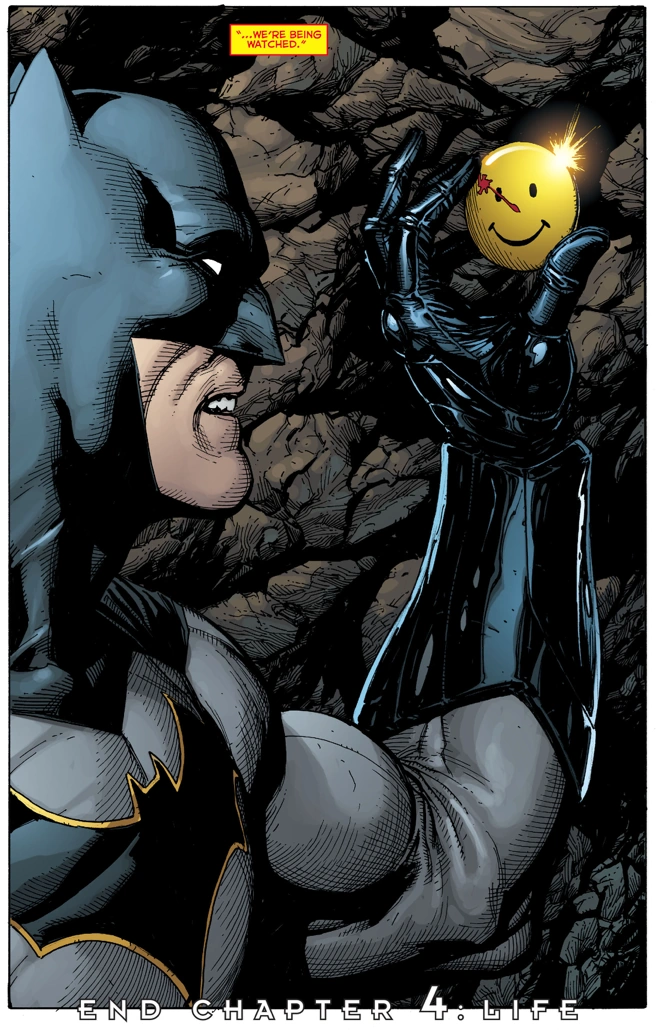
You had a hell of a bullpen, with Joshua Williamson on The Flash and Christopher Priest writing comics again for the first time in years.
I’ve known him forever and I’ve loved his writing since I was a kid. Bringing him back to write comics was great, he did an amazing job on Deathstroke. Rebirth was a really fun time. Pete Tomasi crushed it on Superman with Pat Gleason, that was such a good Superman book. That is one of my favorite Superman runs of all-time, with Pete and Pat, it was so good. There were a lot of wonderful runs and a lot of great storylines came out of it but, most importantly for me when I look at it, it was so much fun to work on it with everybody to just talk and get back to basics.
Rebirth is all about back to basics, but then expansion. It’s not just about rolling the clock back, but about expanding the universe. I remember when we were doing Green Lantern: Rebirth somebody at DC said “How are you going to kill Kyle Rayner?” and I said “Why would you ever kill Kyle Rayner? He’s a great character! I love Kyle Rayner!” I read his run growing up and was super excited by it. I didn’t read Green Lantern before that because I didn’t find the book to be very good and I was super excited when Kyle Rayner showed up.
The key to Green Lantern: Rebirth was that it wasn’t about killing characters, it was about using all of them, bringing them all back, and then opening the door for new stuff. That’s what led to Sinestro Corps War, Blackest Night, Atrocitus, and Saint Walker, all those super fun characters, like Larfleeze, that made the universe grow and expand. We had a Guy Gardner book, we had John Stewart and Kyle, we had all these characters. The reason I love Green Lantern so much is that we have all these characters, it’s an expansion. It’s probably why I love the JSA too.
I don’t love contractions. I like when things expand and grow, when they grow organically from a centerpoint rather than contracting things, like when you reboot a character, erase everything, throw it all away, and restart everything. You can’t erase what’s come before and there are stories that are so good and characters that are so wonderfully established. I never understood full-on reboots for something that wasn’t done because the characters, their histories, and the stories that came before shape who the characters are.
Every time I got on a book for DC, like Aquaman, Green Lantern, or Booster Gold, I would look at the entire history of the character through comics as if that were their entire lifespan. If they went through that, how would that affect them at that point and what moments were important? Booster Gold was one of my favorite books to work on and Dan Jurgens was a huge influence on me. I think Dan is one of the most unsung DC architects of its entire publishing history with all the work he’s done.
Booster Gold is one of those characters in particular and I remember reading all the books, picking up the character, and saying that this character is so ripe to become a real hero at this point and now the world can’t know about it. It’s such a fun arc for him. I loved working on DC Rebirth and it came out of a desire to get the heartbeat back into the DC Universe, to get the relationships back into the DC Universe, to get some of the classic stories back that mattered and meant something.
Not every single story is going to resonate and last the test of time, but there are those touchpoints, emotional markers, that I don’t think you want to erase because they make the character who they are. You look at Bruce Wayne and the Robins, Jason Todd specifically, and I love Jason Todd, but I didn’t really love [him as] Red Hood until I got to do Batman: Three Jokers and realized that this guy has been through so much and this is how he’s dealing with it, which is really unhealthy. Is he ever going to get out of it? I don’t know, he’s such a sympathetic character, in a weird way.
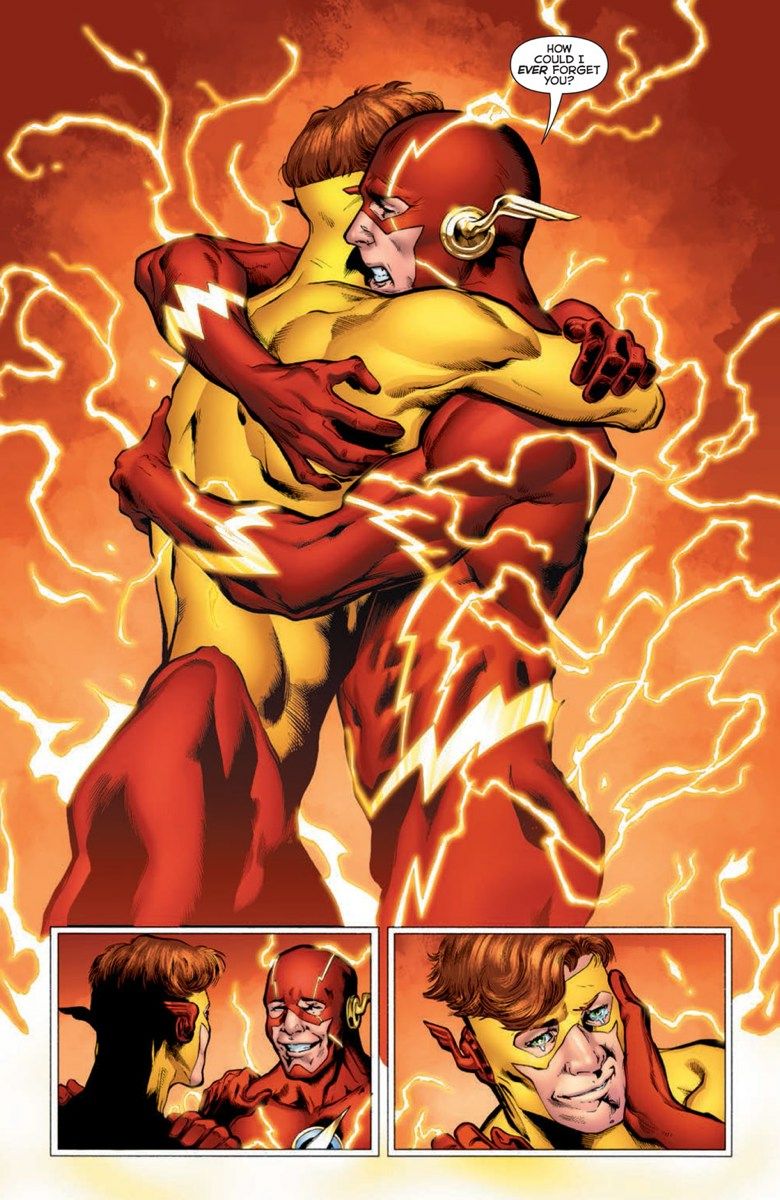
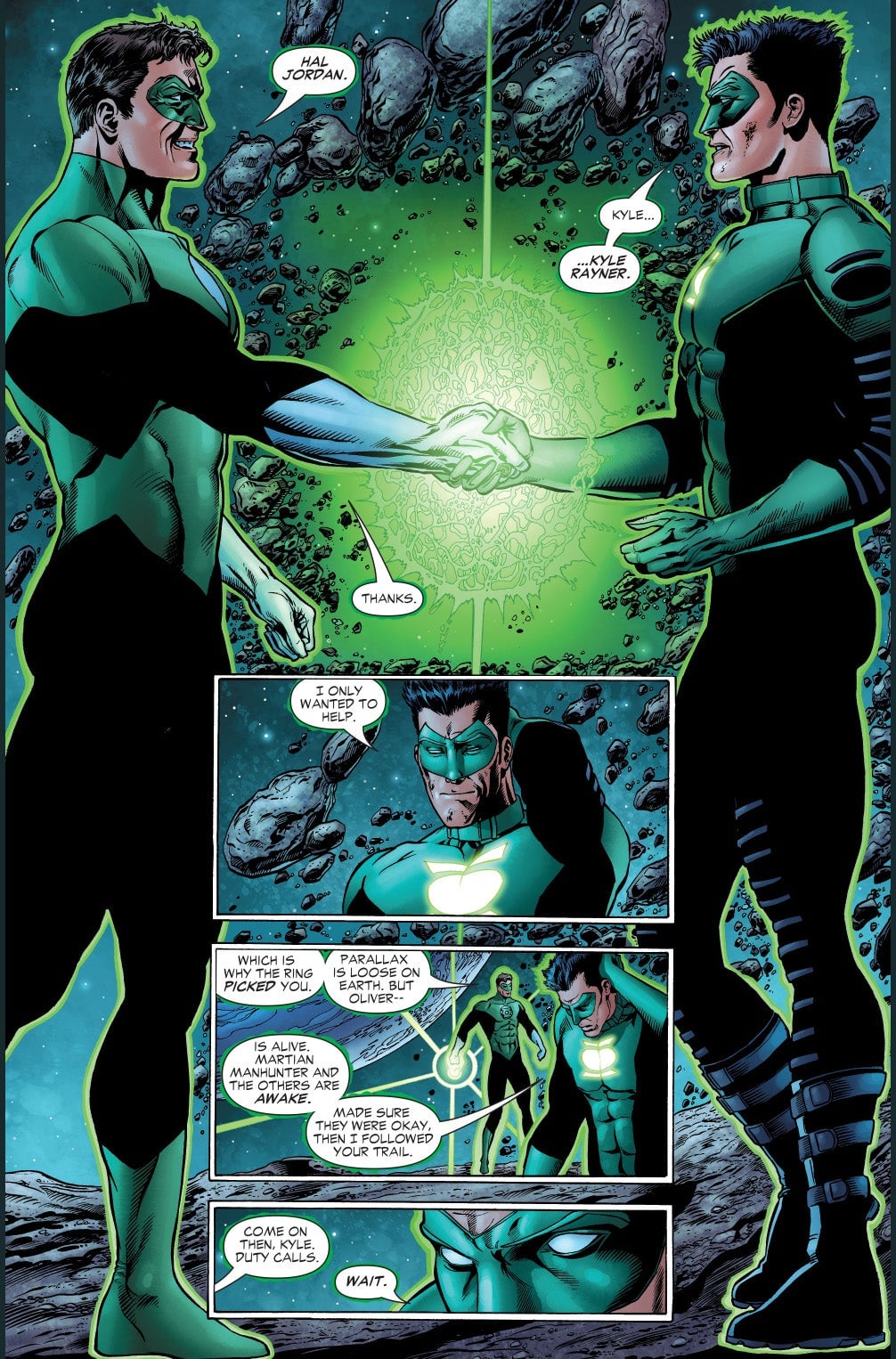
DC Universe: Rebirth has Barry Allen reach out and rescue Wally West. I always thought that was a thematic callback to Hal Jordan and Kyle Rayner’s handshake in Green Lantern: Rebirth. Kyle goes through hell and nobody believes him as the new generation rescues the classic generation. In DC Universe: Rebirth, Barry rescues Wally when nobody else remembers him, as the classic generation saves the new generation.
Yeah, you’re right. It wasn’t a conscious duality that I did. With Kyle Rayner, I really wanted to make Kyle the centerpoint of Hal’s return and show that Kyle was the torchbearer. I always call Kyle the torchbearer because he’s the one who held the light when no one else could. He’s a really important and vital character to the mythology of the Green Lantern Corps. Back then, there was so much infighting and I don’t why people infight. All the Green Lanterns are great, all of them. I really wanted to put to bed any Hal versus Kyle nonsense because it was in the way and counter to what Green Lantern is all about, which is camaraderie, courage, honor, and becoming part of something bigger.
By putting Kyle Rayner in the driver’s seat of Green Lantern: Rebirth, it’s making him the facilitator of Hal’s return. That foursome at the end, with Hal, Kyle, John, and Guy and you see their differences with their rings and how they use them and the intricacies of their personalities in relation to the power of will, it felt magical and important. I remember reading a Green Lantern story where Hal and Guy got in some fight in a bar and they took it outside, leaving their rings on the counter of the bar. They went outside and when they came back, two drunkards had the rings on and were making six-packs with the Green Lantern rings.
I always thought that if anybody could pick up the ring and use it like that, what’s the point, why are these people special? It always bothered me and I never liked that moment. When I did it, I love that moment when Green Arrow puts on the ring and barely makes an arrow. It just exhausts him and he asks Kyle if it’s like that and Kyle’s like “Every time.” That’s how badass Kyle Rayner, Hal Jordan, Guy Gardner, and John Stewart are. It all takes incredible strength, fortitude, and drive to get that ring to create one little spark.
Rebirth was all about taking the time to dig into these characters, line up what makes them special at their core and heart, celebrate it, and expand the mythologies and cast. Dawn of DC is very similar in those respects.
For the past year, you’ve been giving DC’s Golden Age characters a similar treatment with the New Golden Age line, including Stargirl: The Lost Children and a new volume of Justice Society of America, and overseeing Alan Scott: The Green Lantern, Jay Garrick: The Flash, and Wesley Dodds: The Sandman. What did you want to do with the New Golden Age line?
I just wanted to get the characters back on the map because they’d been gone for so long and I wanted to expand them. With Stargirl: The Lost Children, I worked with Todd Nauck and Todd is one of the best illustrators of young superheroes that’s ever lived. The ability and privilege I got to work with him on Stargirl: The Lost Children, which was a book I was so excited about to be a part of, was looking at young heroes and the history, the legacy, the meaning of what it meant to be a young hero, being trained and mentored by older ones, like Stargirl with the JSA, these lost Golden Age characters.
I wanted to celebrate the legacies of sidekicks because everybody has a sidekick in the ‘40s and ‘50s. It could be goofy and gimmicky, but if you look at it from an emotional place with these kids, it was such a life raft to kids that are troubled or have something in their lives that wasn’t going their way. They were lost, or had no family and were powerless to help. In many cases, their parents were in trouble and somebody helped them, and that’s in the ‘40s. Courtney Whitmore, to me, symbolized that bright, shining star.
If you look at DC and say that DC, at its best, is about optimism, hope, and heroism, I feel like Stargirl is up, in terms of tone and spirit, with characters like Superman, the Flash, and Wonder Woman, where they’re very bright and shiny. She’s literally the light and I wanted her to be the beacon that brought all these characters back and reminded the world and us how important every single person is. Everybody is important and needs help, and Courtney would never leave anybody behind. That’s where that series came from.
With The New Golden Age, I was talking to our editor Andrew Marino and I had worked with Jeremy Adams and Tim Sheridan on Flashpoint Beyond and had a great time. They’re fantastic writers and Tim had a really strong story to tell with Green Lantern, a personal story. We talked about how it could involve the Red Lantern and it evolved into something great. Jeremy Adams is a father and was really interested in Jay Garrick and what it’s like to suddenly be a father and have a daughter and how that does change your perspective. It’s one thing for him to mentor Stargirl, Cyclone, or other young characters, but when it’s your daughter, it does have another meaning. Jeremy really wanted to grab that.
With Wesley Dodds: The Sandman, this was a long before Oppenheimer was out but Rob Venditti wanted to tackle the responsibilities of war, weapons, weapon-making, and the morality of killing, using weapons that kill, and creating weapons that kill through Sandman. It’s a great mystery story and harkens back to my favorite Matt Wagner book, The Sandman Mystery Theatre, it’s one of my favorite books of all time.
To see Jeremy, Tim, and Rob come in and expand the Golden Age, it’s the first time that Jay Garrick and Alan Scott have had their own solo titles in literally decades. I don’t think they’ve had one since their books were canceled in the ‘40s and ‘50s. It’s very special, the art is beautiful, and it’s very much in tone with Dawn of DC. It’s getting back to the core of your characters but, in the case of Jay Garrick, it brings in his daughter Judy and a villain that’s previously unseen. With Green Lantern, you get the history of the Red Lanterns and, with Sandman, there’s a villain and mythology in that that expands out.
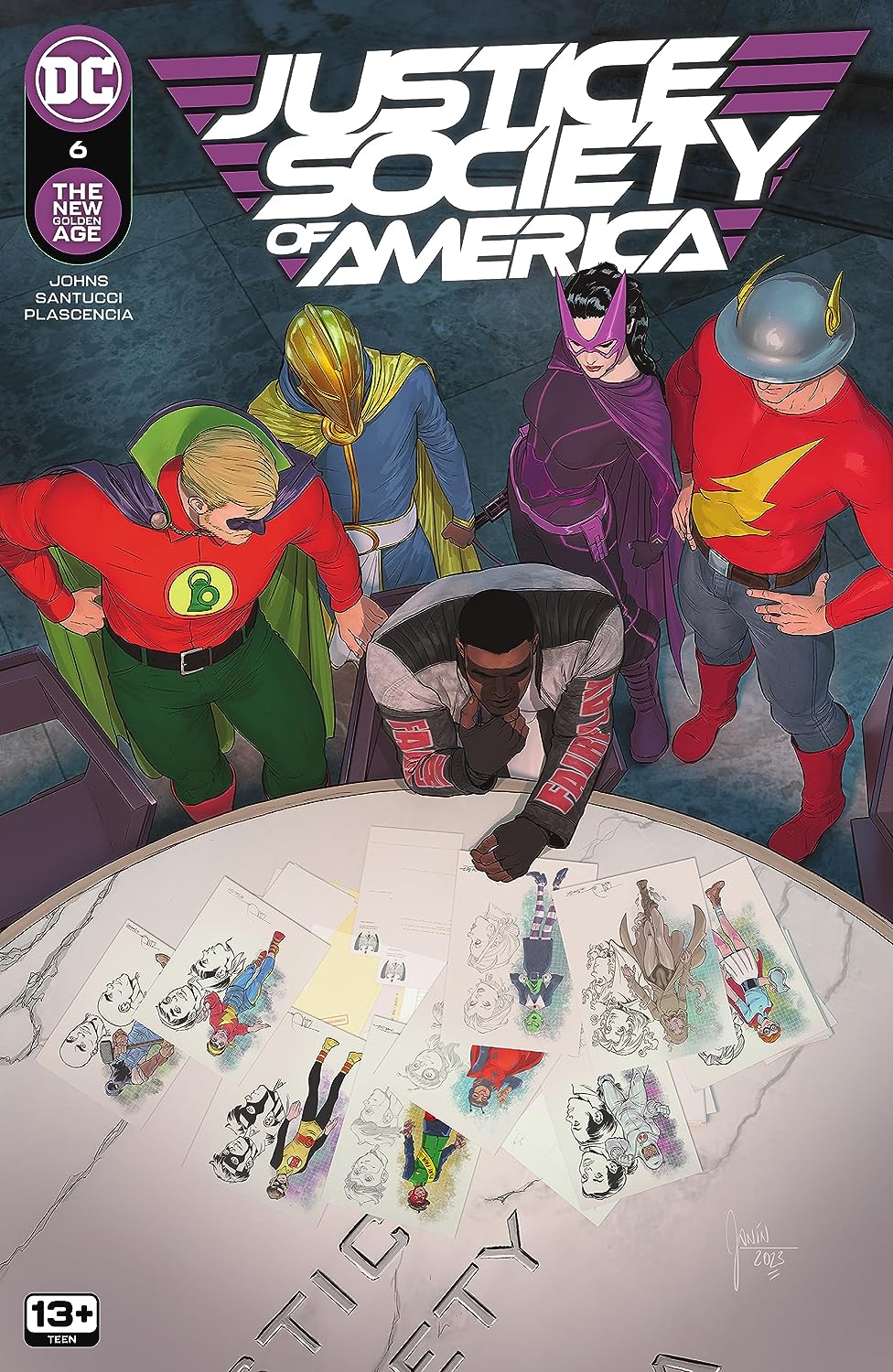
While they’re doing that, the JSA will be in their second arc, which explores Huntress’ desire to not only bring in these new kids from The Lost Children, but also the members of the team she knew from her future. The Mist was part of the JSA. Ruby, the Red Lantern’s daughter, was part of the JSA. These people are out there right now and, even though it’s not their time yet, they’re there and she wants to bring them on now.
There’s a question in Issue #7 from Power Girl asking how many heroes does the Justice Society need and Huntress says “Is there a limit? Do you guys have a membership limit? We should bring in and help as many people become productive members of the Justice Society because they’re going to help the rest of the world infinitely.”
Every Justice Society member that exists, comes on, and is out there, thousands of people are going to benefit from. The JSA is evolving into a much bigger organization, group, and thing. It’s not about seven members each month sitting down at a table. It’s about a global organization and movement that’s going to grow leading up to Issue #12.
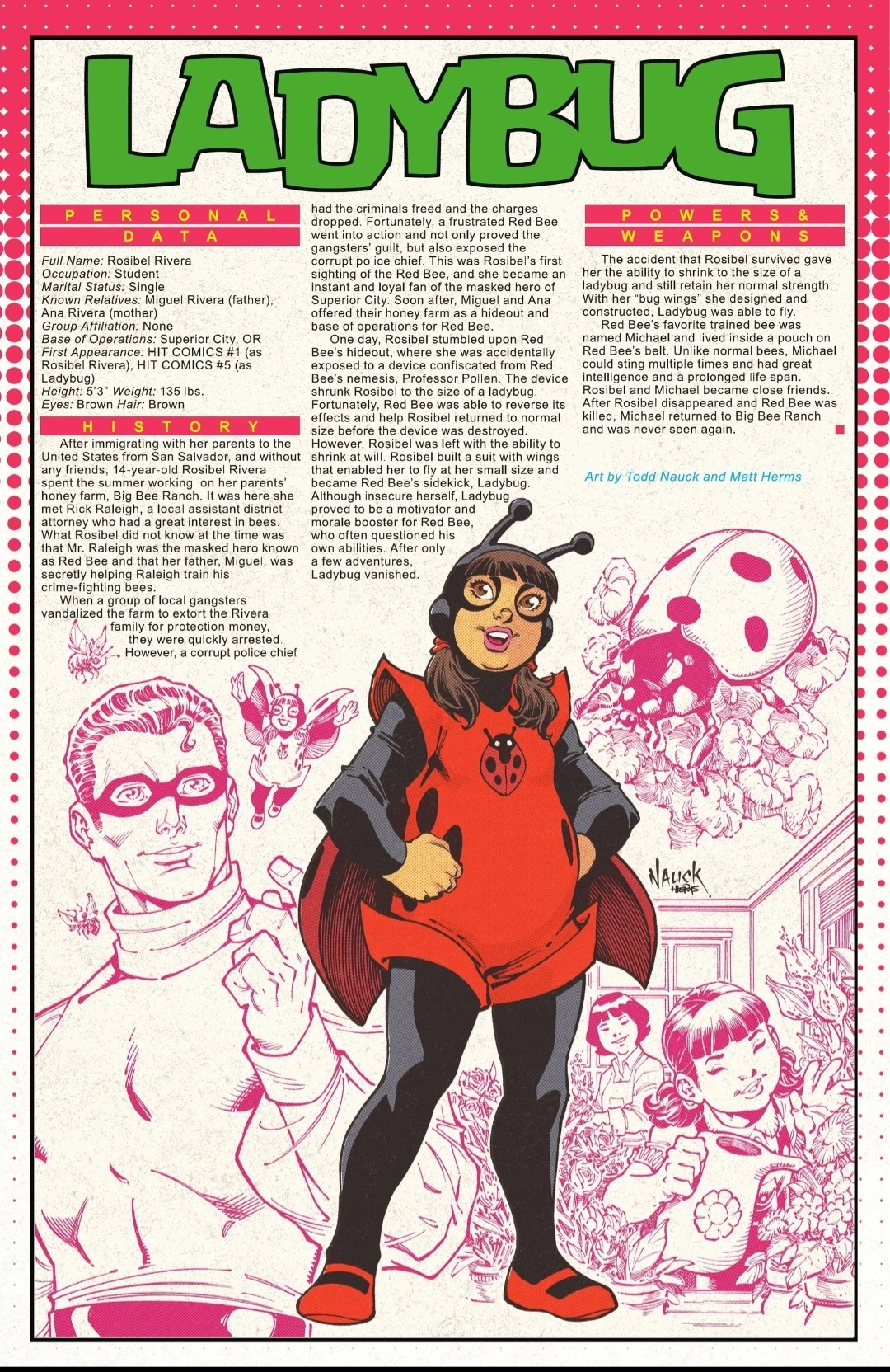
One character that has taken on a big role in the New Golden Age is Red Bee’s sidekick Ladybug, introduced in Stargirl: The Lost Children. Red Bee’s who, if he never showed up in that issue of Starman from ‘90s, I would’ve known existed.
Similar to you, I knew the character from Who’s Who and then he showed up in that issue of Starman. I think the character of Ladybug really took hold of me when I was working on The Lost Children and, when we brought them over, she was just somebody that I liked. She’s different from every other sidekick out there, her parents worked a honey bee farm, she’s intimidated easily, she’s quiet, and she isn’t necessarily the first person that you think of when of a young hero. She just feels very much like a kid in their shell who needs to come out and Courtney can help her come out.
I find the emotional story of someone who disappeared for decades, her parents searched for her, and they never found her and then they died. Now this girl is back and she’s got to face that and process it and try and be good with what she’s gone through. How do you turn that into a positive? These kids are interesting to me and we want to create new characters. The New Golden Age is there to populate the Golden Age with previously unseen characters, which I find very fun.
For me, it’s always about what do you add along the way. People can say how many new characters do you need to add or how big can the JSA get. For me, it’s a society and a society is different than a league or a squad. A society is huge, it’s a never-ending evolution of what justice can mean. It’s more about introducing these characters and finding the ones that work. Ladybug stuck with us and became really fun to work with.
All these characters have really great potential and value to use and I hope some other characters continue on, just like I have with minor characters, and bring them into stories with other characters in the future.
You’ve been really incorporating world-building history into your recent comic book stories, starting with the ancillary material in Doomsday Clock and that carries over to the world that you and Gary Frank started with Geiger and Junkyard Joe.
I love history. Gary and I love superheroes, but we want to tell more superhero-adjacent stories and get into characters that aren’t necessarily straight capes and tights. We want to create beyond superheroes and do characters like Geiger, Junkyard Joe, and now Redcoat with Image and tell stories that, as fantastic as they are, are a little more grounded. We explore history and different time periods and take a look because the present is really the result of the past. Every decision in the past has shaped the present.
I don’t think people often look at it that way, but it is true. Everything that happened has a ripple effect in the present. Everything you do today is going to affect the future. Today is this because of the past. I think the more we recognize that, the more we can prepare, protect, and forge the future in a way that we want to see it. I love history and introducing a mythology, called The Unnamed, where there are these characters in American history, like Paul Bunyan and John Henry, that are mythical and exist out there in myths and legends.
These are their stories and there is a unification between all of them in some way, which we’ll get to. It’s also a place where you can tell beginnings, middles, and ends. There’s never an end for Green Lantern and Superman, really, but great series like Invincible eventually finish. I think doing these creator-owned books are vital for us as storytellers and creators on every level, from a sheer creative challenge and interest and also just as far as your careers.
The ever-changing entertainment business is evolving every day and I think creators need to evolve with it, and we’re proactively doing that.
Is it liberating to create your own world, characters, and stories?
It’s really liberating for us on many levels. It’s creatively liberating, ownership is really important today, it’s vital for creators. It’s an honor to be part of Image’s legacy of creative ownership and creator-owned comics, where it started, and where it’s evolved. There’s not a single company that I know of that exists the same way as Image Comics does and how it was founded, representing and supporting creator-owned books. We have total freedom creatively with what we want to do, we have total freedom publishing-wise.
Quite honestly, there were times when Gary and I were working on a book and it had to come out in this month and someone would say “Hey, we need it to come out three months earlier” because the company needed to make money and then we’re behind on books; it’s frustrating during that situation. I love working for DC and I loved working with Tom Brevoort at Marvel when I did, but there is a freedom to working at Image that is unmatched anywhere else. That’s our focus, on Geiger and The Unnamed.
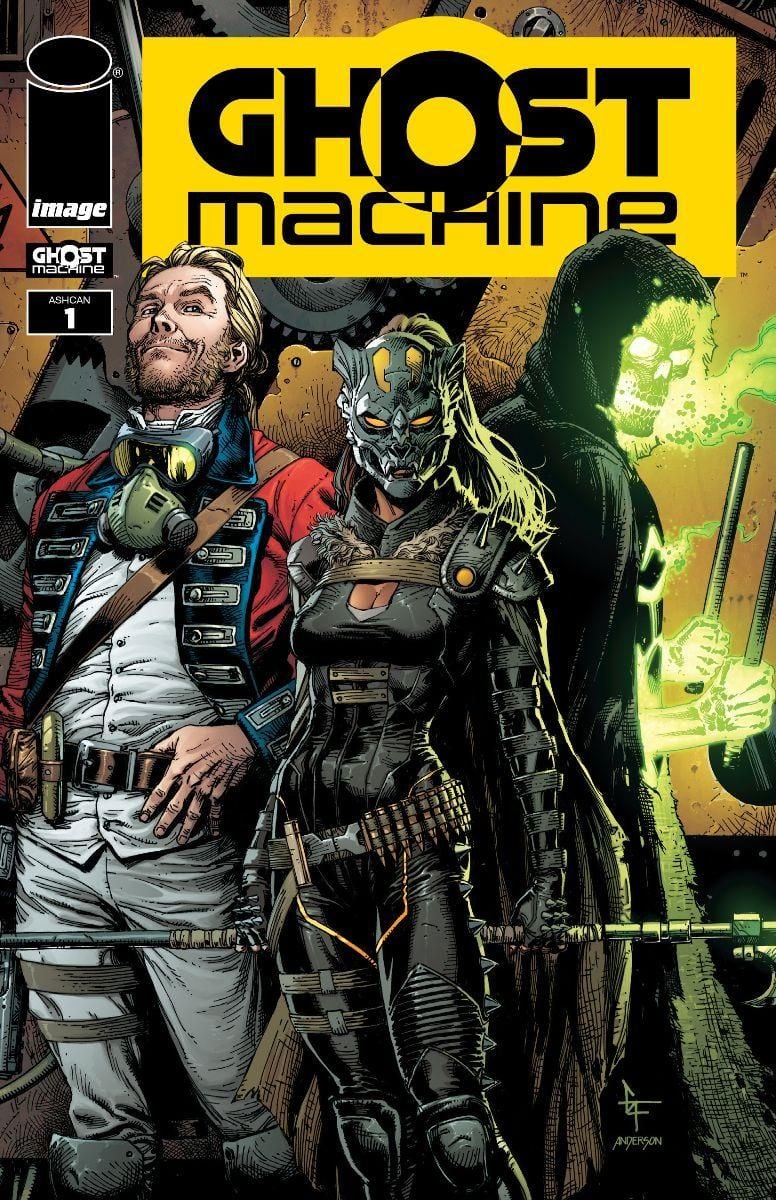
From the recent announcements of Ivan Reis and Peter Snejbjerg to Bryan Hitch leaving licensed work for the foreseeable future to focus on creator-owned, you’ve got quite the creative lineup at Ghost Machine. How was it putting this bullpen together?
It grew really organically after Gary and I did Doomsday Clock, we wanted to do something creator-owned. Gary was finishing up Doomsday Clock and we talked about doing something different, new, and genre but not straight superheroes because we had done so much of it. We did Geiger, Geiger did really well, and we had a lot of fun doing it. I’ve known Eric Stephenson forever and working with Image was something that I wanted to do since they first launched and I read Spawn, Savage Dragon, and Youngblood from way back when.
I just thought it was so cool to see these mainstream creators go do original characters. It was exciting to read their first appearances. The opportunity presented itself and when Gary and I did it, we had such a wonderful experience with Eric and the team – we were going to go back to doing characters that we didn’t own, because that’s what we do, but instead we did Junkyard Joe and knew we were going back to Geiger after that.
At the same time, Jason Fabok and I had finished Batman: Three Jokers and we were talking about what we wanted to do next. Jay, in the same way as I am, is a huge fan of Image and that initial launch and how exciting it was to see all that. We started working on something and then conversations started with Bryan Hitch, Brad Meltzer, and Pete Tomasi. All of it just organically grew and we started to talk about how you could create something new in this business, something that would put great books on the stands and a great new line of characters and so we can explore something new.
We’ve been working on this for well over a year. We worked on what the business would look like, how we could do this together. We had conversations with Francis Manapul and Ivan Reis. Suddenly, it started to grow and grow, and it’s still growing. We’re having conversations with people that still haven’t been announced yet that are coming onto the team. Ultimately, it came down to the conclusion of doing something no one’s ever done.
Let’s not just do creator-owned books, but a creator-owned company, not just a creator-owned company, but a creator-run company. We run Ghost Machine, we own Ghost Machine, and we share in everything; all of us together share all of it. That concept has never been done. We put together a line of titles, books, and characters, curated a great group of creators. The creators are as well-curated as the titles are. We hired a great team that edits the books and puts the books together. We’ve got people like Brad Anderson and Rob Leigh and all that.
We set out to do it and, this summer, we talked about announcing it at New York Comic-Con and launching it in 2024. Building up to that October 12th date was a lot of work and we had to talk to a lot of people: Conventions and, of course, our friends and family, people that we were already in business with. We were building a website and storefront already so that, when we launched, we were already printing books and ashcans in secret.
We were so happy that that day, that morning, there weren't any leaks or anything ahead of the announcement. Image and Ghost Machine, we covered up our name with curtains. We were very careful but, at the same time, there were so many people that were involved with the launch. We were thrilled that we got to do it our way and that’s what Ghost Machine is all about. It’s not just about creative control, it’s about business control. We went out to get creative control and, with that, business control. Those two go hand-in-hand, you can’t have one without the other.
You’ve studied the initial launch library of Image Comics titles closely. What were some of the lessons you learned from that for launching Ghost Machine?
One of the big things that we wanted to do was build a unified team. That’s not just important with creation, but with ownership and business. We’re all in it together and it feels great because we’re all rooting for each other. We all want all the books to do well, we’re all huge fans of each other. When the books come in, we all read it, all look at it, all share it, and all cheer each other on because we’re all excited about each other’s books.
They all matter, we’re all hooked to each other. It’s exciting and the fact that it’s never been done before in the way that we’re doing it, we’re breaking new ground and we hope to inspire other creators to do the same thing. Unify in every way and that’s where you’re going to get your creative power and business power.
Geoff, you own Earth-2 Comics in California, which gives you a unique insight on how readers respond to titles and trends. How did that inform Ghost Machine launching in a market full of superheroes?
Honestly, it was so organic because Gary and I did Geiger and Junkyard Joe, which are genre, but I wouldn’t say are superheroes. They don’t have capes or tights, they don’t have the same tropes, they’re different. When Bryan and I were talking about Redcoat, which is kind of superhero-adjacent, but it’s got an immortal British redcoat soldier from 1776 – that’s it, that’s the story of the character. There’s definitely some of the supernatural genre to it and some alternative history.
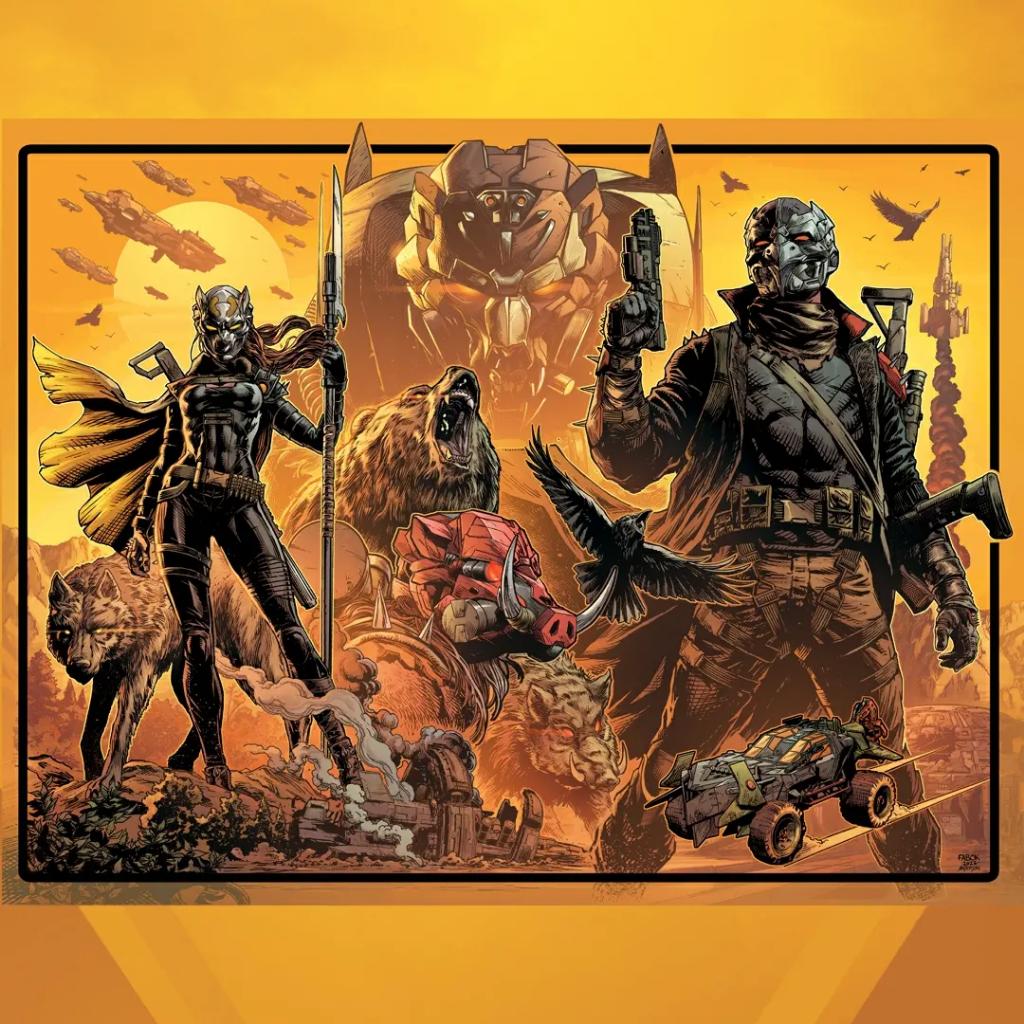
With Rook: Exodus that I’m doing with Jason Fabok, it’s sci-fi. With Hyde Street that I’m doing with Ivan Reis, we’re doing a horror book. This was just stuff that we wanted to do, we just wanted to do different genres. Comic books used to be all about different genres. But we’re all about characters, they’re all genre characters. We didn’t want to do straight superheroes because as much as we love them – and I love Green Lantern, Superman, and Flash – we’ve already done that.
We’re going to take a lot of the experience we had doing those and that’ll inform what we do now. We set out two years ago to do things that weren’t just straight superheroes, but they’ll still have great genre, action, and visuals in them because that’s just what we do and what we love. But we decided to do something just a little bit different than Marvel or DC.
Where did the name Ghost Machine come from?
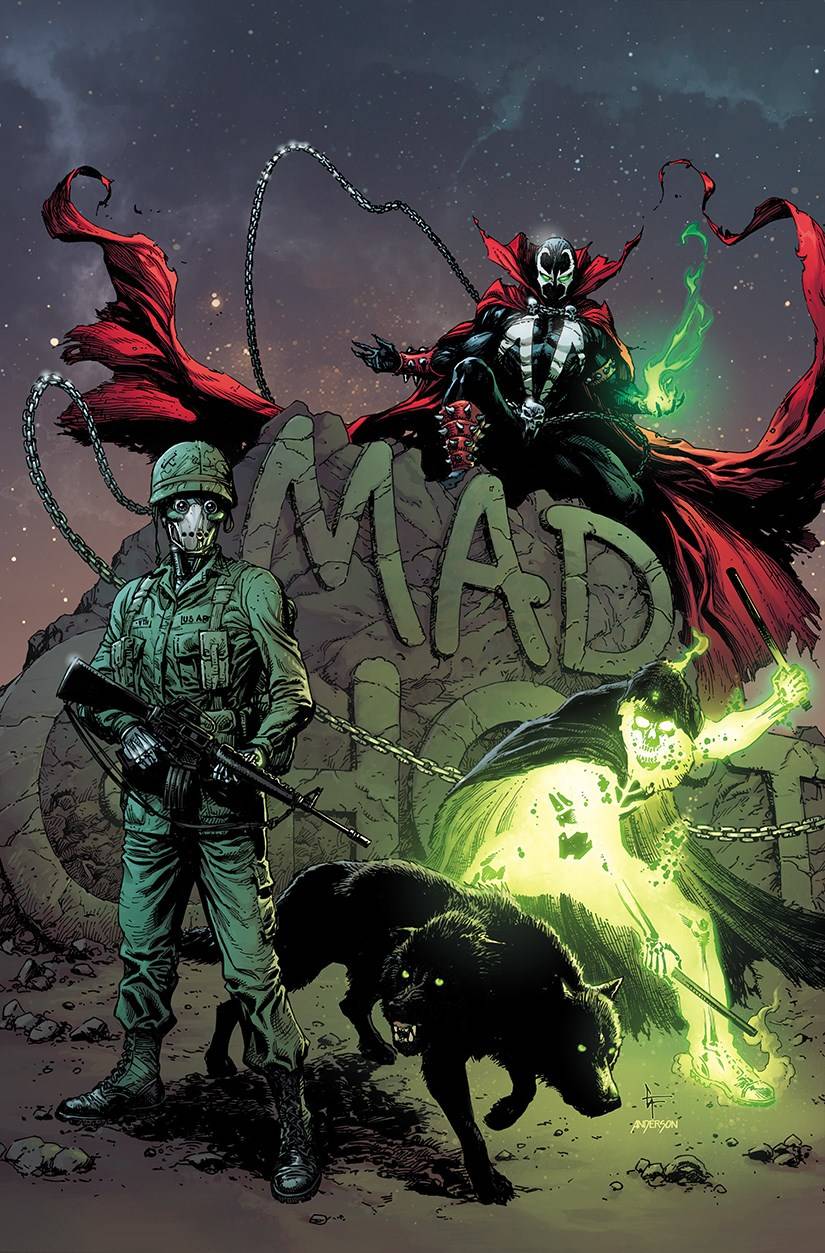
Initially, when Gary and I were working on it, it was called Mad Ghost. When we evolved into something brand-new, other people joined and it became a different business and company, we talked about a lot of different names. Ultimately, it was Gary Frank who called us Ghost Machine. It comes from a phrase in the late 1940s from this French philosopher, “ghost in the machine,” who was originally talking about the spirit and the body being two separate things. In modern day, that evolved to ghosts in the machine being a program in a computer that doesn’t act the way it’s supposed to and you can’t explain why.
We feel like we’re the ghosts in the machine. We’re the creators, the passion, and the magic of storytelling, that’s who we are and what we do. You can’t replicate us because each of us are individuals with something to say and talent that we pour into what we do. We feel like we’re unique and another group of creators doing this would be unique, doing different types of books. That’s where the phrase comes from, from ghost in the machine.
Follow Popverse for upcoming event coverage and news
Find out how we conduct our review by reading our review policy
Let Popverse be your tour guide through the wilderness of pop culture
Sign in and let us help you find your new favorite thing.


Comments
Want to join the discussion? Please activate your account first.
Visit Reedpop ID if you need to resend the confirmation email.