If you click on a link and make a purchase we may receive a small commission. Read our editorial policy.
AXE: Judgment Day writer Kieron Gillen teases the battle ahead in Marvel Comics' premiere 2022 event
Marvel Comics' Kieron Gillen on Judgment Day, Eternals, and what creator owned comics taught him about writing a crossover
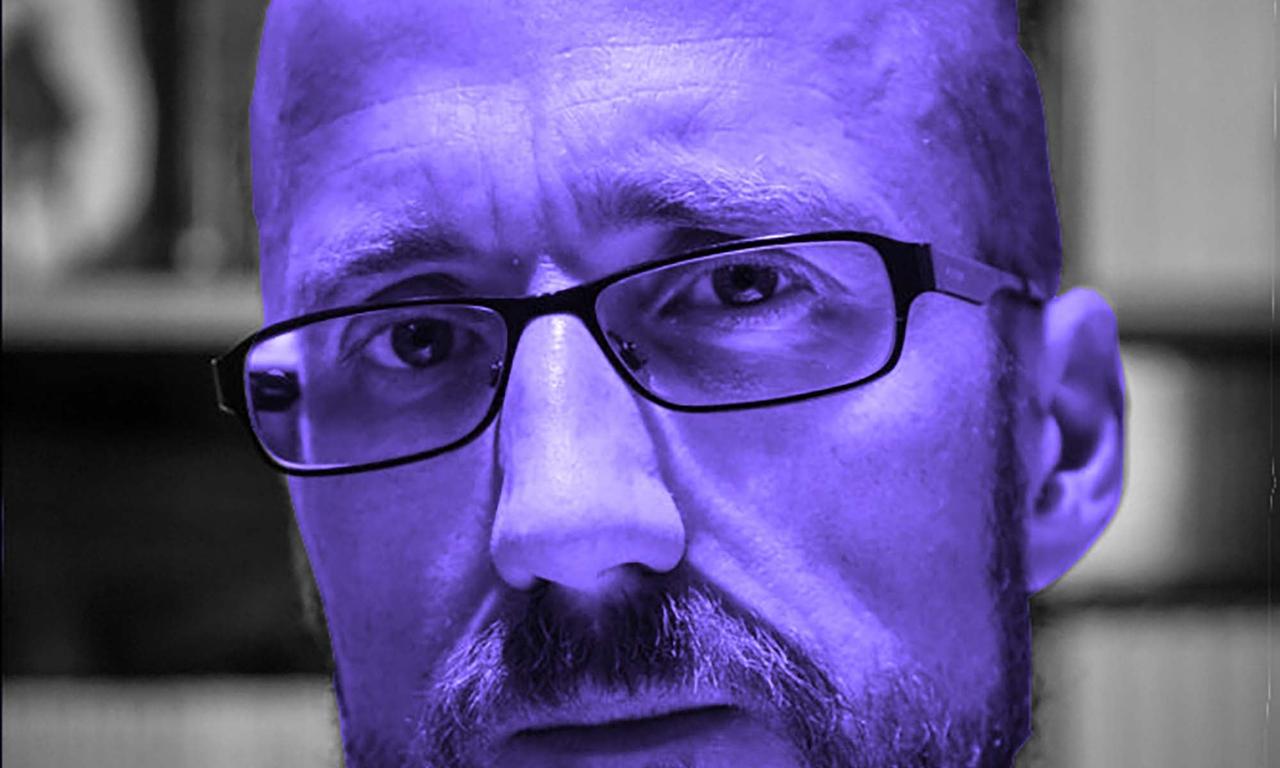
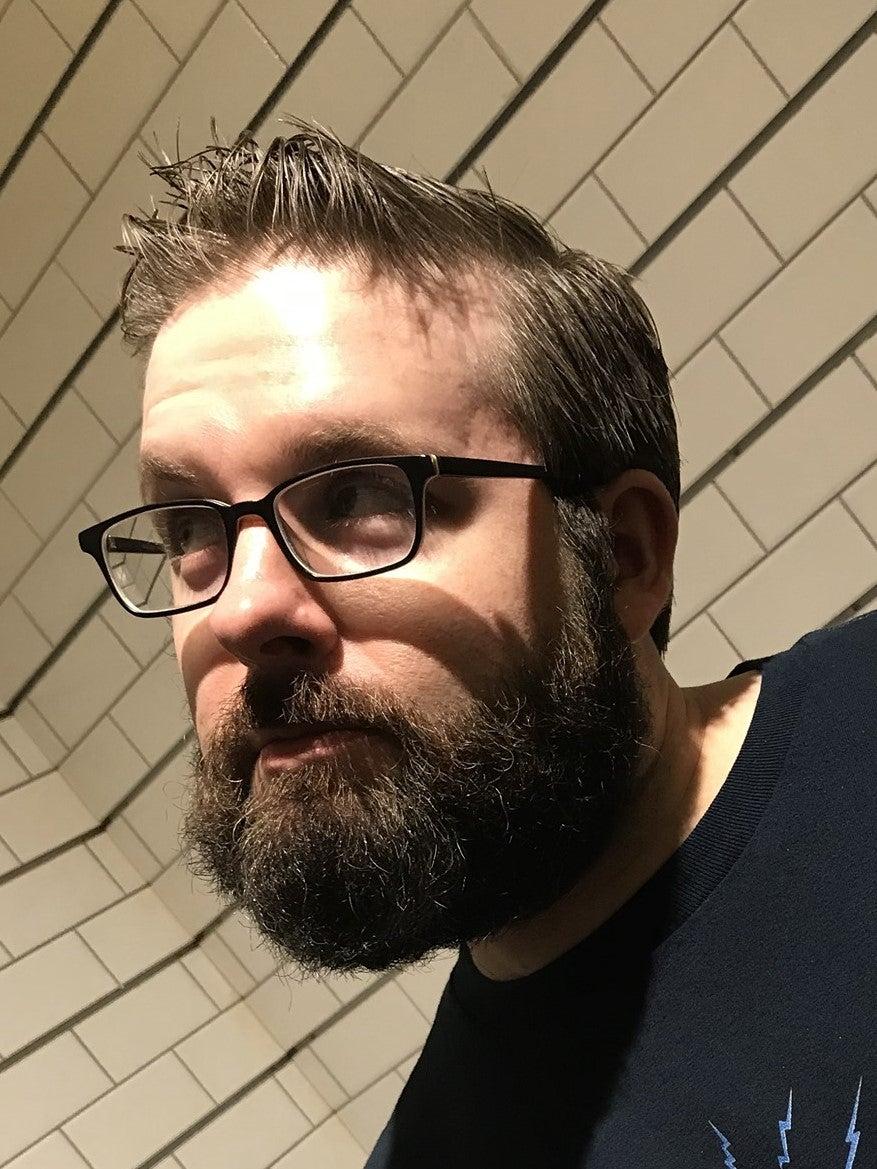
This summer, writer Kieron Gillen will launch his first-ever Marvel Comics event series with AXE: Judgment Day with artist Valerio Schiti, an epic clash that will feature the Eternals bringing the fight to the X-Men, and the Avengers caught in the middle of it all.
We've already heard from Gillen about the stakes of the event, what's coming up in the Eve of Judgment prelude issue, and more, but the creator behind books like Eternals and The Wicked + The Divine also had much more to say about crafting the massive crossover. So, here's out full, extended interview with Gillen, talking everything from his favorite event books to working with artist Valerio Schiti to what creator owned comics taught him about writing superhero events.
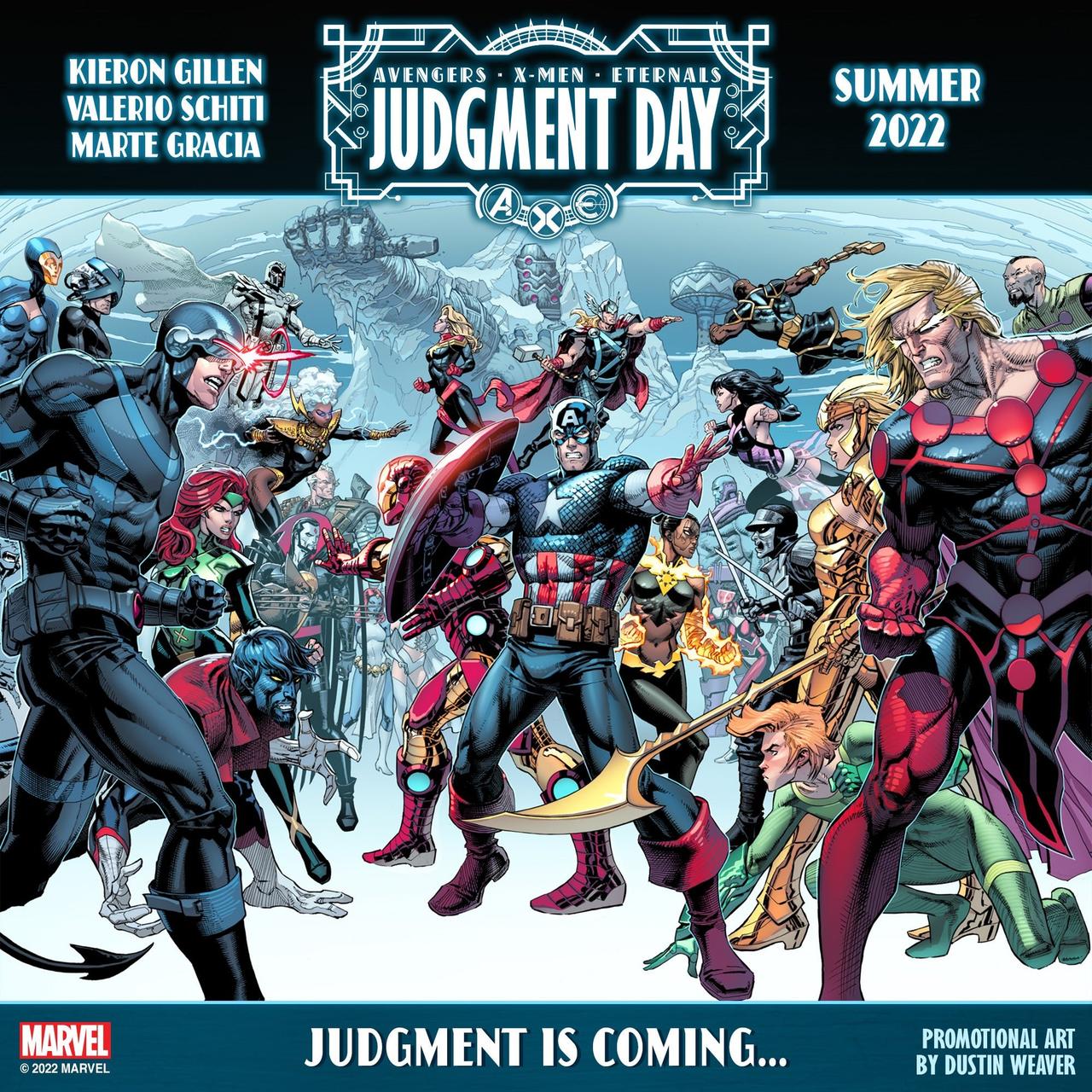
Popverse: Obviously you've been back doing Eternals for a while, but some of the stuff you're dealing with with this story, particularly in the Free Comic Book Day prologue, ties back to stuff that Jason Aaron was doing with the Avengers of 1,000,000 B.C. and things like that. Where does Judgment Day begin for you in terms of where the idea came from and how early on you started developing it?
Kieron Gillen: Honestly, for me, speaking as a reader as much as a writer, there's nothing worse than an event that comes out of nowhere. OK, that's not true. There are many things worse than an event that comes out of nowhere, like war. You know what I mean? Anything in the real world.
But in comics, it's so much better when an event naturally grows from the material. So, when I was asked [about event ideas], it was like 'It had to come from the books.' So yeah, I was looking at the Avengers, what Jason has built in the mythology there. I was looking at the X-Books, the secrets of Krakoa coming to light, and I was looking at these while I was doing the Eternals, which dances with both of them, the various tensions in Eternal society there. And now that stuff's going to blow up. It's just that kind of 'Oh look, these are three logical strains that are intersecting, let's then bring them forth and see what happens with them.'
Did elements of this in your head predate what you were doing in Eternals, or was it something that came once you were scripting that?
Good question. I couldn't quite give you an exact timeline because it came through naturally. I was asked to do Immortal X-Men beginning of last year, I reckon. I would have to check the exact day. Maybe even slightly earlier. I had already obviously been doing Eternals then, and I was already thinking, 'OK, there's an Eternal/X-Men crossover here. There's a war happening here because of this. All this stuff is there.' To go back to specifically, I was already thinking about Eternals versus X-Men like 'There's a conflict here and an interesting conflict. It comes from where both of them are.' I was originally thinking it would be a smaller thing. I was thinking it would be more just about the Immortal X-Men. It would be a small, almost a stealth war.
Like there's a thing we end up doing in AXE: Judgment Day down line: I'm really interested in psychic warfare. The idea that a real big war could happen between two psychic species and no one could know. Kind of the superhero equivalent for a neutron bomb. All the buildings are standing, but people are dying. So, I was thinking about that. That was my original idea. But then the more I was like, 'Oh, what would happen'... It felt more like 'OK, you could do it like that, and I am also going to do it like that, but you could also do it with the buildings falling down too.'
It grew from doing Eternals, then I'm also doing Immortal X-Men and there's a story here, and I'm already with Eternals building off the Avengers anyway. Because explicitly, I want it to be in conversation with other books. It grew and it's like, 'Oh no, this is an event. Isn't it?' So, it gradually slid into being what it is, which is nice.
With this narrative, you have two teams with very distinct means of resurrection at work. The mutants have their thing and the Eternals have their thing. And obviously comic book death is not real death, but the Avengers don't necessarily have the same standing. How does that dynamic come into play further down the line in terms of them being stuck in the middle as the most, for lack of a better word, mortal of these three groups.
Well, part of it is, on a purely practical level, it was really useful. When you eventually read AXE: Judgment Day #1, the Avengers are our viewpoint character. Because if you're not reading Eternals or X-Men, you don't know the secrets. By following the Avengers as the detectives, you can go, 'What? The Eternals are doing what?'
By following the Avengers as the detectives, you can go, 'What? The Eternals are doing what?'
So, them being mortal makes a really good viewpoint character. At the same time, it also makes them, as you say, in a fragile position. And the idea that Thor could ever be in a fragile position, you know what I mean? It seems contradictory in terms. And in some ways, it's useful because [of the humans]. I mean, you see this obviously in the other Free Comic Book Day stories that Gerry Duggan wrote, it's also humans discovering mutants that can resurrect. That secret's out. And of course, humans are pretty angry about that. That's a pretty empathizable position.
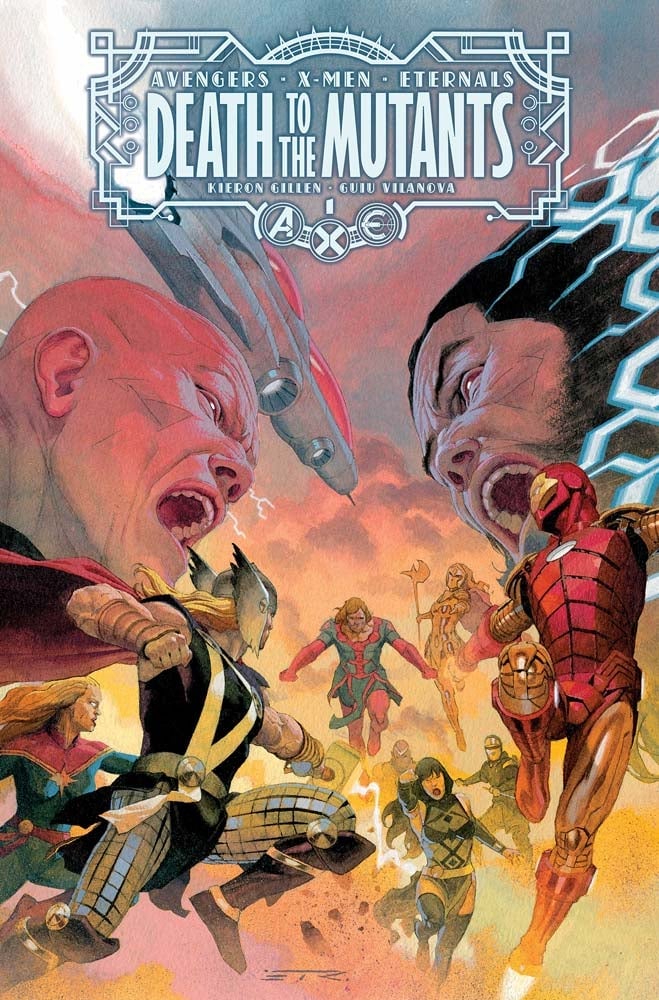
The mutants have got a very good justification, trust me. Like in Immortal X-Men #4 I'm writing Emma Frost's argument why 'No, it's ours and we get to keep it.' The mutants completely can go out to bat with that. But at the same time, it's very easy to understand this is hurtful [to the rest of the world]. That secret's out and that's germinating. The Eternals seem to be wanting to do something about that. But of course, anyone who's been following Eternals also knows Eternals have a secret and it's what their resurrection costs. That's still a secret. No one knows that when Eternals die, they kill humans. That's interesting. That's all sitting there. So, what secrets are going to come out? What happens when they do and how we react? That's very much what drives act one.
But yeah, the Eternals are saying this, but at the same time, in some ways, if humans are angry at mutants, the Eternals are at least positioning themselves as the champion of humanity against them. Eternals are very clearly in act one saying, 'Oh, we're on your side.' When I say the Eternals, I definitely mean the Eternals who are pro this [war]. Because that's the other interesting thing I think about the story. The mutants are joined together. The Eternals are very much divided over this in lots of ways.
For me, it's like the start of Judgment Day is the Eternals, and mutant secrets starting to come out, and the Avengers and the rest of the world catching up. And this enormous Eternal/mutant war of two incredibly powerful people, possibly consuming a lot of this stuff. And how on earth can we possibly stop that?
Which leads to act two, which is where the story changes shape slightly while still carrying on being about what it is. It escalates. And by the time we hit act three, everything's exploding. Trust me, everything's [also] exploding in act one, [but] it's quite important for me, I want to have a thing that's really about the human emotions about it. It's about how people feel about this.
So, it's about the idea of the mutants keeping a secret, why would they keep a secret? How people feel, the real feeling of it. At the same time, giving [it the] widescreen epic nature of a big event.
A Story About "Everyone on planet Earth"
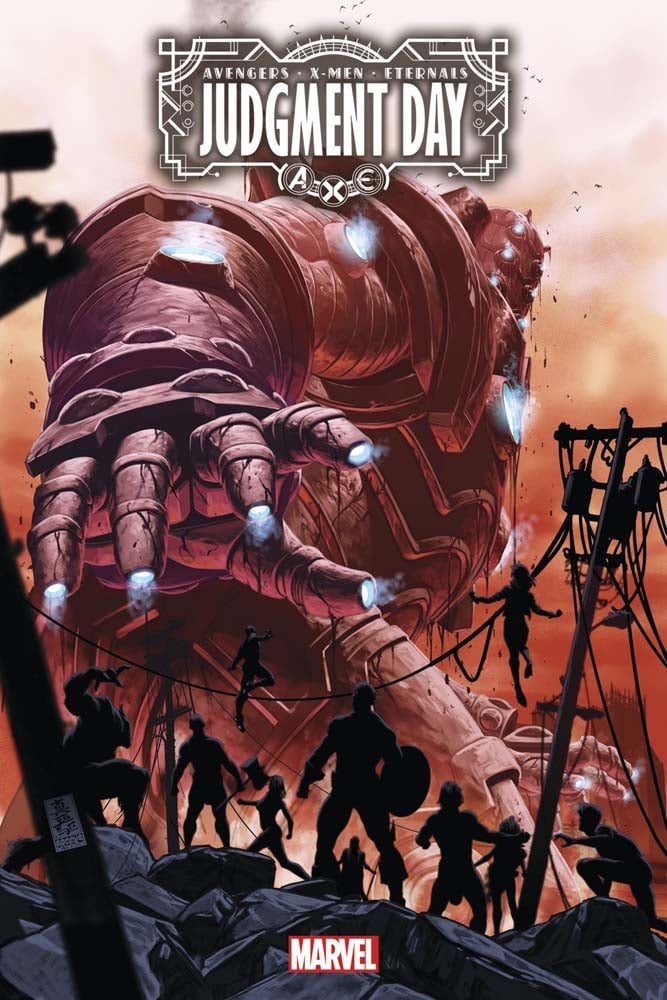
I want to ask about a few very specific elements of the Free Comic Book Day prologue. You begin it with Odin and Uranos in prehistoric times. How much of that sense of history is going to come into play over the course of the event? Are we going to see more of that?
I would say less than you'd think.
We've got eight pages to introduce the concept [in the Free Comic Book Day special]. I was like, 'Let's explain the Avengers and the Eternals and the X-Men from first principles. And let's talk about philosophically, how far back this problem might go.' Because if you're doing a Free Comic Book Day [book], yeah, I'm introducing Judgment Day. I'm also introducing the Marvel Universe. This is going to be some kid's first experience of the Marvel Universe, will be this eight page story. I was very conscious of that. So, I was like, 'Okay, I'm going to get the scale of it. I want the idea of gods and weird aliens talking and thinking of time.'
And then also, we get the Avengers and the Eternals fighting a monster in New York City. Because what's more Marvel than that? And then we have the X-Men doing weird stuff on an island and then people go, 'Oh no.' And then they're going to fight. For me, the scale is about showing how big the Marvel Universe is and how far back this goes philosophically. That was much more the vibe I wanted. I want this to feel epic and make it about the Marvel Universe.
The Avengers are presently living inside a Celestial, which is a problem for the Eternals. It's like if someone hollowed out God and lived inside, we would be a bit like, 'Huh? Are you sure?'
But I think [the event is] much more in the moment. For the Eternals, it goes back this far because everything goes back that far for the Eternals. They're not very good at moving on. That's their thing. There's a big Celestial element to the plot as well. There was all that stuff still in the mix. That's one of the obvious bits of connective tissue. The Avengers are presently living inside a Celestial, which is a problem for the Eternals. It's like if someone hollowed out God and lived inside, we would be a bit like, 'Huh? Are you sure?'
You also had The Great Machine narrating the Free Comic Book Day story, which is a big part of your Eternals run, and in the first issue of Immortal X-Men, you had Sinister narrating things. What voices are you playing with throughout the event? Will the Machine be present through all of it? Will other characters come in?
Obviously, at the moment, I'm really interested in narrators. Clearly as a writer, it's something I'm going for. Obviously, in Eternals I've used the Machine. I used the Machine [in the Free Comic Book Day story] because I felt it was a really good way to introduce this concept.
With the Immortal X-Men, I'm rotating the narrator. So, issue one is obviously Sinister, and every other issue from then on, or at least until I get bored, is going to have a different Council member. For the first eight, I've rotated each time. And I know what I'm doing for #9 and #10 as well. For me, that was a really good way of showing the council. The note behind the note there is I'm interested in a narrator that suits the story.
So, I wanted to use the Machine in this [prologue] because they're used there in all these periods tied together. For Judgment Day itself? Yes, it's got a narrator, but I want to keep who the narrator is secret. Because at the beginning of the first panel, you're like, 'Who the hell is narrating this?' And we don't reveal that in the story. The narrator is very different to even those two voices [The Machine and Sinister]. It is a more serious voice, but at the same time it's got that raw anger to it as well. And so, one of the mysteries of that first issue is who the hell is narrating this. And who is narrating it speaks the nature of the story entirely. But the Machine is a character in Eternals. He's eventually a player in Judgment Day as well, because he's part of the cast.
If I had to say anything, Judgment Day is a story about everyone on the planet Earth. Yes, it's Avengers and X-Men and Eternals, but it's every single one of us. It's a story about what it's like to be alive on Earth.
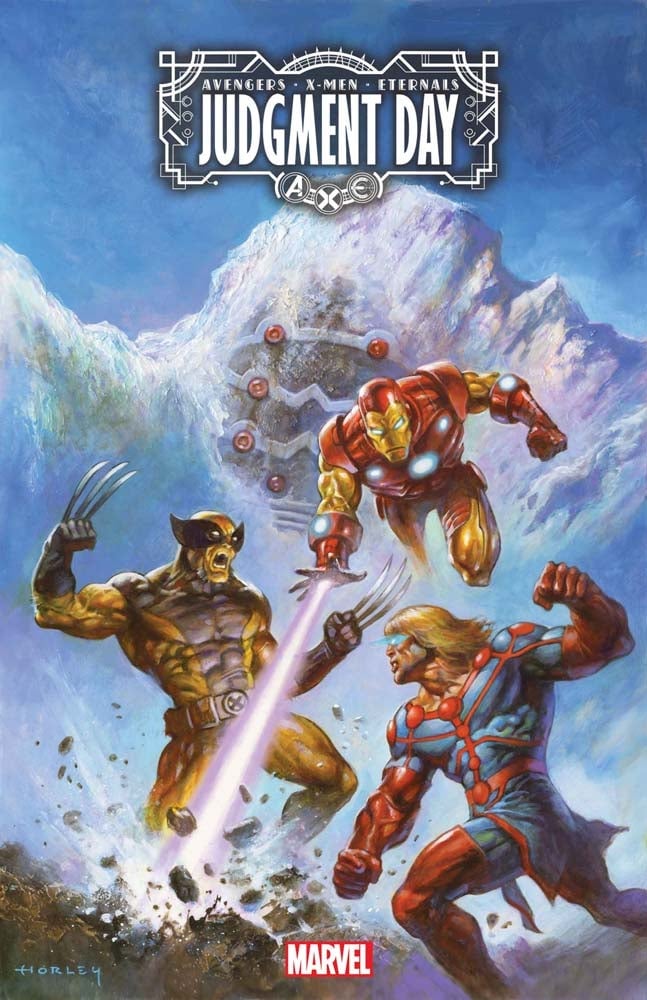
With that in mind, what human characters within the Avengers sphere are you most interested in pursuing and how they react to this event?
The problem with a story like this is, like any event, it's big. So, you've got to choose characters that have an emotional backbone. So, in the main event book, yeah, a lot of people get played. A lot of people get cool moments. But in terms of the emotional backbone, I had to choose. It's true of the Avengers, it's true of the X-Men, and it's true of the Eternals as well.
In the tie-in books, I concentrate on different people a bit more. That's part of the fun of it. I can get to show the mix. In terms of the Avengers, I would say the main characters, it's Tony and Cap in different ways. I think they're my backbone. In some ways they seem to be the two most relevant. Because they're two deeply human, especially the current roster, they're two of the most human ones, and they're the mixture of hope and practicality and suspicion and optimism. The two of them are really useful for us.
There's a scene in the first issue when Iron Man, Tony, is being quite cynical about something, about Sersi. And Cap rightly goes, 'No, she's an Avenger. We've got to treat her better than this.' And that speaks to something about him. Obviously, I've written Tony before, but I haven't written Cap much before. He's a really interesting character to write, in terms of all the contradictions in that man. But there's many more human characters than that in the story too. I don't want to say too much about it, but there's a kind of Greek chorus aspect.
really do touch the humanity of the world. You often forget that in the Marvel Universe there's like seven or eight billion people on the planet.
I really do touch the humanity of the world. You often forget that in the Marvel Universe there's like seven or eight billion people on the planet. I was just rereading [Kurt Busiek and Alex Ross's] Marvels the other day and [was thinking] how wonderful it is to see the Marvel Universe. I wanted to get bits of that in this story as well. So, as well as all our big cast, we've also got that, 'Hey, what would this look like to somebody in New York?' So, that's part of the vibe as well.
You've compared the Eternals to angels in the past, and in the Free Comic Book Day story you have Sersi talking about how much the duty coded in Eternal DNA is "irksome." Is that something you're playing with a lot in this event and how each of them react to that?
I'm existentialist, I believe people have free will, or I choose to believe people have free will, because I believe the alternative [is], 'If we don't have free will, it doesn't matter about what I believe.' It's a Pascal's wager. I might as well believe I have free will because it's worth more if I do.
And for the Eternals, at least part of the fun of it was let's pretend they're not [capable of free will], or like they don't believe. If they see someone excess deviating, they have to kill them, and they don't choose. It's not like, 'Oh no, I will overcome with the power of my love.' No, no, they do it. It's like RoboCop. And then there's also the [Eternals ideas] which are more about interpretation, as their personalities are hard coded and they maybe can't change very much. They're like us, but more, but also less. That's what was interesting about the Eternals.
I think you can't quite trust Sersi because she's so playful. When she says "most irksome," what does she mean? Does she mean it's irksome because it makes me do stuff I don't want to do because I'm too busy because I want to go get a drink somewhere? Or does it mean that it's specifically when it's so extreme? What does Sersi even mean? Because she's one of my major characters. She's one of my backbone characters in the event. She's a cool character. That kind of question mark is over Sersi, and there's no question mark over Ikaris, but that question mark on Sersi is quite an important point as well. So yeah, the roundabout answer to your question is I think that's pretty key. Especially [in terms of] how much can they change? Could they change it, and do they really want to change if they want to?
Because that's the other thing, if you read the eight-page [Free Comic Book Day prologue]. Hero versus hero crossovers, they used to be very rare. Now, they've become more common. This is a bit different than a lot of them in that I'm saying the Eternals are the bad guys here from the off. The mainstream Eternal society, they attack. They are the aggressors here. And there's people in the team, Sersi and people we like, but you might know they're not part of mainstream Eternal society anymore in the comic.
So, it's a very different starting place, and how individuals vs. society… We'v got individuals who can't change, in a society that also is very limited, so what can they do either? That's all part of the story. It's not just individual ability to change. It's also about an organization's ability to change. Especially because abstractly, the Eternals are a democracy. They vote everyone in. If [someone is] a prime Eternal, they voted for it. So, what changes can we make inside a democratic system which is fundamentally flawed? That kind of stuff.
Writing a Wide Universe for a Wide Audience
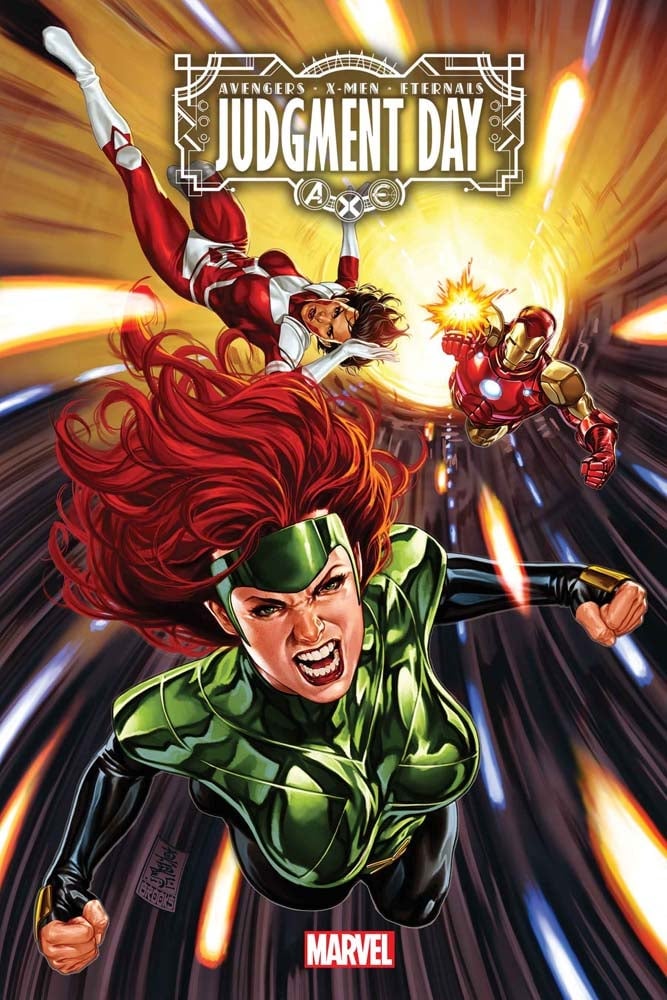
You're doing this event while writing the Eternals and writing an X-Men book, but not an Avengers book. How does not writing the Avengers full time influence the writing of this event? Does it make you feel you have more responsibility, less responsibility? How does that work in your head?
Responsibility is the wrong word. You may have less custodianship. With the Avengers, I'm very aware that if I choose to kill an X-Men or whatever, or permanently wipe them from the system or something like that, I'm writing that. That's my choice. I'm doing it to my book. If they're other people's characters and they have custodianship, I'm more aware of that. I will check, like 'Is this cool?' Because the events are meant to shake stuff up, so you want to make big plays and there's some really cool stuff that happens. But you want to check in on [other creators] as well.
That's probably the main difference. I think I realized this more [in the] beginning, though. I said, 'I've got these two secret societies, which are the mutants and the Eternals. And then the Avengers for me are really good characters to go in.' It's almost a strength [to not write them as much]. They're like the instigators discovering stuff. Since they're less deeply invested in what's going on instantly, they're really more useful for the plot in lots of different ways. Also, they're the moral cards. Obviously Krakoa has been quite often tied to its own corner, and this seems to be the biggest interaction of Krakoa with the Marvel Universe since its inception. I think that might be the way I put it.
[At the same time], The Eternals are very secretive. They have Thanos on the planet, they never told anybody. So, it's like a coming out party for both of them. And the Avengers are the heart of the Marvel Universe, so in some ways, that's interacting with the Avengers. That's what happens if you're at the heart of the Marvel Universe.
You're obviously dealing with a lot of big pre-existing events in the Marvel Universe, but you're also dealing with readers who might be coming to this event just because they saw an Eternals movie in 2021, with no prior knowledge of the world. How do you balance that with the need to keep the story moving?
It's definitely an exposition into ammunition situation.
It's definitely an exposition into ammunition situation. That's one of those old screenwriting statements, as in, 'Okay, what do I need people to know? How can I make that sense?' In some ways that links back to the Avengers not knowing anything. The Avengers not knowing anything is a great way to find stuff out. Also, presenting it as interesting to the reader, and presenting it naturally. And also, because they need to do it for the plot, they have to go and interrogate somebody to get the answers they need.
[At the same time], the Eternals are planning their attack. Eternals planning their attack is a really good way to explain where the mutants are. 'There are a million and a half killer mutants on Mars. We've got to do something about that.' That's really good. We presented a problem for the Eternals to deal with, but we're also introducing this concept. And of course, the entire story is based on the idea that the X-Men are immortal, and now the entire world knows. That's the exciting bit. See what I mean? All that stuff is the plot. The story springs from the status quo, That's how I hope [it works] anyway, but it's fuckin intense. Your brain fries.
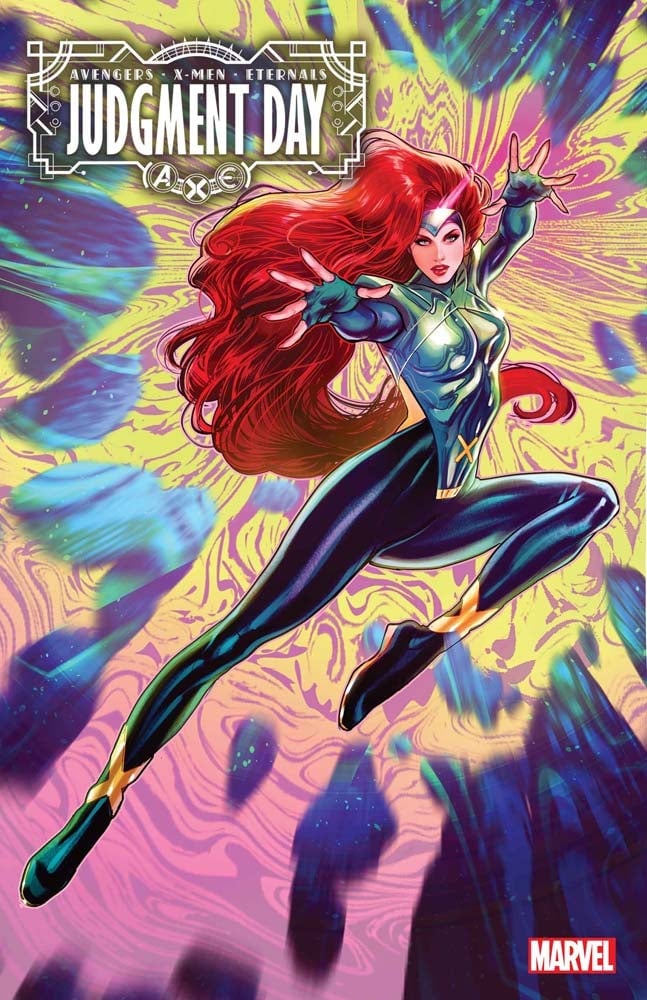
I was very aware when I was writing the entire Marvel Universe. That's how it feels. It's not like you writing a book or a bit of the book. I found myself thinking, 'Okay, what are the Fantastic Four up to right now,' despite them not really being in the crossover. So yeah, it's a very different form of writing and that's why I said yes to it, because I've never done it. The easiest way to make me do something is I have never done it and [want] to see how I would cope with it.
I'll tell you one thing, it's good to have the Avengers as detectives, good to have a narrator, and good to have the Eternals being very plan-y and be able to explain stuff that way. And also, I'll tell you something else, it's also really good to have Valerio Schiti. Because event books, they're compressed. You get a lot of really big beats in a very small space. Valerio makes every single thing land. I was going through the inks for issue four last night and it's just amazing with like, 'Oh my God, big beat, big beat, big beat every single page' and I'm thinking, 'This is amazing this is hitting like this.' It's a comic, so it's all about how the art and the writing intersects.
Speaking of Valerio, what were the conversations like working with him in terms of looking at influences and ideas that you wanted to incorporate into the look of the book? Did you look to other event books for inspiration?
Valerio is really good at design, really good at glam. There's a design that popped, there were some new baddies we had to make up at a certain point in issue one. And when I had the idea for them, I pitched it a little bit and Valerio just came up with a bunch of ideas and then I integrated them and he came up with six designs. I saw these designs and I was like, 'We're fine.' You know what I mean? Because so much in comics is like, 'Is this a cool baddie?' Especially when introducing something new and interesting and weird, you need the, 'What the hell is that thing?' You need that excitement.
I was going through the inks for issue four last night and it's just amazing with like, 'Oh my God, big beat, big beat, big beat every single page' and I'm thinking, 'This is amazing this is hitting like this.'
Valerio sent these creatures through, these six creatures, and I was like, 'Oh yeah, we're fine.' And I immediately went to write biographies for each one and did my usual D&D nerd stuff. But it was that sense of 'Oh yeah, this feels like that 15 minutes into a disaster movie, we see the things.' It felt like, 'Oh, I could see these in a movie.'
You mentioned people coming in from movies to see stuff, and my approach is obviously part of that, because we're always interested in newcomers. But [it's also] always like, 'Let's try to give people stuff they haven't seen yet.' And then have that, 'OMFG, look at that thing!' [feeling]. That's what I got. [Valerio also] makes really good-looking people. He's very good at crowd scenes, which obviously for an event book is impeccable, and he's very good at grounding. That's the other thing.
[In terms of influences], when planning this, I went back and looked at some of what I felt were big books. I looked at stuff like Civil War, I looked at the original Ultimates, I looked at stuff like Infinity Gauntlet and I was trying to think, "Okay, how do you want this to feel?"
Some techniques fell by the wayside a bit, and I thought 'We can use these.' Obviously, having a narrator is not something people have in event books very often anymore. So, that's one thing I decided to use. There are bits of the philosophical edge to the destruction in the Infinity Gauntlet, especially the further you go in, there's quite a bit of that. The idea that it's something to be utterly nightmare fuel, but really have a brain behind it as well.
Also, just stuff that the Ultimates did, like, 'Let's draw a page showing New York to ground it.' Because for me, the Marvel Universe, it's most important if you realize it's Earth and then Spider Man flies past. Literally the first page of Judgment Day is a shot of New York, because this is important to ground it, because then we're going to do some really fantastical things. That's the vibe. That's what I wanted.
Valerio is the guy who can literally draw ... He seems like he can draw anything. That seems to be the key part of it, especially, I mentioned we have lots of real humans in as well. So, we go from the ground level, real human emotions, real people eating and drinking and loving. And then we also have space gods tearing apart the planet. And the fact that he draws both in the same register means there's a coherence to it. That's what I wanted, it's a big coherent statement of life and punching.
Speaking of the big books, what are your favorite event books, and what did you learn from them that you applied to writing your first event?
Alot of them I've said already. I quite like stuff that grows in the books naturally. That's the thing. I wanted this to come from the books in progress. It's not like suddenly, there's this big problem.
Like when you hit the second act, it's got a big game changer. It's a unique problem for people to face. People go, 'Oh, this is the crossover when this happened.'
But at the same time, there's still an actual concept in the book. Like when you hit the second act, it's got a big game changer. It's a unique problem for people to face. People go, 'Oh, this is the crossover when this happened.' It's not just like big baddies come and fight each other. It's not just 'Here, it's time to fight each other.'
This is a story where the thing happens and then all the heroes have to deal with it in their own way. I mentioned the Infinity Gauntlet earlier. I mentioned Ultimates, I like the way Civil War grounded itself. Weirdly, there's bits of Fear Itself in there, I think because Fear Itself is also about emotions. There' even some Secret Wars in there, Secret Wars one, even, in terms of…there's a simplicity to a bit of it. There is bits of that in terms of 'Here's a situation, now see people deal with it.'
Because, I've written a lot of tie-in comics. If you go back to my first time at Marvel, I think like 75% of the things I wrote was abstractly tying in. Because it was a very tie-in period. From the writer's side, I was aware that the tie-ins I really like doing were an event which threw the ball. It doesn't necessarily need to derail your story, what it does is this event can be used in your story. "Here's a useful problem. Here's a cool toy for you to have, you can play with it. You can play with it in lots of ways. It's customizable to your book." That's going to be very clear as in, here's something people can have fun with. It's like a writing prompt, and that was important to me.
A crossover like the second Secret Wars or a House of M, it's something where they show us [writers], 'Here's something you can play with, have fun.' Actually, Original Sin as well. Original Sin was a really good one in terms of 'Everyone's got a secret.' And then your tie-ins are, 'Great. Here's a prompt. I can do a story about my secrets.' That kind of thing. So, a crossover's additive to the tie-ins rather than just demanding of them.
You mentioned thinking about what other characters think about this event, even if they're not a part of it. Obviously each team has their own enemies and internal issues in their own books. I don't want to outright ask if figures like Orchis are going to be a part of the event, but how do you balance this central conflict with all those other things that don't necessarily go away while the event is going on?
I would say, especially because I'm writing Eternals stuff and X-Men stuff at the same time, and especially with what you know about the Hellfire Gala in their Free Comic Book Day story, I think all this stuff is still going on. Orchis aren't just going to be sitting on their backside after all this is happening. I don't want to say Orchis are involved yet or not, but yeah, I agree that the Marvel Universe carries on being the Marvel Universe. The great thing about Judgment Day as a story is, as the name implies, it happens over quite a short period of time as well.
Bracing for Judgment
In the Free Comic Book Day story, the Machine mentions a "prologue to the end." This is a hard question to answer without spoiling anything, but what do you hope you leave behind by the end of this story in the Marvel Universe?
There's probably two answers to that. One of them is like, it's just a practical answer: It's really early to talk about.
There's various themes and ideas and toys that you're dealing with. A crossover is a destabilizer. I think, was it [All of the Marvels author] Douglas Wolk was I think talking about this recently. Events are about destabilizing, as in you take a situation and you destabilize and that's what events do, they create a new status quo. They create fun toys for people to play with. That's what you hope. You shake the stuff up. That's part of it. And really, this sounds incredibly saccharine, and I apologize for it because it's not like me, but I just want to do a really good story.
You know, in the same way you pick up, I don't know, Infinity Gauntlet, and you know the Marvel Universe isn't going to be ended because of the finger click, but you see this stuff happen, and it's glorious and it's epic and it's absolutely true to the characters and you see them in extremis and it reaches this conclusion and it's emotionally, morally fascinating. That. You know what I mean? I've never done a Marvel event before and I'd really like to do a good one.
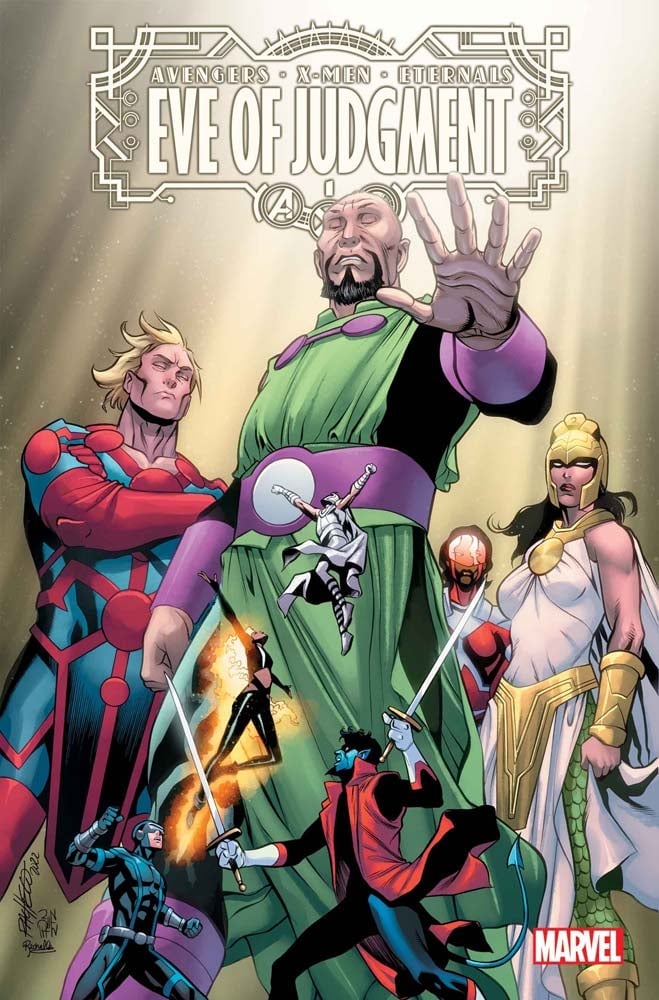
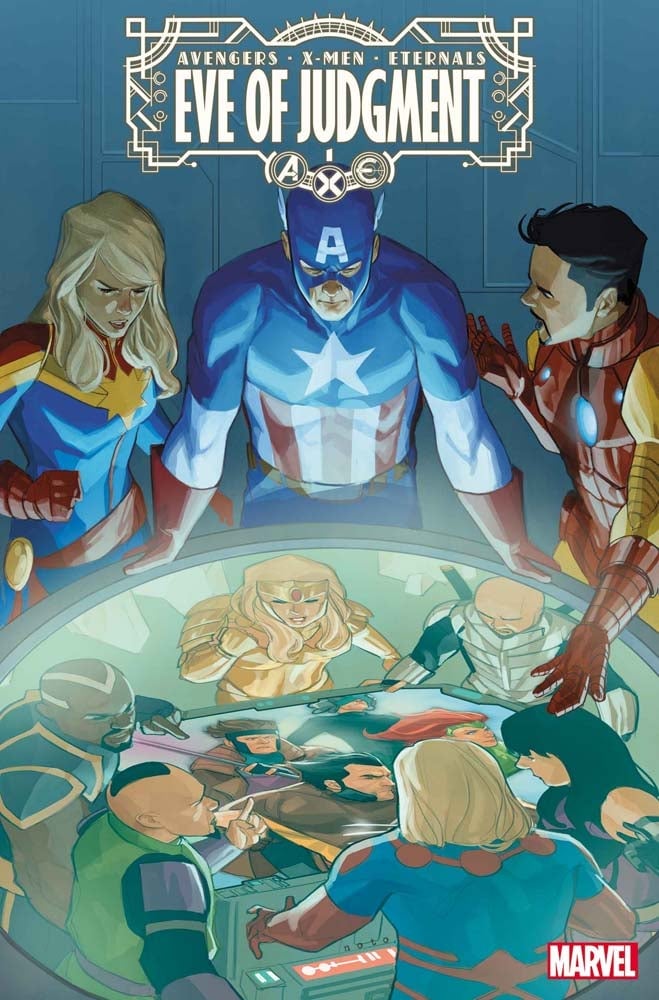
Obviously, the Free Comic Book Day special is out now, which means Eve of Judgment is next. What can you tease about the focus of that issue?
Weirdly, it's a sort of sister issue to Immortal X-Men #4. Immortal X-Men #4 is about after the [Hellfire Gala], it's about what literally happens then in terms of the X-Men dealing with the fallouts of everything that happens. And [Immortal X-Men] four is also a prologue to what happens next.
Eve of Judgment is almost the same thing from the Eternal perspective. As I said, the Eternals are the aggressors here. This is the Eternals about to go to war. You get to see the prime Eternals building their armories, working out how they're going to kill people, various plans and kidnappings, and the good Eternals perhaps being a bit more lost. It's preparation for war. I think that's the best way of describing it, as well as being also a really good restatement of what's going on in the Eternals. Because if you haven't read issues one to 12, this is like, "Okay, I don't know anything about Eternals. I don't know, why would we be going to war? Who are they even?" It's that as well. This is the preparation of the war happening and everything you need to know going in.
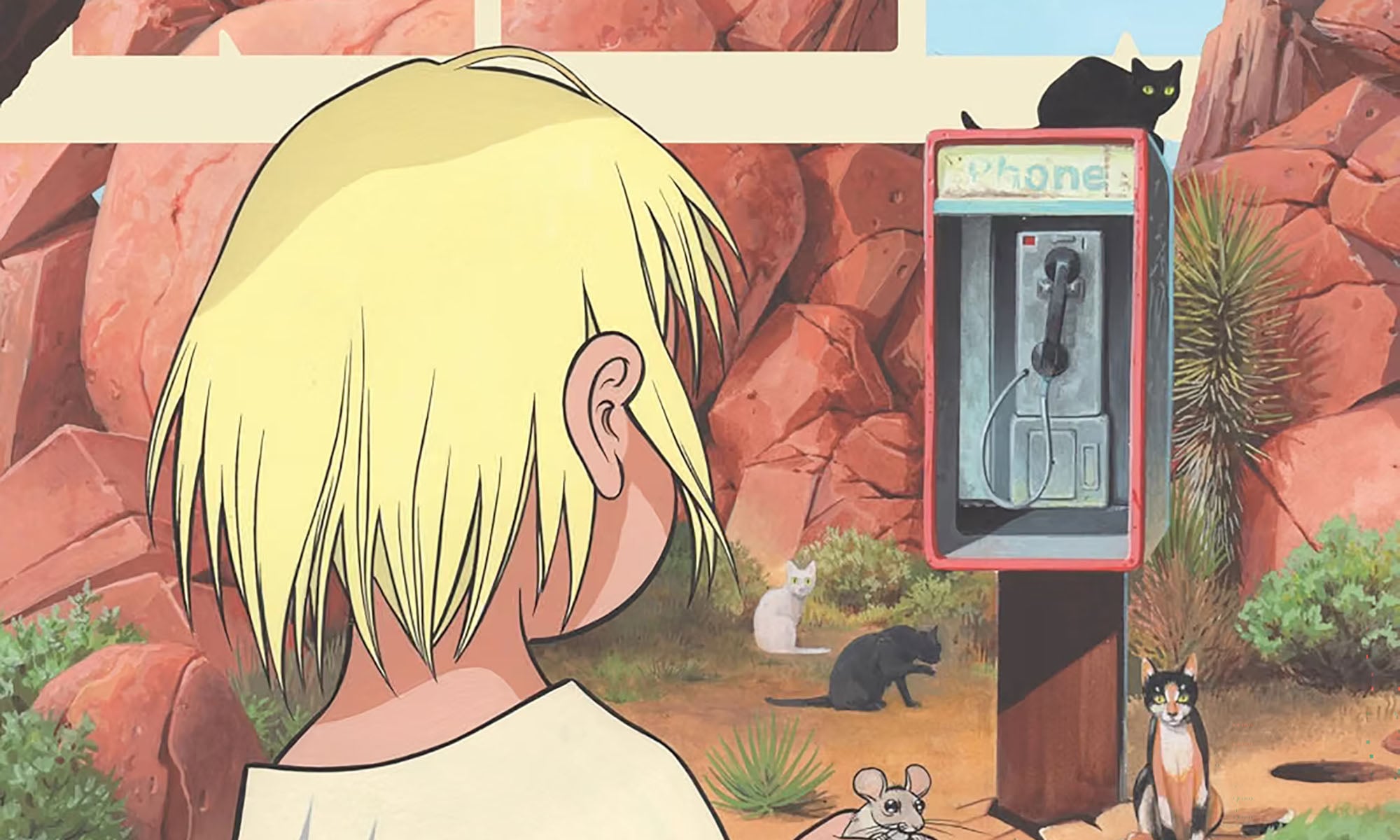
You've mentioned many times that what drew you back to Marvel was the ability to do something new, but in the years leading up to coming back to superheroes, you did creator owned things like The Wicked + The Divine and DIE. What did that creator owned work teach you that you were able to bring back to these superhero books now?
Anytime I move between projects, there's stuff you carry over. I think that's the same as any creator. If you look at [Jonathan] Hickman, what he did with Krakoa was basically Black Monday Murders. These are transferable lessons. You see what he did [there] and now he's applying it here.
At some level you get bits like that with me as well, like certain design choices, a lot of world building choices. In terms of how I approach Eternals, the idea that it carries on going off the edge of the page is so much of what's in DIE, specifically, my reconsideration of Tolkien with DIE.
And then there's some real technique stuff, like DIE was all about me rediscovering captions. I mean, there's always captions in what I did to some degree, but there's more captions in DIE because you've got this close narrator, an oppressive narrator all the way through, in the case of Ash, and how captions can interact with dialogue. That's a pretty common technique. DIE was about compression and I wanted a lot of stuff to happen, but also to give space to stuff I wanted to linger on. In other words, the more you compress certain things, the more you wind up other stuff.
With a narrator in Eternals, we can create a sense of playfulness, but also get fun bits where you interact with the thing. In Immortal X-Men, you get that with character voice, you get [the sense] that they're inside.
There's also the clearness. There's a bit in Judgment Day, especially in the second act, [about] the power of a simple choice. And that's really built into DIE, in that DIE's based around the [choice], 'If we kill everyone, we can all go home. We've got to agree, and dead people don't get votes.' That's what DIE is. And it's really simple rules, but with the infinite possibilities. There's that kind of thinking in Judgment Day a bit, but it's also the fact DIE was a war. It's a story about big mechanical forces fighting and that's played out on a practical scale. That's probably from [the Avatar Press series] Uber, as well.
y. When the Eternals are attacking the mutants, they're doing it in a pretty practical way. They've got a plan, and especially Eve of Judgment is primarily about the Eternals trying to win the war before anyone realizes. It's like, 'No, let's not have a war. Let's just kill them all and hopefully we don't have to do this crossover.' Spoilers, they fail. But they try.
That's in Eternals, that's in Judgment Day. When the Eternals are attacking the mutants, they're doing it in a pretty practical way. They've got a plan, and especially Eve of Judgment is primarily about the Eternals trying to win the war before anyone realizes. It's like, 'No, let's not have a war. Let's just kill them all and hopefully we don't have to do this crossover.' Spoilers, they fail. But they try. You know what I mean? For me, characters trying to do the sensible thing grounds the story. You do the sensible thing first, and then you're pushed to increasingly desperate situations.
Is there anything else you'd like to mention?
Just Valerio and [colorist Marte Gracia] are great. Honestly, I don't want to name the stuff, the monsters or all the design stuff, but it is a joy. I've handed in issue five, so I'm well ahead, which is nice. I always see my friends who write events, they always have this dead eye [look] because it's so hard work, and it's been hard work, but it's been all right so far. Ask me in two months' time and I might change my mind, but this has been really fun. And what I'm really hoping is that the fun we're having comes across. This is a serious story of epic scale and with real emotional content to it, but it's also like something really pure about how we see the world. So, I hope people like it.
A.X.E.: Eve of Judgment is in stores July 13. Judgment Day #1 follows on July 20.
There's a lot of Marvel Comics - what if someone tried to read them all? Well, they did. Read about the Marvel marathon.
Follow Popverse for upcoming event coverage and news
Find out how we conduct our review by reading our review policy
Let Popverse be your tour guide through the wilderness of pop culture
Sign in and let us help you find your new favorite thing.


Comments
Want to join the discussion? Please activate your account first.
Visit Reedpop ID if you need to resend the confirmation email.