If you click on a link and make a purchase we may receive a small commission. Read our editorial policy.
Why Patsy Walker is one of the most important characters in the Marvel Universe
Is Patsy Walker Marvel's Archie? Or is she even more important?


Patsy Walker might not have the name recognition of Spider-Man or Wolverine, but she’s one of the most important characters in the Marvel Universe. Modern readers know her as Hellcat, the fierce superheroine that has fought alongside the Defenders and Avengers, but Patsy’s roots go deeper. Some might consider Hellcat a c-list Marvel character, but there was a time when Patsy headlined six titles at once. In fact, Patsy still holds the second-place record for longest running female led Marvel title, right behind Millie the Model. Contemporary Marvel heroines like She-Hulk and Captain Marvel would need to go at least a decade without rebooting before they would hope to surpass her. If you haven’t considered the historical importance Patsy Walker holds in the Marvel Universe, I guarantee you this article will change your perspective forever.
Marvel's Archie
Patsy Walker made her debut in 1944’s Miss America Magazine #2. Most of the development process has been lost to time, but the general consensus is that Patsy was created by cartoonist Ruth Atkinson. According to Marvel editor Tom Brevoort, legend goes that Timely Comics (which eventually became Marvel) saw the success of the Archie family of comics, and sought to create a teen comedy character of their own. Patsy’s debut story was written by Stuart Little, drawn by Ruth Atkinson, and described her as “a real typical teen-ager” in the opening narration.
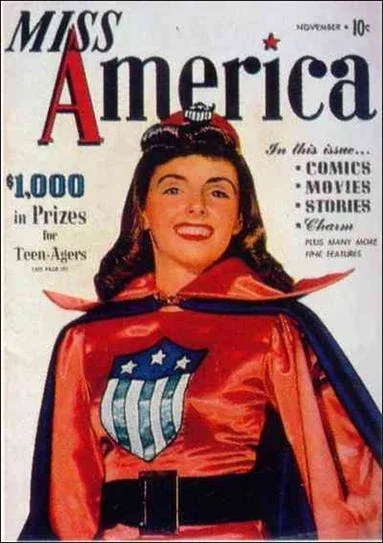
In addition to Patsy, the story introduced her father Stanley, mother Mary, kid brother Mickey, boyfriend Buzz Baxter, and her rival Hedy Wolfe. Subsequent stories would introduce Patsy’s best friend Nancy Brown, and her classmates Tom 'Tubs' Hale and Ronnie Robbins. Many of the stories centered around Patsy’s rivalry with Hedy Wolfe, as the two sparred over everything. Much of the comedy also revolved around Patsy’s teenage romance with Buzz, as the two regularly had wacky misunderstandings.
In other words, this was Marvel’s version of Archie Andrew s. Archie had debuted three years earlier in Pep Comics #22, and his influence could clearly be seen in these early stories. In fact, while the kids lived in Centerville , some early issues identified their town as Riverdale. Centerville was a typical early 20th century American small town. It had a malt shop the kids would frequent, friendly neighbors, and was the perfect setting for humorous teenage adventures. In 1945 Timely published Patsy Walker #1, making Patsy the first teenage girl to have her own comic series. As her popularity grew, more spin-off titles emerged, including Patsy and her Pals, Patsy and Hedy, Teen Comics, Girls’ Life, Hedy Wolfe, and A Date with Patsy.
In her book Archie’s Rivals in Teen Comics, 1940s-1970s: An Illustrated History, comic historian Michelle Nolan states that next to Archie, Patsy was considered the most commercially successful teen comedy franchis e of the Golden Age. By the early 1950’s superheroes had fallen out of favor, and Timely Comics ceased publishing tales of superheroes like Captain America and the Human Torch. Patsy Walker never missed a beat, only growing in popularity. Along with Millie the Model, Patsy Walker is one of the only characters Marvel continually published from 1944-1966. In fact, at certain points of the 1950’s Patsy was tied with Superman when it came to monthly appearances. This changed in 1958 when Superman’s Girlfriend Lois Lane brought the Man of Steel’s regular appearances to seven titles.
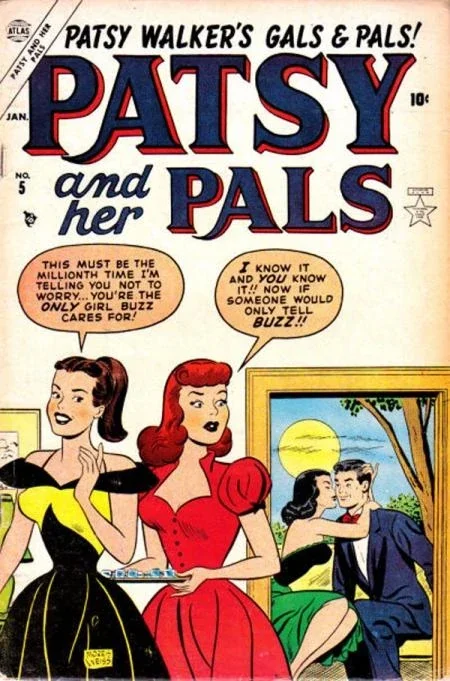
Patsy’s titles encouraged audience participation, inviting readers to send in their fashion ideas. Each issue would have Patsy and her friends wearing clothes designed by the readers, whose names would be printed for posterity. Fans would also write letters to Patsy, asking for advice on their teenage problems, with Patsy responding in character. Because Stan Lee was writing and editing many of Marvel’s books at the time, it’s possible that he was also ghostwriting Patsy’s advice column. This creates an amusing sight of the charismatic Lee pretending to be a teenage girl as he doled out advice.
Patsy Walker was also the nexus for an early version of the shared Marvel Universe. Although Marvel’s Golden Age comics teamed up their superheroes in titles like All Winners Comics, the traditional idea of a Marvel shared universe didn’t come to fruition until December 1962 when the Fantastic Four faced the Hulk and Spider-Man. However, Patsy was having crossovers with Marvel’s other humor titles years before the Fantastic Four debuted.
Wendy Parker (star of the college comedy series Wendy Parker) warned Buzz about Patsy’s vacation activities in Miss America #65. Della Vision (star of the title Della Vision) interrupted one of Patsy and Buzz’s dates in Patsy Walker #59. Millie Collins (star of the popular Millie the Model) had a few crossovers with Patsy, the first one occurring in Patsy Walker #76. Betty Bliss (the title character of Meet Miss Bliss) became Patsy’s teacher in Patsy and Hedy #58. Patsy visited the set for a television production about Blaine Colt (star of the Western comic Kid Colt) in Patsy Walker #77. Kathy Carter (lead character of Kathy) encountered Patsy in Kathy #14. Linda Carter (star of Linda Carter, Student Nurse) visited Centerville High in Patsy Walker #99, with the cover treating their meeting like it was as iconic as The Jetsons Meet the Flintstones. In other words, Patsy Walker could almost be considered an architect of the modern Marvel Universe.
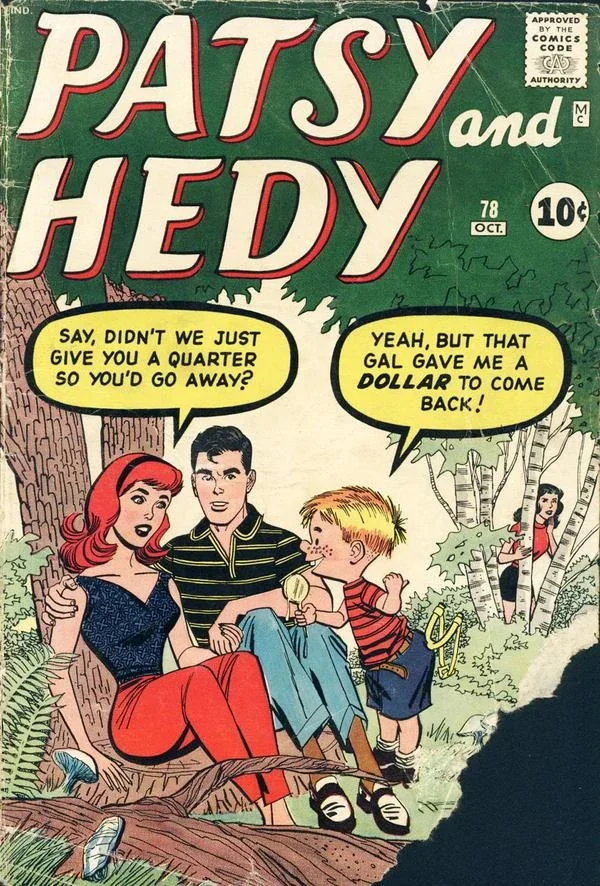
In addition to teaming up with other teen comedy characters, Patsy Walker also had one of Stan Lee’s earliest appearances as a comic book character. A year before he was terrorized by Doctor Doom in Fantastic Four #10, Stan Lee and Al Hartley were threatened by Hedy Wolfe in Patsy and Hedy #78. It seemed that Hedy was tired of Lee turning in scripts where Patsy came out on top . While it would be a stretch to say that Patsy Walker invented the idea of the modern Stan Lee cameo, it’s fair to say she was an early pioneer. In April 1961 (cover dated June) Journey into Mystery #69 and Patsy Walker #95 were published with MC boxes on their covers, making them the first official Marvel Comics.
In interviews about the creation of Marvel superheroes, Stan Lee often speaks about how he wanted to change the format of comic book storytelling, giving the heroes pathos, adding soap opera elements, and telling new kinds of stories. It’s interesting to note that while Marvel was doing this with Fantastic Four, Stan Lee also began to experiment with the storytelling format in Patsy Walker. Buzz left Centerville and joined the military in Patsy Walker #115, then Patsy and the gang graduated high school in Patsy and Hedy #95.
The new direction officially kicked off in Patsy Walker #116, which took the series from teen comedy to serialized drama. Previous issues had contained multiple stories without any continuity, but this new era began telling full length serialized tales about Patsy’s life after graduation. Stories from Patsy Walker would continue in Patsy and Hedy chronicling Patsy’s first steps into the adult world as she got a job at a local newspaper and moved into her first apartment with Hedy. With Buzz in the Army (later stories would identify his branch as the Air Force) Patsy went through a series of love interests, including her boss Ted Trent. Characters like Tubs and Ronnie were phased out after graduation, giving the readers a sense of realism . After all, high school classmates often go their separate ways after graduation, as college, marriage, and careers pull them in other directions.
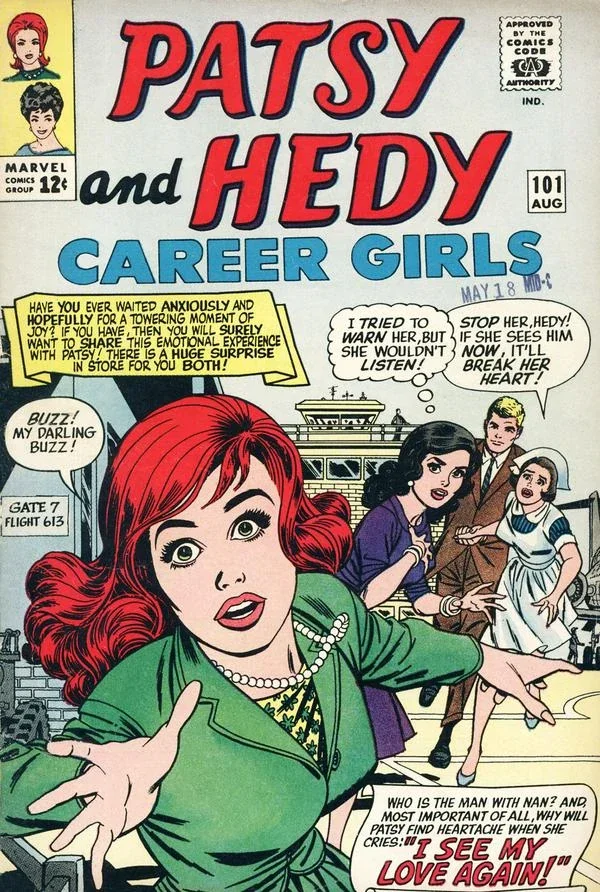
Patsy and Hedy #101 was one of the first American comics to deal with the horrors of the Vietnam War. The storyline revealed that Buzz’s unit had been shipped to Vietnam, where he was wounded in combat. The experience shakes Buzz up, and he attempts to break things off with Patsy to spare her the heartbreak of him being killed in the line of duty. While the comic never uses the phrase “Post-traumatic stress disorder,” modern day readers will easily recognize the symptoms in Buzz. This was a big step for a book that had been a teen comedy just a short time before.
As the superhero explosion kept Stan Lee busy, longtime artist Al Hartley took over scripting duties. After Al Hartley moved on, Roy Thomas had a brief run in Patsy and Hedy #105-106, which were some of the earliest comics he ever wrote. Patsy and Hedy #107-110 are credited to a writer named Denny-O, which was actually a playful pseudonym for future comic superstar Denny O’Neil. In fact, Patsy and Hedy #107 was the first Denny O’Neil comic ever published!
As superheroes grew in popularity, Patsy Walker’s adventures grew out of favor. While she once headlined six different series simultaneously, by the end of 1966 Patsy and Hedy was the only remaining title. Patsy and Hedy #110 was published in November 1966, and it would be Patsy’s final appearance in a Marvel Comic until 1972. This ended Patsy’s streak of being published continuously for 22 years. Marvel’s superheroes wouldn’t surpass her streak until Fantastic Four #262 in 1983.
Patsy's Second Life
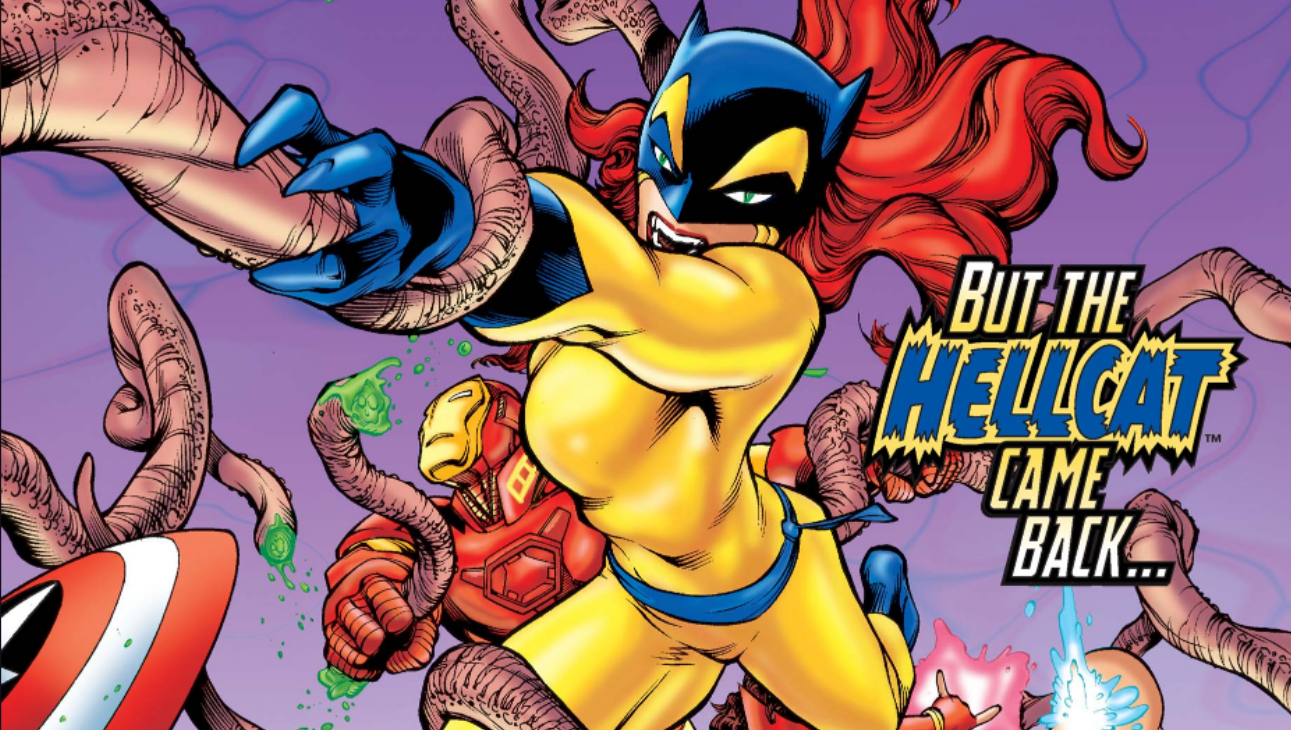
Patsy’s transition from teen comedy star to superhero is one of the most interesting events in Marvel history. For proper context, imagine if after Boy Meets World was cancelled, the title character Cory Matthews showed up years later in the Marvel Cinematic Universe, became a superhero, and his ex-wife Topanga became a supervillain. That seems bizarre, but that’s exactly what happened with Patsy Walker.
Before her teen drama series was cancelled, Patsy and Hedy made a cameo appearance in Fantastic Four Annual #3 as onlookers to Reed Richards and Sue Storm’s wedding. The entire issue seemed to be a celebration of the Marvel Universe as a whole, with almost every major character showing up. This issue established Patsy as a part of the mainstream Marvel Universe, which opened up the door for the next phase of her life.
As revealed in the letter pages of Amazing Adventures #15, when Gerry Conway was making plans for Lady Sif over in Thor, Steve Englehart pitched the idea of Patsy Walker becoming her secret identity, like Donald Blake had been for Thor. While that idea was rejected, Englehart never forgot the idea of reviving Patsy. When Englehart began writing a Beast feature in Amazing Adventures, he decided that Hank needed an antagonist, and inspiration struck.
Patsy and Buzz made their grand return to the Marvel Universe in 1972’s Amazing Adventures #13, as the Brand Corporation brought in Buzz as their military security specialist. Patsy and Buzz had tied the knot during their hiatus, but the romance was gone. Now that they weren’t in a teen comedy book, their relationship was presented in a different light in the backdrop of the more serious Marvel Universe. Buzz insulted Patsy, and seemed to be annoyed by her very presence at times. When Patsy discovered the Beast’s true identity, she colluded with the mutant to help him evade her husband.
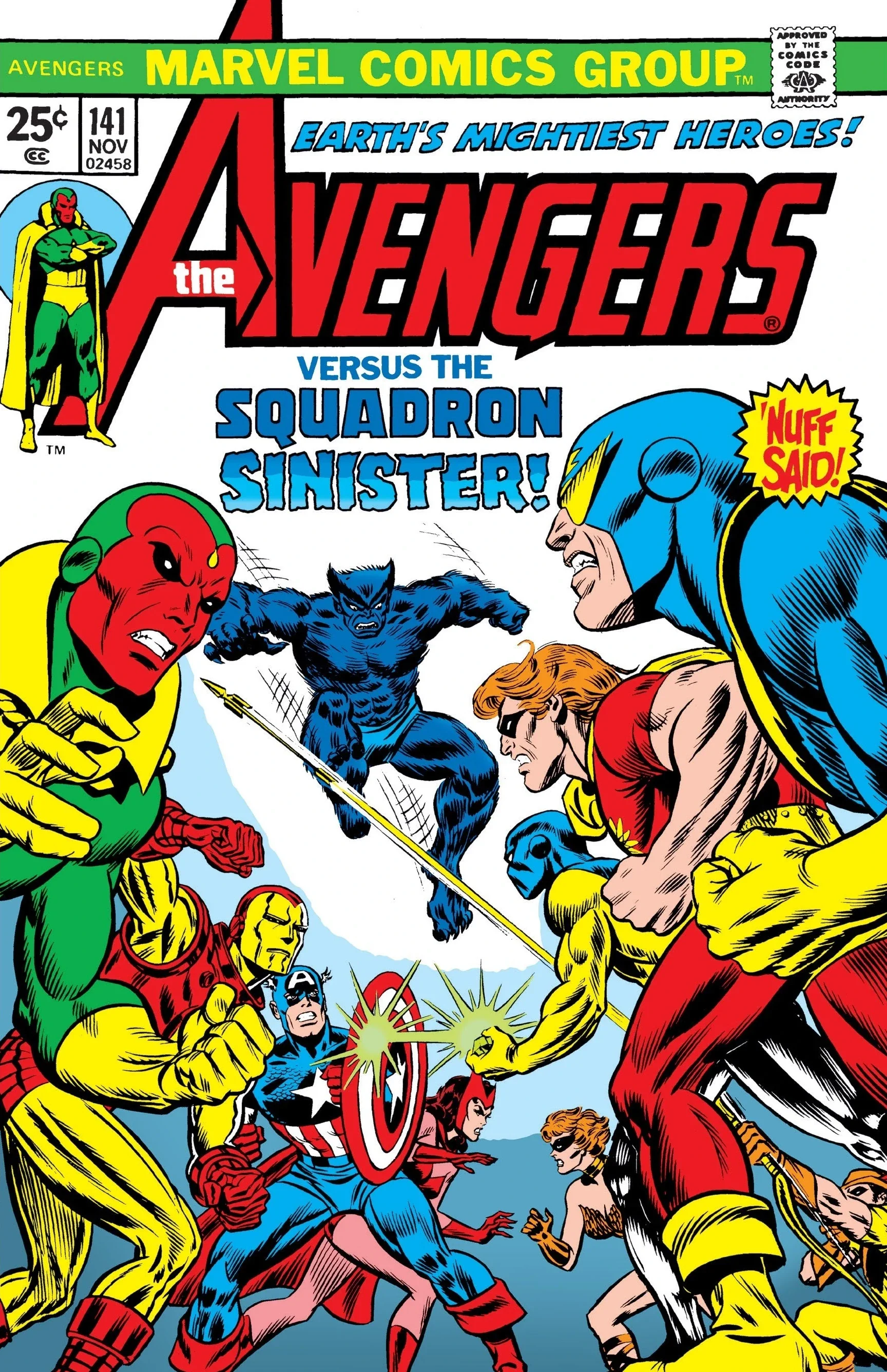
When Steve Englehart was given the Avengers title, he moved some of his Amazing Adventures subplots over to the series. This included a recently divorced Patsy, who stormed into Avengers Mansion in Avengers #141 demanding that he make her a superhero. The Beast allowed Patsy to have a “ride-along” with the Avengers as they investigated the Brand Corporation, hoping it would dissuade her from wanting to be a costumed adventurer. While evading Brand’s security and her ex-husband in Avengers #144, Patsy came across a storage crate with one of the Cat’s old costumes.
The Cat had been a short-lived superheroine title about a woman who gained enhanced abilities when she wore a special cat jumpsuit. Although her series had been cancelled after four issues, the character later found popularity when she was transformed into Tigra. Needing help to take down Brand’s forces, Captain America and Iron Man suggested that Patsy suit up. And thus Patsy Walker became Hellcat for the first time in an iconic splash page beautifully illustrated by the legendary George Perez.
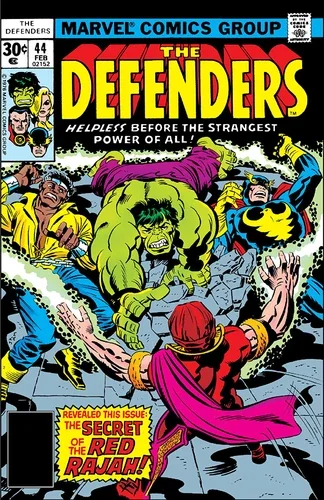
Buzz later captured Hellcat and the Avengers, but Patsy was able to break free, take down her ex-husband, and free her teammates. The adventure was enough to convince the Avengers to offer Patsy fulltime membership, but the cosmic heroine Moondragon felt she needed more training. Moondragon took Patsy to the moon Titan for training. While under Moondragon’s mentorship, Hellcat unlocked new psychic abilities.
Hellcat returned to Earth in Defenders #44 and helped the team save the world. Patsy decided that she felt more at home with the Defenders than the Avengers, so she stuck around for a while. The Defenders title is where Hellcat really developed as a character and came into her own as a Marvel heroine. She bonded with her teammate Valkyrie, who became one of her best friends. Feeling that Patsy had squandered her psychic gifts, Moondragon took them away in Defenders #77. Initially believing that her Hellcat suit gave her enhanced strength and agility, Patsy came to realize that it was just an ordinary costume and all of her feats had come from her natural abilities.
Defenders #89 introduced an interesting piece of Patsy’s backstory, one that has been one of the character’s most defining traits. While visiting her late mother’s home, Patsy revealed that she had been a childhood star thanks to a series of comics written by her mother. The premise is that the Patsy Walker comics of the Golden and Silver Age existed in the Marvel Universe as fictionalized accounts of Patsy’s life written by her mother.
Subsequent comics have played up this aspect of her character, as Hellcat deals with life as a former childhood star. In some ways the classic Patsy Walker comics foreshadowed this, with a handful of stories breaking the fourth wall, such as Hedy threatening Stan Lee in Patsy and Hedy #78. Later publications like Marvel Legacy: The 1960’s Handbook #1 and Christopher Cantwell’s Iron Man run would refer to specific events from Patsy’s classic comics, making it clear that events in some of the stories are canon.
Patsy eventually fell in love with Defenders teammate Daimon Hellstrom, the Son of Satan. The two of them got married in Defenders #125, but not before their wedding was interrupted by Buzz Baxter, who was now mutated into a canine supervillain known as Mad Dog. During Daimon’s series Hellstorm: The Prince of Lies an encounter with Daimon’s demonic dark side shattered Patsy’s psyche . After spending a year in bed going in and out of various states of awareness, Patsy committed suicide in Hellstorm: The Prince of Lies #14.
Thankfully this wasn’t the end for her character. Daimon tricked Hawkeye into leading the Thunderbolts to rescue Patsy from Hell in Thunderbolts Annual 2000. After returning to life, Patsy made the wise decision to divorce Daimon, and discovered her time in Hell had given her new supernatural abilities, including the ability to conjure her costume and sense the presence of demons.

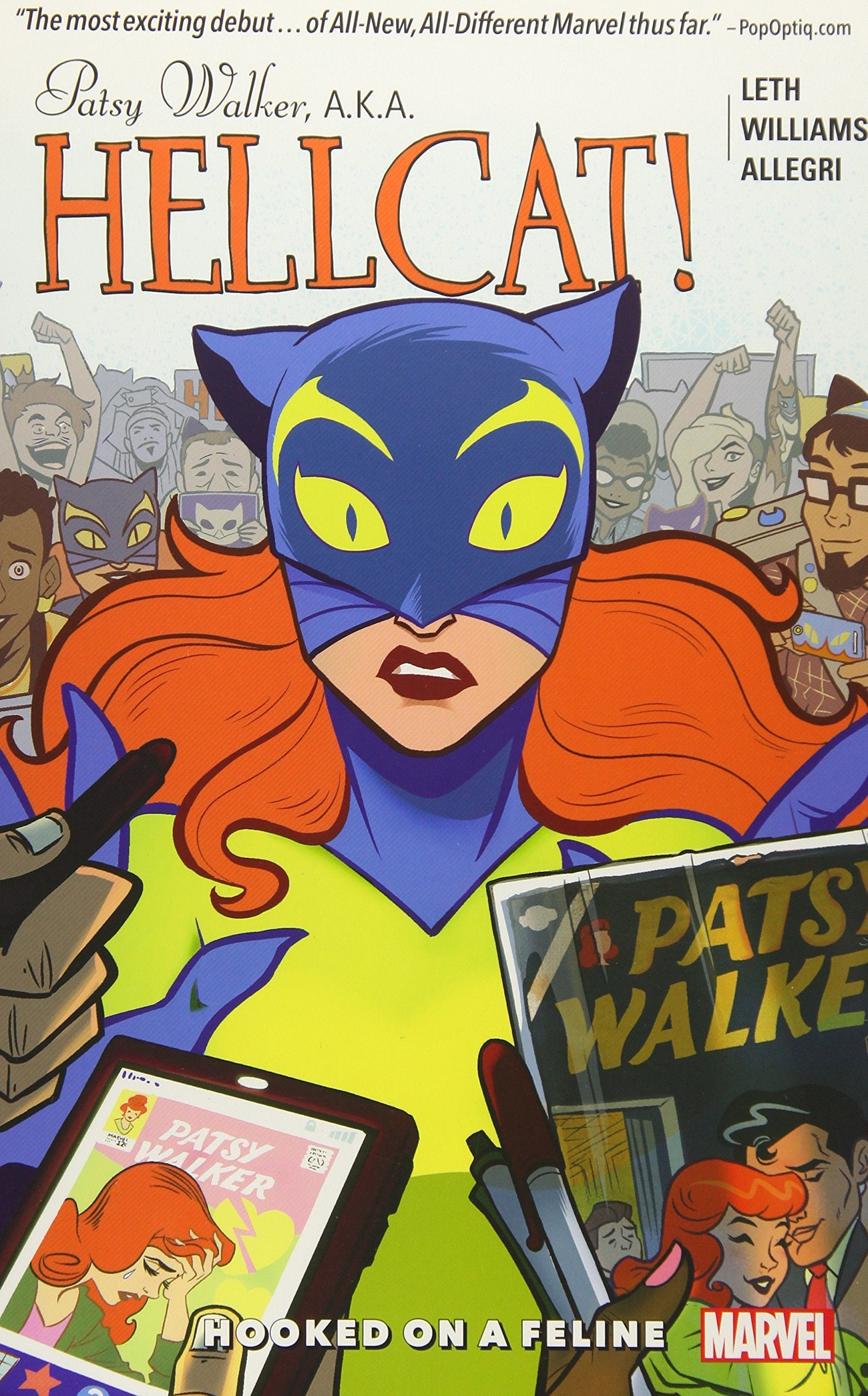
Hellcat starred in a limited series in 2000, and another in 2008. In 2009 she co-starred in Marvel Divas (think Sex and the City with superheroes) alongside Black Cat, Firestar, and Monica Rambeau. In 2016 Patsy Walker starred in her own ongoing series for the first time in 50 years. Patsy Walker, A.K.A. Hellcat was a celebration of her entire history, as writer Kate Leth and artist Brittney Williams embraced Patsy’s teen comedy past. Tubs returned as a regular supporting character, as did Patsy’s old frenemy Hedy Wolfe. The title lasted 17 issues and was seen as a breath of fresh air during a time when superhero comics had grown darker. Patsy Walker also made her way to Marvel’s television universe in the Netflix series Jessica Jones. Rachael Taylor played Trish Walker, former childhood star and best friend to Jessica Jones. Although Taylor’s version of Walker went by the nickname “Patsy” when she was a childhood star, as an adult she prefers to be called Trish.
Patsy Walker currently appears in Christopher Cantwell’s Iron Man run, where she’s become Tony Stark’s partner in and out of costume. The series has given Patsy the most exploration she’s had since Kate Leth’s title, as Hellcat has struggled to come to terms with the trauma from her past suicide, and her fear of returning to Hell.
Closing
Patsy Walker can be considered one of the lynchpins of the Marvel Universe. Her presence in the modern superhero titles are an eternal link to the days of Timely and Atlas Comics. Patsy is the conduit to an era where Marvel published a variety of genres, such as romance, comedy, westerns, and monster tales. Consider, while the Fantastic Four faced Galactus for the first time in January 1966, Patsy was helping Hedy deal with romance drama during a trip to New York. This helps Marvel feel like a fully realized universe, where all kinds of stories are happening at once. It’s a universe where gods battle for the fate of reality, while a teenage girl ponders life after high school. A universe where a character can have a goofy story about going to the beach with her friends, and years later battle Satan himself. Patsy Walker has literally been to Hell and back, but at her core she’s still the girl next door.
Follow Popverse for upcoming event coverage and news
Find out how we conduct our review by reading our review policy
Let Popverse be your tour guide through the wilderness of pop culture
Sign in and let us help you find your new favorite thing.











Comments
Want to join the discussion? Please activate your account first.
Visit Reedpop ID if you need to resend the confirmation email.