If you click on a link and make a purchase we may receive a small commission. Read our editorial policy.
Todd McFarlane on the problem with still being relevant
"You don’t let people stay on the stage until they’re sixty or seventy!"
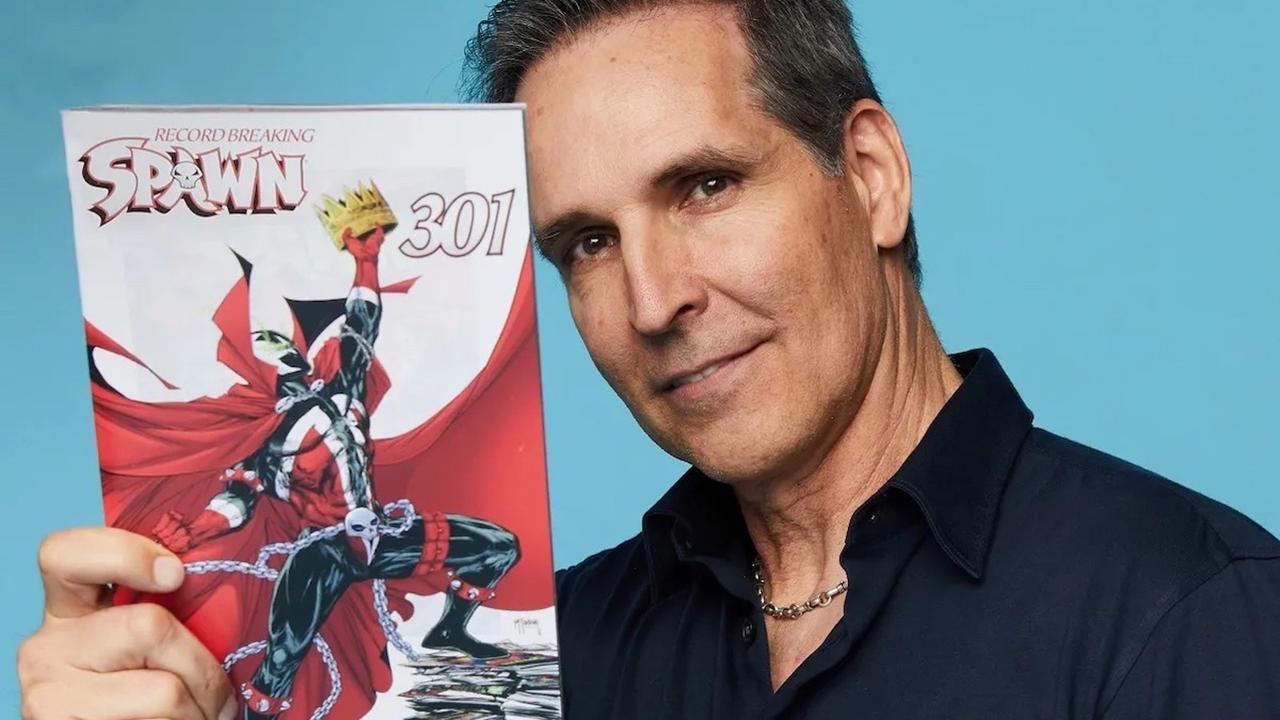

You don’t so much have an interview with Todd McFarlane as you end up having a Todd McFarlane experience. One of comics greatest rebels, co-founder of Image Comics, and creator of countless comic book favorites, McFarlane is never at a loss for words when it comes to talking about the industry — and Popverse found ourselves in the perfect position to talk to him about all of that rolled up into one conversation.
Is that rebellious kid still in there? Are the other rebellious kids still around? What does literally any of that mean? Well let me tell you, the Todd was more than happy to tell me during our brief chat at San Diego Comic-Con.
Popverse: Let me tell you — you are a hard man to get in a room alone.
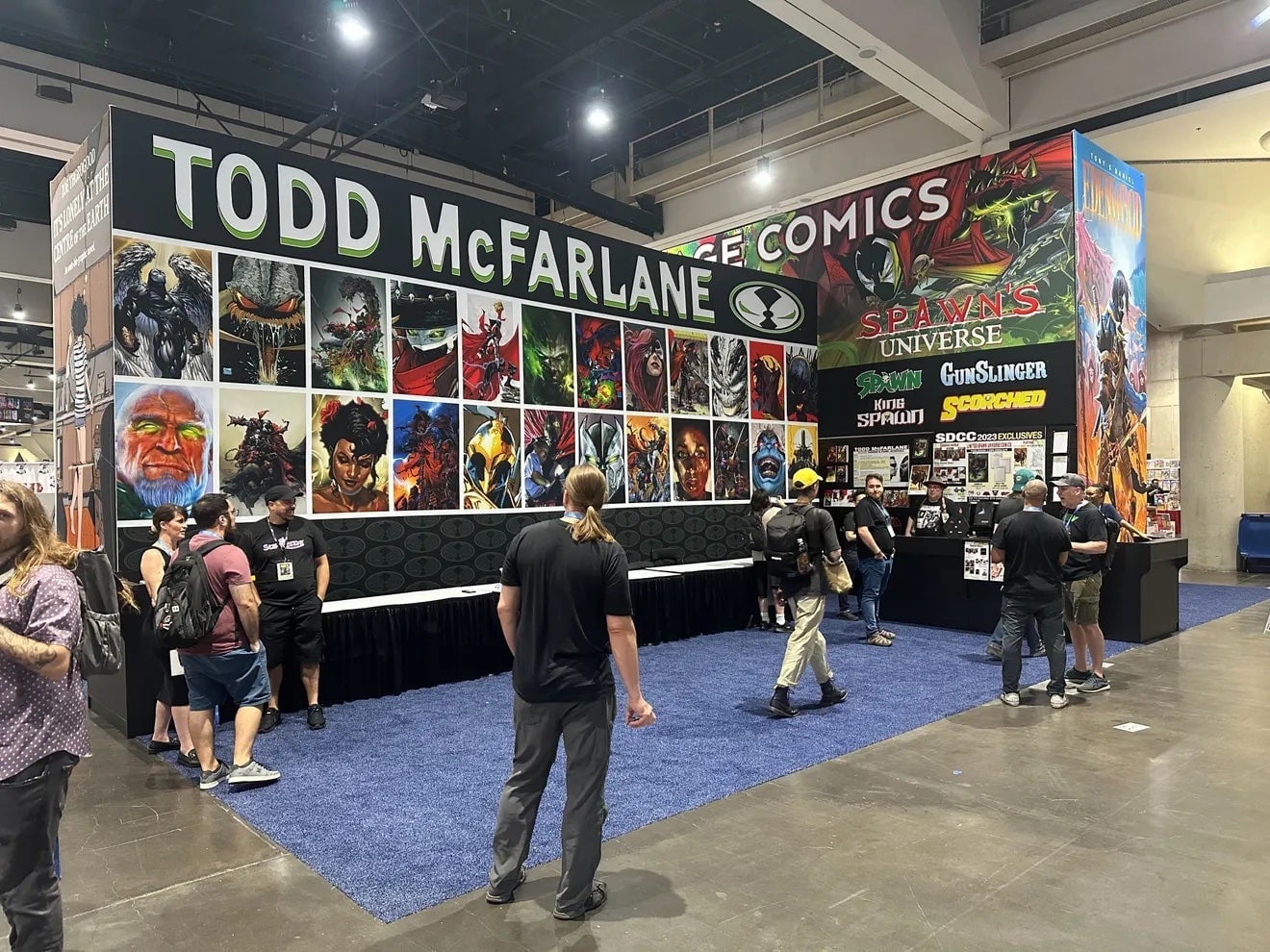
McFarlane: Yeah. Well you know what? We got a different kind of San Diego on our hands here. All the big shots aren’t here so folks are left with me.
It is very very different, it’s true.
Well the Hollywood folks didn’t come so us second-tier folks get a little bit elevated! So we’re back to it feeling a little more like Comic-Con for a change. That’s how it used to be. I guess it’s kind of a false positive, but we’ll take what we can get, right?
I mean you’re hardly second tier, Todd. But I mean…yeah. Part of what I was going to ask was if this was giving 1990s Comic-Con vibes for you again; folks here and hyped about new stuff and comic books for a while.
There was a time when comic-cons were 100% comics and so — as you can imagine—the comics people were the rock stars. Just like the movie stars are kind of that now. We were the rock stars of comics to this crowd and we got that moment. I know that a lot of people, as it grew — as San Diego [Comic-Con] grew into more a wider pop culture event — some people in our industry got bent out of shape a bit.
And that’s a mild way of putting it!
I understand, really. I think there’s a big social part of it. It was small enough that everybody was at the same hotel and you always ran into the same people. Then at the end of the show day everybody was at the same bars. There’s that social aspect that’s kind of gone now. You have to schedule everything with everyone; get penciled in.
[laughs] Calling your buddy’s assistant to see if they have five minutes to say hello. That type of thing.
Yes! If you want to meet your best friend — look, I know J Scott Campbell. His booth is right over there. It’s eight feet away. We’ve known each other for ages. We’re buds. But I ran into him last night by accident going to get a snack at a vending machine at 11 o’clock at night and it was fucking weird. We were like 'Woah, we’re on totally different rhythms at this show.' We’re literally eight feet apart all day. What if we were rows and rows apart? Would I see my friends at all? You have to schedule friendship when you’re here.
Yeah, I kind of get that at this show in particular.
I’ve always thought that the growth of San Diego Comic-Con and New York Comic-Con would be a boon for our business. This is the tide that lifts all boats, really. Regardless of how — if there’s more people getting into geekdom and fandom and whatever else you want to call it — it’ll eventually seep down to us. So let’s get millions of people to see these comic book movies and geeky movies because they might eventually and casually want other stuff, and that’s where we come in. We’re there. We’re the next line of defense. I think people look at this situation so half-empty instead of half-full. This is an opportunity. But there’s so many people being like 'Arg! You young kids don’t know what this is about!'
It’s all very 'Get off my lawn!', it’s true. It’s almost funny how being a nerd is now this thing that’s considered very normal and cool, right? That was 100% not my experience growing up. So in a way these kids are kinda lucky!
Oh yeah, I know. That was far from what happened when I was a kid. I was literally a closet collector. All of my collection was literally in a closet because if anything knew that you were into capes and guys running around in tiny shorts then you were absolutely mentally arrested. But then you get older and you start doing them yourself and when someone asks what you do and you said 'Oh, I do comic books' and they gave you the side eye. Now you say you do comics and people freak out. The reaction has flipped entirely over the last 30 years.
Well when you came on the scene you did it with kind of bang as well. You and your compatriots came on the scene and flipped a few tables in your own way.
That’s kids still there. He’s never going away. I’m taking that dude to the grave with me. [laughs] But it wasn’t just me I don’t think. It was a generation of us. There was this whole group of us that were the new wave. You see the same trend in other media as well — music and stuff like that. Or fashion. So people came in to comic books in the 60’s, 70’s, 80’s, whatever and got a little bit comfortable. Then all of a sudden here comes the mid-1980s where they start showing people that you can alter things — that we can go from this status quo look to doing things that were different and could still actually work. Each of us took a page from that and made it more of a collective shift. I just happened to be one of the handful that was helping lead the charge. It was good for me, individually, but I couldn’t have done it on my own. I needed people on the flanks just like they needed me on theirs. It was time to change the tempo and the volume a bit. Let’s go. Let’s have fun.
In a way you guys were the new underground in your own right.
Yeah! And some writers came in, too. This was the same time as the British Invasion into comics books so you got people like Alan Moore, Neil Gaiman, Grant Morrison — they all took our industry and and turned it sideways for the better. They didn’t know they were messing with icons. You have to be a little bit youthful to do that because you don’t know when you’re messing with stuff. You just look at it all like 'Well this looks like fun and would be cool.' You don’t know you’re being a disruptor. It’s not a conscious choice, you know what I’m saying?
I know exactly what you’re saying, actually. I had a similar talk with Morrison not too long ago, funny enough.
Well then there you go! With all of us it was just never intentional. And then time goes by and hindsight comes in and you’re stuck there going….well, yeah I guess that’s what we did in that moment! When we started Image Comics in 1992 we didn’t know we were doing something historic. We knew that we were doing something that would serve the six of us and might give some opportunity to other people. And 30 years later we got a lot of accolades for doing something that none of us really had an idea about at the time.
Y’all were just trying to do something groovy, from the sounds of it.
We were just trying to do our own music, man. We wanted our own art. We just wanted to do it. That wasn’t unique for anybody! What we wanted was no different than what millions of creative people have done for centuries.
Well what about now then? Cause you say that, but how many disruptors do you really see now? Or do you see any at all?
No.
[laughs] I wish I could record just how quick and flat that answer was.
It’s because I don’t see any. I don’t have to think about it.
Okay…so what’s the difference for you then? Where are they?
It’s frustrating, right, because I think there should be more distruptors. I think that should just be part of the process. Look — I’m over sixty years old and you’re sitting in front of me right now and you’re asking my questions like I’m still someone important. Why is a sixty year old man still relevant? The way it normally works — the way it should work — is that you come in when you’re young. The people at the top of their game are maybe in their thirties or forties…but then more young kids come in and knock them off the stage! And then the next group comes in when that last group is at their height and so on. You don’t let people stay on the stage until they’re sixty or seventy!
I get what you’re saying, yeah. It’s served you pretty well though!
Oh, no, it’s served me extremely well. But I’m saying that you can now go to panels and they go “oh my god it’s Frank Miller! There’s Jim Lee! There’s Greg Capullo! There’s Todd McFarlane and Rob Liefeld and the Kubert brothers!” But we’re all just old men now. It’s weird that we’re still kept on the stage by the generation that was below us.
Like it almost skipped a generation?
Why am I relevant? I’ve had my time in the sun and if people wanna do an oil painting of me an stick it up somewhere because I’m some kind of pioneer or founder or whatever then great. Got it. But why are there so many of us?
Well yeah because I keep wondering why the forty year olds have knocked us off the stage because for some reason they just didn’t want to. And then where are the twenty year olds to take us out when they don’t? When I was twenty they said 'Todd, your competition is a sixty year old man,' and I would have said 'Fuck that' and then asked to have my arm tied behind my back. We took them all on! So yeah. Why am I still on stage? Why am I relevant? I’ve had my time in the sun and if people wanna do an oil painting of me an stick it up somewhere because I’m some kind of pioneer or founder or whatever then great. Got it. But why are there so many of us?
This isn’t how it works, Chloe. The way that it works that the next generation is always cooler and faster and stronger and better…and then the next one comes alone and proves that they’re better in all those things too. I don’t know. It’s weird.
Any idea on why that hasn’t happened? Like, just your personal guess, I suppose.
I think the internet had a lot to do with it.
Ah, yeah. I guess it would, wouldn’t it?
The internet opened everything up. We were looking just for talent in North America and it busted it open to something globally. The talent pool is greater than it’s ever been before and the skill level is higher than it’s ever been before. I get to watch it with my own two eyes. We’re at the highest point of skill that I’ve ever seen in my life right now, but that means that the competition gets tougher. Oh, and by the way, because it’s gotten so much more open, some of the people that are the most talented don’t have access to conventions all the time in the same way that we did. Back in the day it was just a fishbowl — so being in a fishbowl there wasn’t that many of us. It was a little easier to get noticed and build your reputation.
Now some guy in Spain that might be the next Michelangelo — how does he make his mark in North America unless they manage to get onto the hottest book Marvel or DC are doing at the time, or they do a bunch of American conventions? Then add to that that you can go to conventions and just do sketches all damn day and make money. You can be a “cover artist” and you can then do sketches on your website and you’re done with it. You don’t even have to do comic books to make a hell of a living in comics. You can potentially make a hell of a lot of money now being a comic book artist and not doing comic books.
That is kind of a thing that we’re starting to see, yeah. It making the space for those new people.
And it’s not even about if you’re good. Shit, if it’s about being good, there’s thousands of artists who are good right now. Matter of fact, there’s hundred that are even pretty damn great! Back in my day there wasn’t hundreds that were great. If I had to break in today I don’t think I could with all the competition that’s out there. But it’s all there now and there’s some easy money to be had. And again, everybody’s allowed to live their life as they see fit, so knock yourself out. If you’re having a good time and you got a smile on your face and can feed yourself and your family then I’ll be your cheerleader. What I don’t want, however, is the follow-up conversation of 'Man, I wish I could have the life like Todd or Robert [Kirkman]. That’d be so cool.' Because that’s another conversation.
Is it a conversation you’ve actually had before?
Oh sure. I run into those people. 'Man, Todd, I'm just trying to be like you.' Well, you want to be like me, you want to be like Robert. I don't know. If it was me, I'd fucking do what me and Robert did then. What you want to do is you want to do shortcuts.
So it’s a matter of like…paying dues, basically?
It just doesn’t make sense to compare yourself to the people who have been it for the long journey. I don't know. So either just enjoy the life that you have or start working towards that other one. But if you're not going to go to the gym, I'm telling you, your muscles aren't getting bigger. So you can say you want to get ripped, but if you don't want to go to the gym, I don't know how that works. So go ahead. Those are the people that I run into, sadly, on a bit of a regular basis, that just think that they can now use the internet to short circuit all the work. I'm an old man. I was on the train — I did two plots when I was on that train coming here. Right? My life's established. My career's good. I'm good, and I got plenty of money. I don't have to do two plots, but I did two plots anyway.

You’re still grinding; still doing the work.
Right! So I don't know. I don't know if anybody else was doing it, but I was doing it. So I've been at this now, almost going to be close to 40 years. I'm not an overnight success. Neither is Robert Kirkman. Neither Jim Lee. I mean, we put in decades, not years. We are now decades into it. I was just having this conversation with somebody the other day. I had a conversation with Eric Stephenson, publisher of Image Comic. Spawn, right? We're working on issue 344. We got a Guinness Book of Worlds record for hitting 300. Okay. Take that record and throw it in the garbage and give everybody amnesia. I still got 44 more issues out since. “Eric, how many issues have we done in 30 ... How many books have we done in 30 years that have got to issue 45 or higher?" Right? In 30 years? And the answer was off top of his head — and he's really good — is if you throw out the founders and the partners, so no Spawn, no Walking Dead, Invincible, whatever — two.
Two?!
Saga and Deadly Class.
Well shit.
So I'm a bit of a dad and I'm giving a message to my son. "Son, if you do a book and you put your head down and you draw that book for four and a half years, devote that full four and a half years of your life to drawing that book, because you're going to be drawing anyways. You're going to be in the industry anyway. So the drawing part is already there, it's a given. But I'm saying draw the same character, same book. And you get to 50, you don't even have to be good. You don't even have to be good." You know what you will be then? One of three books that are not Image partners that are there. You can build off that, saying, "I'm only one of three books that have done something."
That’s a hell of a dose of perspective.
If people don't want to do something, then if you do it, you put yourself up and you don't even have to be that great. Are there other people that can out-draw you? Yes. Are there other people that can out-write you? Yes. Did they do 50 issues of it? No. So you put yourself in an elite category without being an elite talent. I don't know. It's staring them in the face. I hope somebody finally takes it.
About Comic-Con International: San Diego 2023
Dates
-
Follow Popverse for upcoming event coverage and news
Find out how we conduct our review by reading our review policy
Let Popverse be your tour guide through the wilderness of pop culture
Sign in and let us help you find your new favorite thing.







Comments
Want to join the discussion? Please activate your account first.
Visit Reedpop ID if you need to resend the confirmation email.