If you click on a link and make a purchase we may receive a small commission. Read our editorial policy.
Jonathan Hickman reflects on the emotional end of Ultimate Spider-Man and the "gutsy" move of Marvel closing a hit universe anyway
Marvel’s Ultimate Spider-Man is ending at its peak — and Jonathan Hickman explains why that’s exactly the point

Popverse's top stories
Much like being a football and soccer fanatic, being a Spider-Man comic book reader is an emotional experience. There is a cyclical sense of rebirth and loss, of triumph and heartbreak, that's experienced en masse with other fans. Nowhere else has this been more apparent than in the journey that Jonathan Hickman and Marco Checchetto's Ultimate Spider-Man has taken.
First announced as part of Marvel Comics' fresh revamp of the Ultimate Universe, Hickman and Checchetto's Ultimate Spider-Man takes place in an alternate universe where Peter Parker is middle-aged, married with kids to his beloved Mary Jane, and still manages to find time as Spider-Man. It's an interpretation of the character that so many Spider-Man fans have longed for ever since the days of the infamous Spider-Man: One More Day storyline from 2007 that broke up Peter and MJ's marriage for good.
But as any sports fan can tell you, all good things must end. At New York Comic Con this year, Marvel Comics announced that the Ultimate Universe would be concluding with 24 issues of all of its mainline series, with a final farewell covered in one mini-series called Ultimate Endgame by Deniz Camp, Jonas Scharf, and Terry Dodson. Before Ultimate Spider-Man concludes with Ultimate Spider-Man #24, we spoke with Jonathan Hickman about his journey into the Ultimate Universe.

Popverse: How do you feel about your Ultimate book and the Ultimate line ending completely despite all of the commercial and critical success that you guys have had?
Jonathan Hickman: Well, I mean, for me it's not a big change. I mean, I agreed to do 24 issues, and then I was going to be off. And I set up a whole construct to make sure that that didn't change, leading to one of the things we're talking about, which is Endgame. So I'm happy with the book, as much as I'm ever happy about anything that I do, you know, I'm one of those people. All I see are errors and mistakes instead of success and all that. But it's a good book. It's a solid book. Obviously, we had great art throughout, and I certainly told the story that I wanted to tell. I feel very good about thematically where we're wrapping up at the end of 24, so.
You know, I think it's one of those things that everybody would consider to be a success, and I'm trying to cope with that as best I can.
So right. And you know, I know that things are winding down, but would you ever return to the Ultimate line were it rebooted or restarted in the future, and would you have anything in mind for that if that were to happen?
Well, I think what I would say is, generally speaking, when I leave a book, I have said everything that I want to say about a quote, property unquote, right. And I would generally say that this is true regarding me writing Spider-Man stuff.
Obviously I write a bunch of Marvel Universe things, and Spider-Man will show up again, and I'm sure some of those are inevitable. People seem to like Spider-Man [chuckles]. But I know, I mean, I feel like I have said everything that I wanted to say. And you know I set up Endgame to work a certain way, very happy with what Deniz [Camp, writer of The Ultimates and Ultimate Endgame] is doing, really crushed it at the end. And so, generally speaking, once I'm done with something, I'm done with it. I think the only thing I would say that that's not been true about is when I was doing X-Men.

And so, just to clarify something from earlier, you said you signed on for 24 issues. Did you know that at the end of the 24 issues, that that was gonna be the end of the Ultimate Universe, or did you know that from the start?
Well, I don't think that decision was like concretely made until somewhere after we had done issue 12, right? Like I was always out. But it was at a Marvel retreat whenever we all talked about it. And, you know, I've been at Marvel a long time, and I've never seen us do what we're doing, which is end a book that is selling well and a line that is selling well. But I understand the decision because we, generally speaking, don’t do discrete units of books. We don't do stuff that's pre-built to be a collection, and [Marvel President Dan] Buckley and all those guys looked at it, and they were like, ‘Look, we think we're really proud of this entire Ultimate line.’ [Ultimate X-Men writer-artist] Peach [Momoko] was on for 24 issues, I was on for 24 issues, [Ultimate Black Panther writer] Bryan Hill, I think, was pretty much 24 and out or whatever, like we all started with knowing that the city was going to open back up. That [Ultimate] Endgame was going to happen. And so we all kind of wrote to that.
And I think it's one of those things where everybody just looked at it, and they were like, ‘We feel like we can sell these books forever, if we don't do the thing that we normally do.’ I thought it was a really, really gutsy decision. I kind of love it. I kind of love it because it's not what we normally do. And I think it's the right decision. Just, I was surprised at the time. I was shocked at the time because it's not what Marvel normally does, and I love it when we throw curveballs at the audience and at the market. And we should do more exciting, different things, not less. I guess that's how I would answer that. I don't know if that is the answer that you're looking for is that okay?
That makes sense, yeah. And so your book is about living in a lost generation, and once you get to a certain point in life, looking around and realizing that time has gone by. I think Peter's first line is like, 'Oh man, Parker, you're getting old.' And what would you like people to take away from your contributions to the Ultimate Universe?
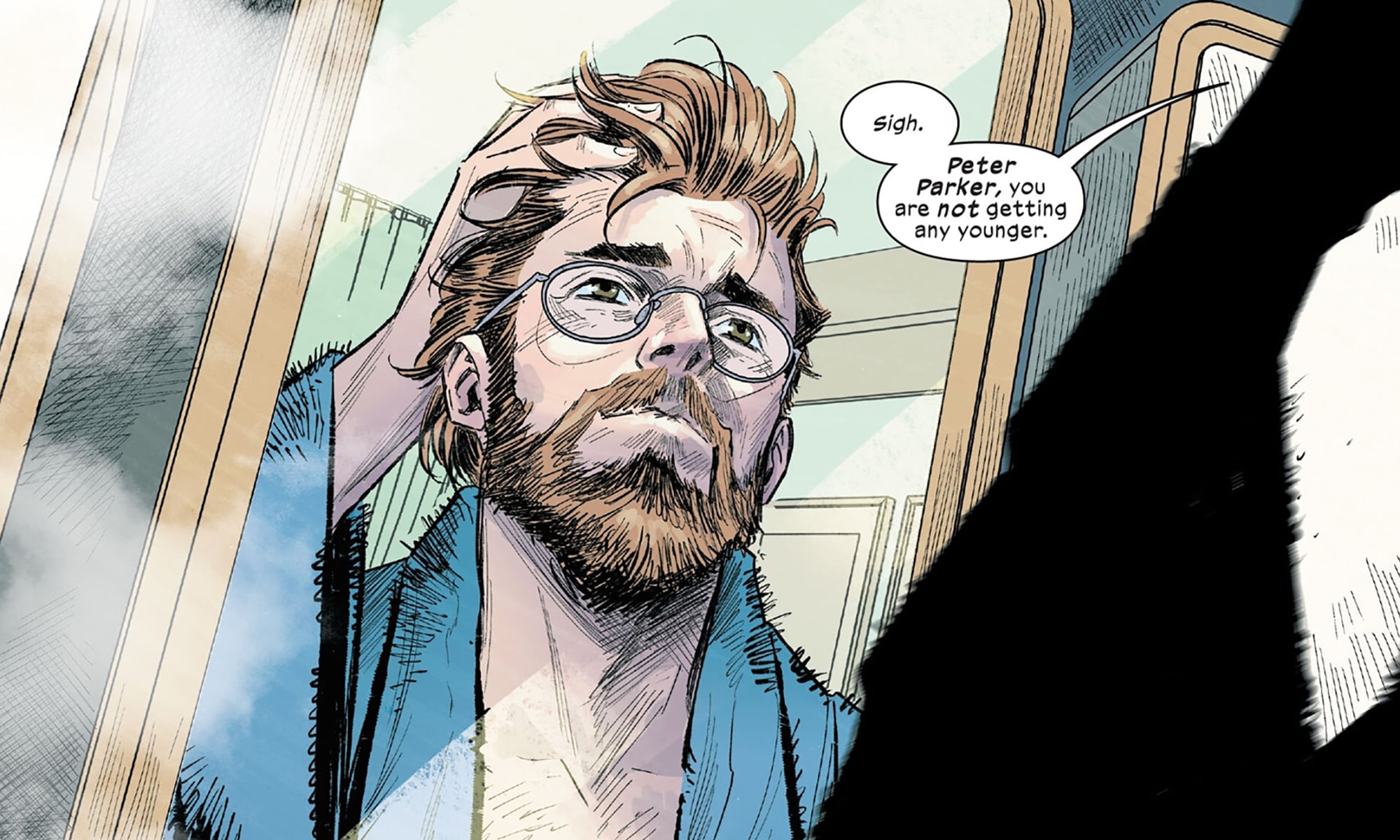
Well, from a technical and creative standpoint to other creative people, I think it's OK to have happy accidents every now and then. I wasn't supposed to write Ultimate Invasion. I wasn't planning on writing Ultimate Spider-Man. All of this just kind of happened in a very organic way. And at some point, I said to myself, you know, I really love Peter B. Parker from the Spider-Verse movies. I would love to write that Spider-Man, like nobody's written that Spider-Man. Everybody else writes, you know, the other guy that we've got thousands of comics of, and plenty of movies. And I was like, ‘I really, I kind of dig that,’ and it comes with a specific kind of story and I think that people - obviously there's the aspects of the story that people glom onto immediately, that they're still married, that Uncle Ben is alive, that on and on and on - but I also think when we're done, thematically, it will resonate in an even more powerful way when they see the complete thought of what I'm doing. I hope that's the case. You obviously you can't control how the audience responds, you just try your best. But I feel that way.
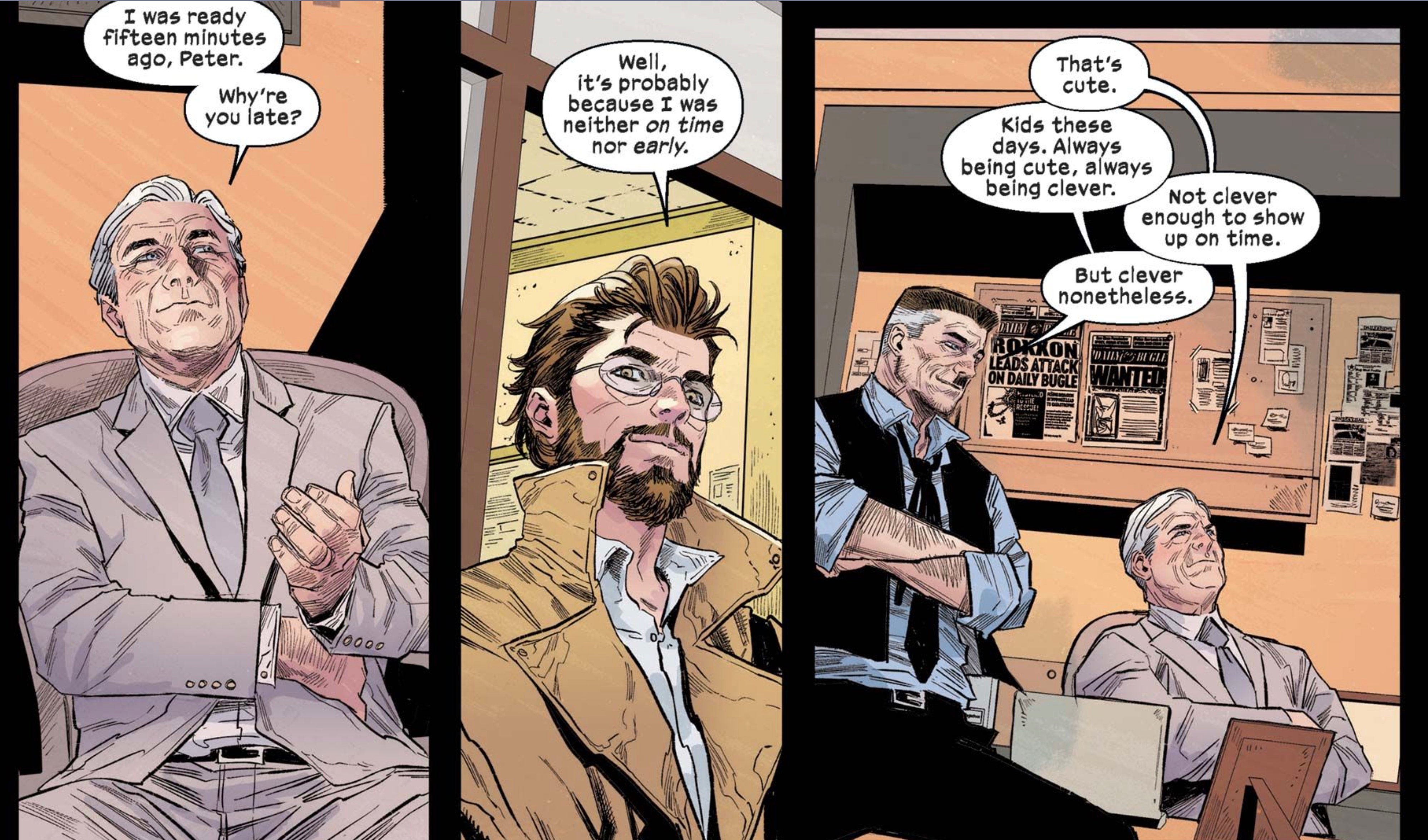
For sure. And you know, speaking of Ben, one thing I love about this book is that it spotlights real old school journalists, and that whole mentality. And Ben just feels very, very real. I mean, I'm from New York, so I feel like there's always one guy around who's like Ultimate Ben Parker. Did you have any real person, real-world person in mind when it came to crafting Ultimate Ben?
Listen, I was raised around guys like this. Like, both of my grandfathers would sit me down and tell me stories, you know, just drip in real-world wisdom. Listen, the Ben and Jonah act is literally my grandfathers, they were both really, really good friends, and they hung out. They hung out even after my parents got divorced. You know, it was one of those things. I definitely stole from my own life experiences when it comes to those two groups.
That's really sweet. So, you know, we know that Mysterio is the master of illusions and such, but what led you down a path to completely reinvent the character from the ground up?
Well, I think it ties into what we were doing with Harry, you know. I don't want to explain the story too much. I generally don't do that, but I think there's a thing of where the world is full of real people and fake people right now. And the fake people put on, they glom on a hyperreal but entirely superficial aspect of themselves. And they put that out into the universe, and it's almost like they don't realize how fraudulent it appears to people who have things that are real. And I'm obviously playing with all of that, you know, with Harry and Gwen. But there's a cost to that, and I'm also playing with that as well. And then you know, obviously, stuff happens in the last couple of issues that I'm not gonna spoil.
Thank you for not spoiling, because we're just on the edge of our seats here already. So just one to one question to close us out, and you touched a little bit on this, but one thing I can't help but notice with this book is again, this idea of aging and getting older. I loved seeing May tease Peter about it, especially when he is trying out different costumes and she's like, 'Dad, why are you wearing that? It's weird.' Do you feel that Spider-Man is this cultural institution that is no longer a spring chicken?

Well, it’s just a story. And Marvel will tell thousands and thousands of stories, and obviously, the preference is that we maintain our IP in a certain position that is the most accessible and the most profitable, that's the reality of our business, right? That's our responsibility to the company. Where the guys across the street have done a fantastic job over the decades is taking those institutions and, every once in a while, looking at it through a very different prism. And you get what is a standalone evergreen book like Superman: Red Son or something like that, right, where you're not shitting on the character, you're not destroying the character, you're just saying, you know, it's a glorified ‘What If…?’ story. But it's done in such a way, and it's done as a complete thought. And it is almost like a feedback loop into the other thing, where Dark Knight Returns suddenly is such a powerful vision of the character that it seeps into the main continuity of the character.
So I don't know. Don't know what Spider-Man is gonna be like 20 years from now. I don't have any idea. I don't have any control. But I think it's okay to play with the IP so that it can organically evolve as a response to societal change. And all of those kind of things, which is what the guys across the street have done very, very well over the past 20-30 or so years, and I'm excited that Marvel is starting to do a little bit more of that, and I'm 100% on board for it, even if it means that the books have to end earlier than sometimes people would want.
Right. You know, at least they happened.
Yes, yeah, yeah. And you've got that book forever. That’s that.
Want to know what's coming up next in pop culture? Check out Popverse's guides to:
Follow Popverse for upcoming event coverage and news
Find out how we conduct our review by reading our review policy
Let Popverse be your tour guide through the wilderness of pop culture
Sign in and let us help you find your new favorite thing.
Comments
Want to join the discussion? Please activate your account first.
Visit Reedpop ID if you need to resend the confirmation email.