If you click on a link and make a purchase we may receive a small commission. Read our editorial policy.
How Hellboy II gave us a classic onscreen romance — and led to The Shape of Water
The relationship you remember from Hellboy II: The Golden Army probably isn't Abe Sapien and Princess Nuala. That should change.
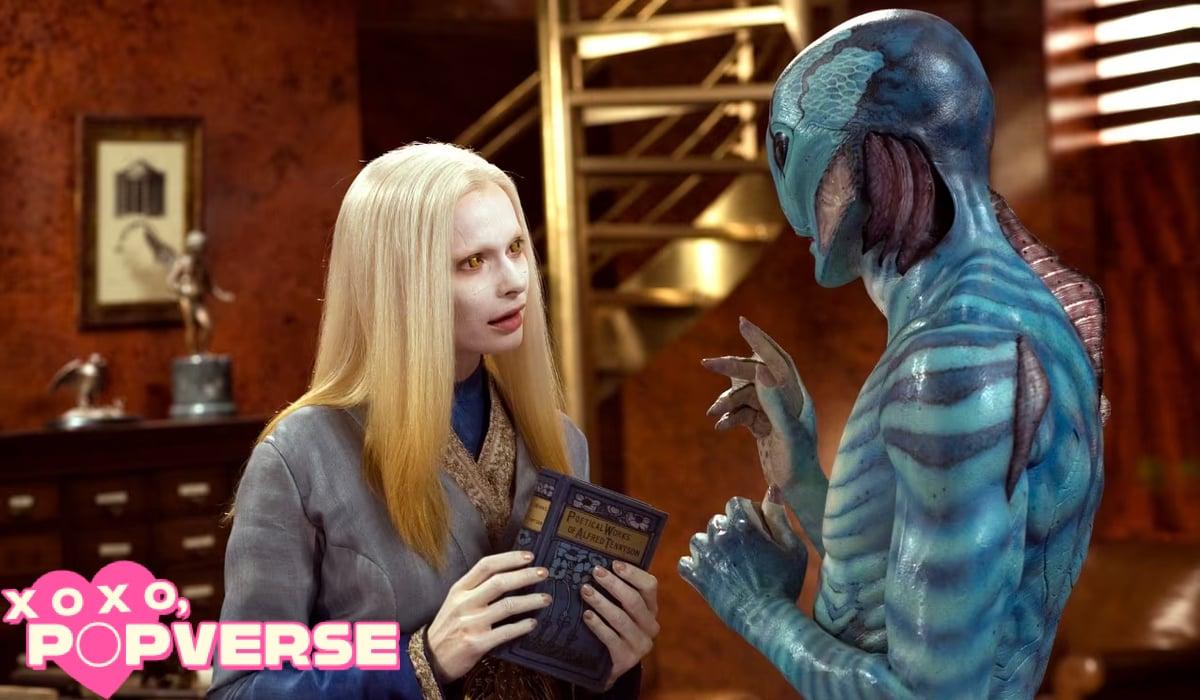

Welcome to XOXO, Popverse! Our Valentines gift to you this year is a week-long celebration of all things love and romance in pop culture, from our favorite couples to which superheroes would make the worst dates. (It's the X-Men.) Find our love notes to you right here.
He was an amnesiac fishman who swore to protect humanity; she was heir to a fairyland under its thumb. In the words of Avril Lavigne, can I make it any more obvious?
I'm kidding; there's absolutely nothing obvious about the love story at the heart of Hellboy II: the Golden Army - that is, the one between Abe Sapien, agent of the US government's BPRD, and Princess Nuala, royal leader of a mythical race facing extinction. You can clock the classic inspirations that went into it - there's some Romeo & Juliet here, some Beauty & the Beast there - but what the relationship gives us is something you don't typically see in movies, particularly in monster movies, in both good and bad ways.
And since it's love week here at Popverse, I thought we'd take a moment to talk about it.
Tecate and Tennyson - Abe Sapien in love
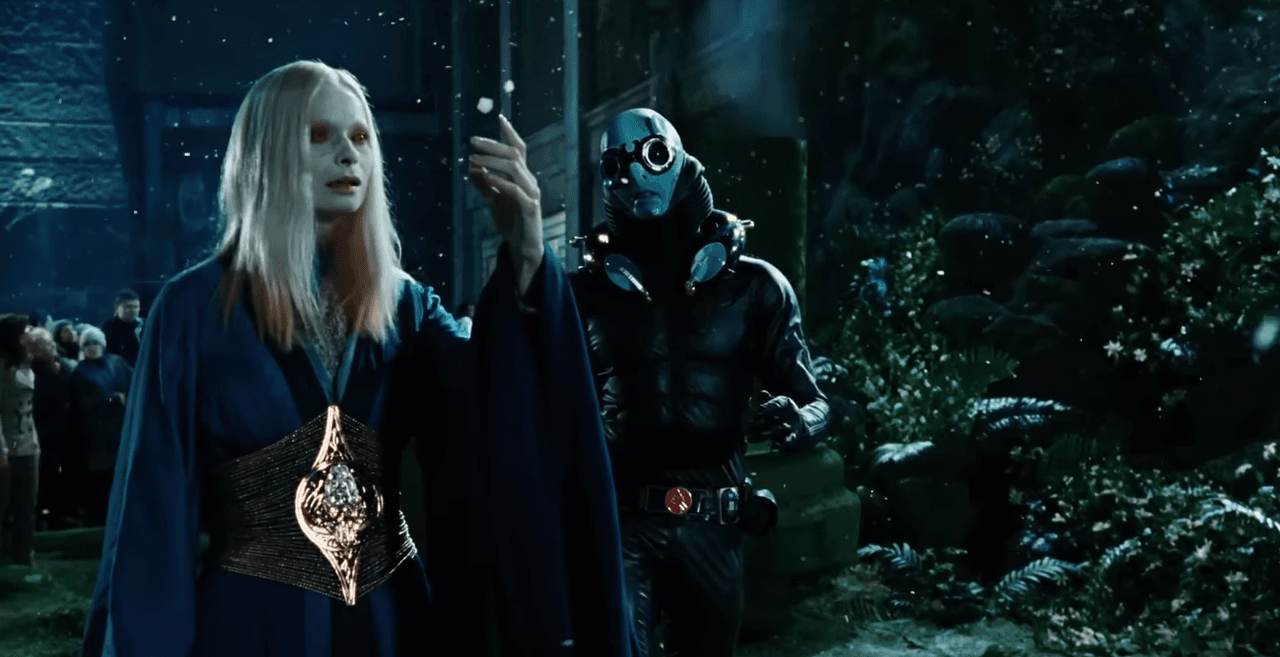
In case you haven't seen one of Guillermo del Toro's most underrated movies (seriously, go watch it), let me get you up to speed. Having established his titular character in the first Hellboy movie, del Toro decided to flesh out Big Red's best buddy, one Homo Ichtyus Abraham Sapien, played by brilliant creature actor Doug Jones. The way del Toro chose to do this was by giving him a romantic subplot, and to spice things up, his paramour is elven Princess Nuala, played by Anna Walton, who is sister of the film's archvillain. Both outcasts in different ways, Abe and Nuala spend the movie bridging a gap between their species and over all of humanity, only to be doomed by the conflict therein.
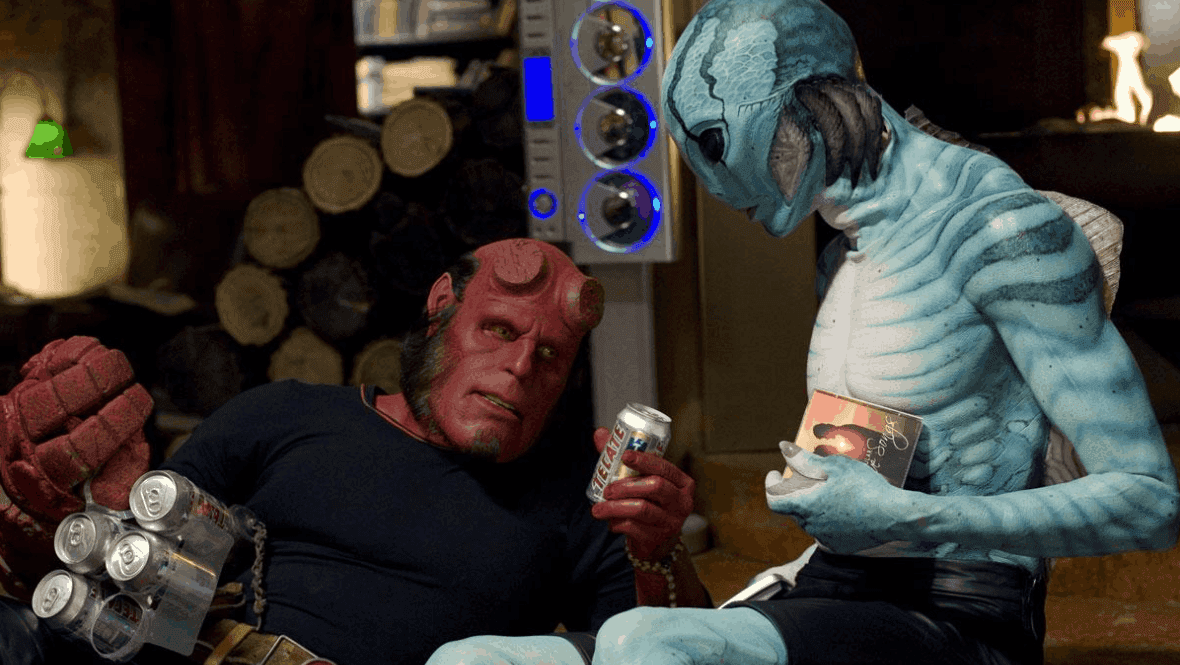
Even before we get to the tragic end, though, there's a moment stemming out of this relationship that's just unlike anything you get in your average monster romp. At about the halfway point of the film, both Abe and Hellboy find themselves at crossroads in their respective relationships (remember, Hellboy is with Selma Blair's Liz Sherman in these movies), and even though there's a literal fairy war going on in the shadows, both they and the movie decide to spend a beat commiserating. Set to the tune of Barry Manilow's 'Can't Smile Without You,' the pair of freaks drown their sorrows in a six pack.
Hot take here: though I will forever adore prosthetic SFX, the greatest gift that monster movies give us is empathy. If we can feel for the creature on screen - whether that's Quasimodo in his tower or Frankenstein pursued by pitchforks - we have a better chance at feeling for those that have been othered in our real lives. Always keen to find the monster's heart, del Toro paints an undeniably human portrait with undeniably inhuman brushes - despite their demonic and aquatic origins, Hellboy and Abe are just two pals who've loved and lost.
Even though for Abe, that loss is only about to get worse.
(Fun fact before we move on - The phrase "'Tis better to have loved and lost than never to have loved at all" comes from poet Alfred Lloyd Tennyson. In an early scene featuring Nuala at the BPRD headquarters, the tragic romantic is shown reading a volume of his works.)
A lance in the heart
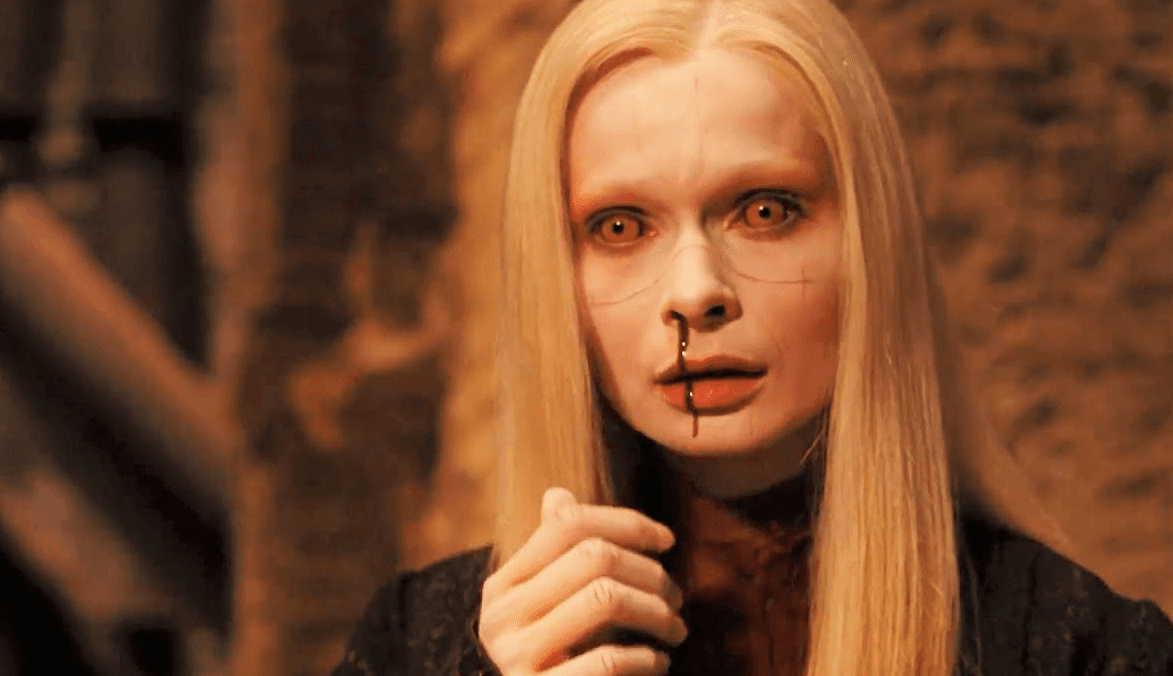
By the end of the movie, though, there's a giant difference between Hellboy and Abe's relationship troubles - namely, Hellboy's partner stays alive. In the climax of the movie, Nuala sacrifices herself to kill her brother, ending his plan of revenge on humanity for casting aside the fairy races. And look, I love this movie, but I think it's worth pointing out that even as a tragic beat, this moment is a bit too much of a downer.
There's certainly a discussion to be had about Nuala falling into the role of "pure woman who sacrifices herself so the men can live," a trope that del Toro himself has proven he's better than. Then, there's the issue of portraying an oppressed people like the elves as the villains against a team of heroes that uphold the status quo (read some old Magneto or Poison Ivy comics and see what I mean). But if you want an even easier reason to believe this ending didn't feel right, try this:
Universal Studios said so.
That's right, the production studio behind the Hellboy movies believed there was so much more to the Abe/Nuala relationship, they were planning on making another movie about it. Written by Hellboy scribe Peter Briggs and Aaron Mason, Silverlance was a cancelled Hellboy spinoff that would've focused on the further adventures of Abe Sapien, as he investigated the history of the war between Nuada and humanity.
Spanning centuries of different historical eras, Silverlance would've paired Nuala and Abe Sapien again, psychically connecting them even after the former's death. Doug Jones reportedly was on board for the project, but unfortunately, the film was axed in favor of the Hellboy reboot, and I'm simply not going to comment on that very real fact.
All this to say, there's a parallel between what the Abe/Nuala relationship was both on-screen and off: beautiful, tragic, and objectively too short.
The tale as old as time could use a reboot
Still, there's a way at looking at this film as part of Guillermo del Toro's catalogue and finding some amount of closure. In a way, a gilled monster played by Doug Jones did get his love story, in the form of Oscar-winner The Shape of Water. Like Abe/Nuala, it's a story of romance between outcasts, though one of those lovers is admittedly fully human. Still, there's something that springs out of the that movie that contains the very essence of the princess and fishman's tale - though we have to dive into its novelization to get it.
Written by del Toro himself, The Shape of Water novelization expands on ideas from the film, and at one point, its central character Eliza (played in the film by Sally Hawkins) is dealing with something we don't get as much on screen: her loneliness.
"But I can't be alone, can I?" Eliza says, "Of course not; I'm not that special. Anomalies like me exist all around the world. So when does an anomaly quit being an anomaly and start being just the way things happen to be?"
Speaking to the gillman, she continues, "What if you and I are not the last of our kinds, but one of the first? The first of better creatures in a better wold? We can hope, can't we? That we're not of the past, but the future?"
I mentioned earlier that monster movies give us empathy, and one of the best ways they do that is with the "Beauty & the Beast" trope. It makes us feel for the monster by presenting us with another person, kind of like us, who falls for them. But at the same time, there's a downside to that messaging - it can also be read as the monster not being lovable enough on their own, essentially saying that there's value in the other... so long as someone we're familiar with finds it.
The pairing of Abe and Nuala in Hellboy II, for all its imperfections, is the answer to that problem. It's a testament to not just the idea of the outcast being loved, but that love itself - in all its many permutations - is worth our respect. Whether it looks familiar to us or not.
Follow Popverse for upcoming event coverage and news
Find out how we conduct our review by reading our review policy
Let Popverse be your tour guide through the wilderness of pop culture
Sign in and let us help you find your new favorite thing.







Comments
Want to join the discussion? Please activate your account first.
Visit Reedpop ID if you need to resend the confirmation email.