If you click on a link and make a purchase we may receive a small commission. Read our editorial policy.
Where to read comics online in 2026: The best apps and platforms compared
The battle to replace ComiXology is heating up.

Popverse's top stories
While digital comics have been around in some form or another for decades, recent times have seen it become the most competitive of eras. Big moves are being made at a speed that would make even the Flash blush, including partnerships and distribution deals involving major publishers such as Scholastic, VIZ Media, DC Comics, Marvel Comics, and Image Comics. By the time this is published, it's likely there's been even more digital comics-centric news stories that could change the playing field again.
From a reader’s perspective, it’s all very intriguing — and daunting. Whether you’ve been devouring comics since the cradle or you’re preparing to dip your toes into the medium for the first time, knowing where and how to access digital comics is rife with confusion. Which platform or app should you sign up for, and what will you have to pay? Will it have all the titles and genres you’re into? And if you’re out to build up a digital collection, are there any safe bets to invest your hard-earned cash into, given some of today’s most promising players may not survive the current arms race (as anyone previously burned by the decline or demise of certain platforms will readily attest)?
But fret not: Popverse is here to help. I’ve done my darndest to de-mystify the digital comics space, reaching out to representatives from several of the platforms making waves right now to hear first-hand what sets them apart from the pack. I’ve also consulted comics experts David Harper (founder of comics site SKTCHD and host of the Off Panel podcast) and Susana Polo (freelance journalist; formerly senior entertainment writer and editor at Polygon) for an independent perspective on each platform’s pros, cons, and long-term prospects.
By the time we’re done here, you’ll know how and where to read comics online, what the most exciting digital comics platforms are right now and what they offer, and (above all) which of them is right for you!
How and where to read comics and manga online

First, let’s clear up what we mean when we talk about “digital comics.” For our purposes, digital comics are all forms of sequential art storytelling — comics, manga, and webtoons (a smart phone-native comics format that originated in South Korea) — available on, and primarily consumed via, an online platform or app.
That said, for completeness’ sake, there are other options out there. Some creators upload their work (often without any charge) on self-hosted or small press sites, or even on social media platforms. Panel Syndicate — a direct distribution publisher run by several heavy hitters in Western comics — sells DRM-free (i.e., non-copyright protected) files in a pay-what-you-want model. Humble Bundle regularly sells comics in heavily discounted batches (again, in DRM-free format). Services such as Libby grant free access to an impressive line-up of digital comics to anyone with membership at a participating library. Some publishers such as VIZ, DC, and Marvel offer their own company-specific digital comics platforms. Newsletter outfit Substack boasts a modest selection of comics — some free-to-read, some not. And then there are piracy websites, which host illegal scans of a decent chunk of the comics and manga on shelves today.
But assuming you don’t want to break the law and do want easy access to a large collection of comics material, you’re probably better off sticking to 'digital comics' as defined earlier, and which broadly fall into two camps.
Camp 1 is the publisher-owned platforms, which (you guessed it) only carry properties controlled by their owners. For Western comics, this includes DC Universe Infinite and Marvel Unlimited (as their names suggest, the online portal for DC and Marvel’s respective libraries), and Mad Cave Studios (a mix of licensed and creator-owned titles). On the manga side of things, there’s Viz’s Shonen Jump, which is home to fan-favourite series such as Jujutsu Kaisen and My Hero Academia.
Camp 2 is the third-party platforms, which rely on some combination of titles owned (in theory, if not always in practice) by their creators or by publishers the platforms have cut deals with. WEBTOON (also the name of a company, hence the caps), Tapas, and other toon-oriented platforms fit this bill, as do Comixology Unlimited/Kindle, GlobalComix, Neon Ichiban, and the relaunched Crunchyroll Manga.
Both camps typically offer at least some free-to-read comics (WEBTOON and Tapas are particularly generous in this respect). But don’t expect Tony Stark levels of philanthropy; every platform employs one or more forms of revenue generation — a la carte purchases, subscriptions, in-app currency — to keep the lights on and pay the creators that have made them.
Historically, ComiXology had cornered the market on digital comics and manga in the US, however, a series of controversial changes to the platform’s functionality after its acquisition by Amazon have tarnished its reputation with many readers. There has been unconfirmed reports spread that ComiXology sales remain stable, but there’s a demonstrable appetite for a worthwhile ComiXology alternative. And that’s where the aforementioned digital comics arms race comes in, sparked in large part by four platforms — two old, two new.
Which digital comics platforms are shaking up the industry (and how)?
WEBTOON
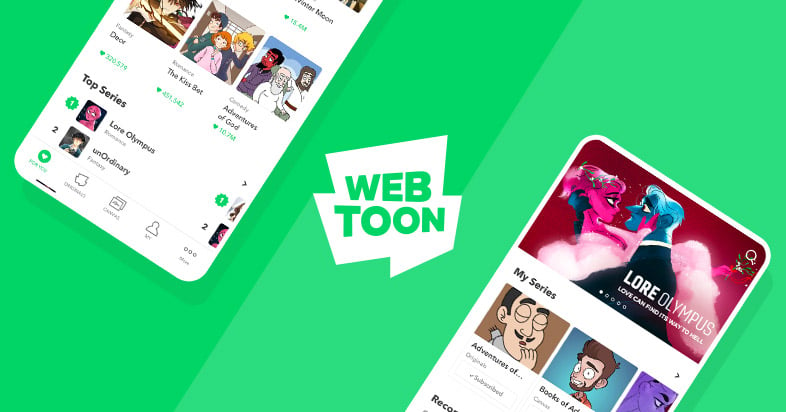
Understandably, one of the most publicized recent digital comics developments is the arrangement between WEBTOON and Disney. The two companies plan to have WEBTOON share via its digital services over 35,000 Marvel, Star Wars, Disney, Pixar and 20th Century Studios digital comics, as well as an unconfirmed number of WEBTOON Originals. Disney+ subscribers will have access to a subset of the app’s library as part of their existing subscription. WEBTOON’s existing base of 155 million monthly active users is also catered for, via a planned multi-year drop of nearly 100 classic and original Disney/Marvel titles reformatted for the platform’s vertical scroll presentation.
Together with deals to publish select titles from (among other publishers) BOOM! Studios, Dark Horse Comics, and IDW Publishing, as well as an arrangement with Paramount to Star Trek-themed original series, this broadens WEBTOON’s slate (which skews towards romance, comedy, and slice-of-life material) to encompass genres, storytelling sensibilities, and IP closer to what long-time readers of Western comics are used to.
“Strategically, our approach has always been about offering a rich content library across every genre [...] By working with major publishers we’re now able to expand our reach to include a wider range of comic content,” said Yongsoo Kim, chief strategy officer and head of global WEBTOON. He downplayed the idea that reformatting Disney/Marvel content for smartphones was a conversion tactic — framing it as more of an optimization exercise — and argued that most readers don’t distinguish between comics, manga, and webtoons (“[They’re] following the stories and characters that speak to them.”).
In terms of beefing up WEBTOON’s backlog with the likes of Marvel and Star Wars, Kim said it places the platform in a “best of both worlds” scenario, “offering legendary IP and developing digital-native originals.” And on the subject of what gives WEBTOON the edge, Kim cited “scale, accessibility, and community” as the platform’s “unique strength,” as well as its user experience (including its phone-friendly vertical scroll reader, Netflix-esque personalization, and social features).
GlobalComix
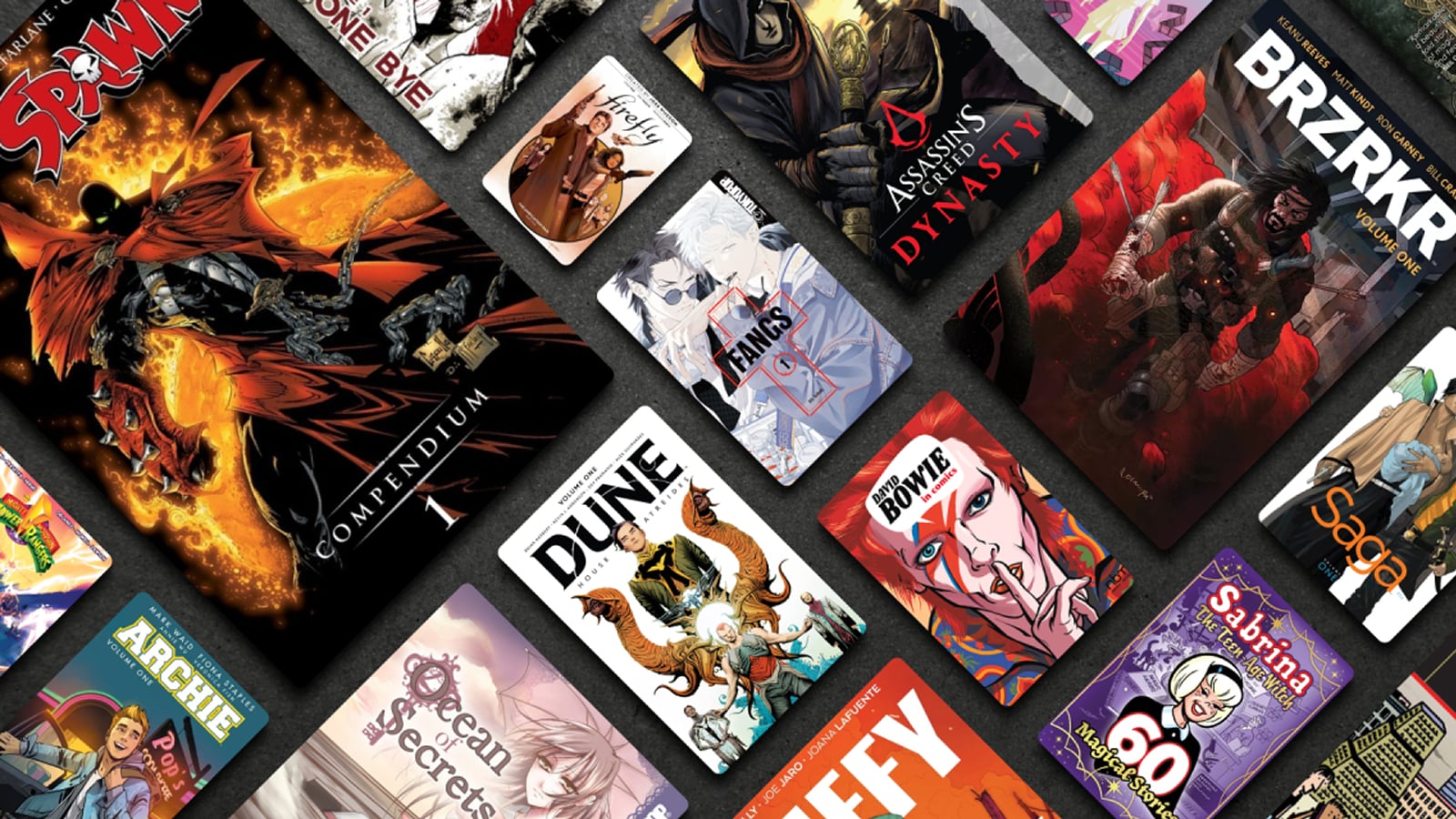
WEBTOON isn’t the only digital comics player to strike a deal with Marvel, though. GlobalComix confirmed Marvel was coming to its primarily subscription-oriented platform in October 2025, mere weeks after the much-hyped arrival of DC’s titles. Both agreements involve day-and-date access to new comics, as well as a steadily expanding backlog of older comics. Combined, they lend an appreciable bump to an already strong line-up that features Western comics publishers Dark Horse, IDW, Dynamite, Mad Cave Studios, and Vault, manga publisher Kodansha, various indies, and a range of webtoons. GlobalComix's partnership with Image is currently uncertain, with day-and-date releases stopping abruptly around April 2026.
GlobalComix’s other big swing is a series of community-building initiatives (think chat rooms and video content) designed to boost engagement with — and, just as importantly, attachment to — the platform. Plus, GlobalComix’s relatively new a la carte service includes DRM-free purchases (albeit only for roughly 15% of the platform’s catalog as of October 2025).
“We're thinking bigger as far as what digital makes possible,” said Eric Tapper, GlobalComix co-founder and VP, Business Development, describing the platform’s community add-ons as going beyond a “transactional experience, effectively a storefront” and cultivating a vibe similar to what you’d get at Comic-Con.
Tapper also noted how GlobalComix uses its videos and articles to get Western comics readers to try out manga and webtoons (and vice versa), and talked up a deep enough backlog — Gold subscribers get access to 100,000+ comics (allegedly the biggest on the market) — to address readers’ hunger for both new releases and a hefty archive in a single platform. Tapper’s framing of Global Comix’s growth is likewise positive. While GlobalComix’s a la carte sales option is apparently too green to properly evaluate, Tapper says subscriber numbers are increasing “steadily”; stats supplied post-interview put the overall user base at 750,000 accounts (as of October 2025).
Neon Ichiban
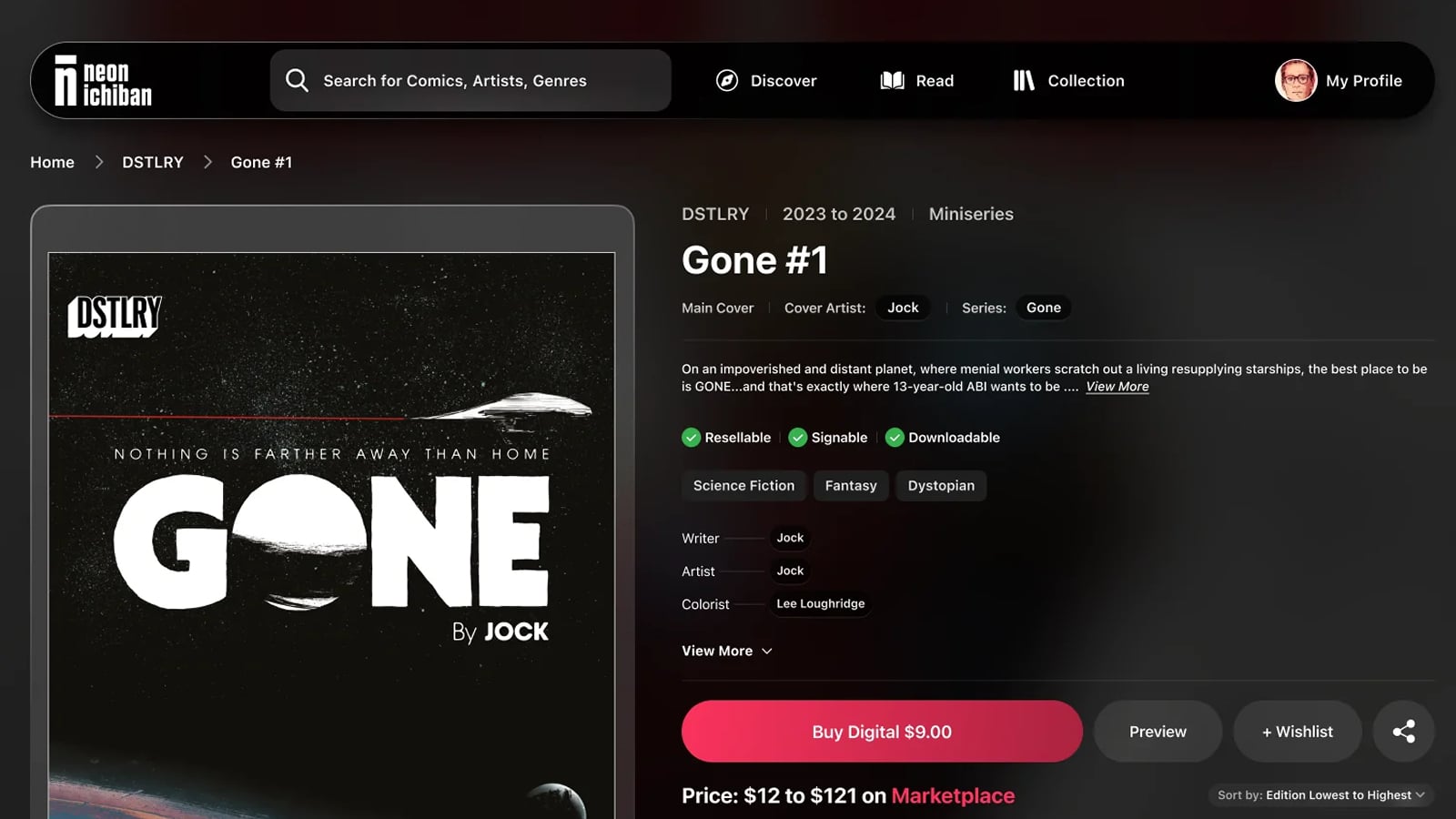
Publisher DSTLRY’s Neon Ichiban platform also has DC and Marvel (with its Marvel library being larger than GlobalComix), as well as its own titles and those published by Dark Horse, Dynamite, Kodansha, Vault, Titan Comics, Oni Press, Mad Cave Studios, Rebellion, and others. Like some of their rivals, they’re also promising Day 1 releases, growing backlogs, and DRM-enabled back-ups, and DRM-free purchases for 10 publishers, including DSTLRY,Marvel (featuring visible watermarks), Dynamite, Mad Cave, Oni, and Vault (with some DRM-free books from Dark Horse and Rebellion, as well). The platform's recent 2.5 update brought with it added functionality (including user profiles, reading lists, reviews, and featured collections) and quality-of-life updates to the desktop and iOS versions, as well as the unveiling of a public Android app beta and Mac desktop alpha waitlist.
None of this is Neon Ichiban’s key difference maker compared to other platforms, however. Instead, the platform has much deeper focus on digital emulation of print comics' collectibility and resellability to give it the edge, and works very closely with comic creators to open up income opportunities for them beyond just selling digital comics. Within Neon Ichiban’s storefront-style framework, users can buy and sell DRM-enabled comics directly for a price they set; they can also commission and sell ‘remarques’: one-of-a-kind digital sketches and signed comics (with commission fees and resale royalties going to the artist and/or publisher, where relevant). Again, the idea is to take something traditional (comic convention commissions) and put a modern spin on it (online accessibility, for buyer and creator).
Not for nothing, DSTLRY co-founders David Steinberger and Chip Mosher (formerly key figures at ComiXology) also insist that Neon Ichiban’s discoverability and comics reader technology — especially critical when displaying print comics layouts on screens — is the best in the market. Neon Ichiban's panel-to-panel viewing dynamic essentially boils down the best of the comiXology Guided View stylization (which they know well from their time there).
“We have great reading experience,” Steinberger said. “I think you'll find that if you talk to consumers and compare [digital comics] sites, we have the best browsing experience to find what you want.”
Algorithm-driven recommendations are intended to improve platform navigation further and facilitate comics/manga readership crossover, as well as onboard newbies unsure where to even start.
As Mosher put it: “If you're new to comics and manga, this is a site that every day gets better [at] introducing people to comics and manga, and holds [your] hand through that process.”
What’s more, Steinberger acknowledged Neon Ichiban’s lack of webtoon content, confirming that he and Mosher are aiming to bring webtoon creators into the fold — “It would be irresponsible as a business person not to get into that space,” Steinberger said — but not until the backlog of comics and manga is fully uploaded.
Transparency also came up more than once (Steinberger insisted Neon Ichiban will be “right in your face” about a given comic’s DRM status),and in a follow-up email Mosher highlighted the platform's print pre-order/digital credit promotion as an innovative way of accommodating different users' buying habits and supporting bricks and mortar retail. He also noted Neon Ichiban's community-building initiatives, such as offering users up to $5 in store credit each for submitting reviews.
Sweet Shop

Our final digital comics mover and shaker is Sweet Shop, which is currently in an "early access" beta period where you have to apply to take part. Despite being in the early stages, Sweet Shop has partnered with comic publishers Image Comics, Dark Horse Comics, IDW Publishing, Mad Cave Studios, Fantagraphics and more to be a part of its library. There are no chat rooms or collectibility measures on offer here, and that’s kinda the point. Sweet Shop’s goal is a no-frills experience geared towards maximum discoverability and minimal friction. You buy what you want in-app with actual money (no tokens or subscriptions) as soon as it’s in stores. You have offline DRM-free ownership of most of what you buy (however, a handful of publishers don't offer this option, nor is it guaranteed that publishers who join the platform will offer it, either). And you can organize reading lists, make wish lists, and post reviews.
“What we’re focused on is the hardest problem in comics: it's not reselling and it's not cheapening the value of comics, it's finding comics,” said Sweet co-founder and CEO Kenny Meyers.
Elaborating further, Meyers laid out a two-pronged strategy of making sure those already reading comics and manga are well served (and treated), while also repping for the platform in “spaces where people who might buy comics that didn't know that they exist” gather (such as non-comics events). He also touted Sweet Shop's reliance on non-VC financing as a safeguard against potential enshittification, and highlighted the platform's hard-line stance against any form of generative AI versus some of his competitors.
In terms of reading experiences, Sweet Shop currently focuses on the pinch-and-zoom method of reading comics and not the panel-to-panel smart viewing which comiXology pioneered, and both Neon Ichiban and GlobalComix do to varying degrees.
Lastly, in terms of the Sweet Shop beta's launch, Meyers said he was “incredibly happy” with where things are and the features already in place, and teased that he “wouldn't take anyone off the board” in terms of future publisher deals.
What our independent comics experts said
That’s the platforms’ point-of-view — what did our experts, David Harper and Susana Polo, have to say?
Sizing up the WEBTOON/Disney platform, Harper is impressed by the “massive” combined audience size (which, as a reminder, includes Disney+ subscribers), the mainstream hook of the Star Wars and Disney titles, and the potential for “cross-pollination” of WEBTOON and Marvel readers. However, the lack of clarity around how the new app’s roll-out will work — specifically, how it might impact existing WEBTOON users — gives him pause: “I would wager that the vast majority of [WEBTOON users] don't pay for anything [...] If you're trying to cross-pollinate these audiences and you're asking them to try a new model that's entirely paid rather than a freemium model or a free-to-paid model, that's going to be a lot harder to translate that audience over.”
For her part, Polo flagged that there “are significant genre differences in what's big on WEBTOON and what's big in superhero comics” that WEBTOON and Disney/Marvel will need to take into consideration to get the most out of their partnership. “I think it's important not to get stuck in the idea that like, ‘Oh, we'll convert those readers to people who are reading Spider-Man and Fantastic Four and Immortal Thor and Aliens Vs. X-Men,’ when those platforms are markets in their own right that work and make money,” she said.
Shifting focus to GlobalComix, Harper branded the platform “an enigma” that “seems like they want to be everything.” As evidence of this, he pointed to what he perceived as the platform’s shifting away from an indie publisher-focus and pivot to an a la carte as well as subscription model. At the same time, Harper recognized the value of having “a robust library of the most desirable material” that users will “migrate” to. Polo also touched on the draw of being able to access multiple major publishers’ outputs via one platform more generally, likening it to readers’ experiences with other media. “When people go to buy a book, they don't go to the Penguin Random House bookstore and then the Hachette bookstore and then to [the next bookstore],” she said. “They go to one bookstore where they can find all of the books there from all of the companies.”
Rounding out our experts’ analysis are Neon Ichiban and Sweet Shop, which Harper declared the “most interesting players” currently (excluding WEBTOON, which he walled off due to its freemium model). Of the two, Harper was most impressed by Sweet Shop’s emphasis on developing “a quality user experience, adding community elements to it, trying to make it a more active and sticky user base.” He was less complimentary about the scale of the platform’s publisher portfolio, though, arguing that “[Sweet Shop’s] weakness is Neon Ichiban’s strength.” Based on her bookstore analogy, Polo presumably concurs.
However, Sweet Shop hadn't yet announced 20 of its 22 publishers when I spoke with Harper and Polo, something that — dearth of DC and Marvel material notwithstanding — presumably redresses this perceived catalog deficiency.
Other pros Harper listed for Neon Ichiban included Steinberger and Mosher’s reputation “as people who understand the market,” and the platform’s “slick” and “easy to browse” user experience on desktop . Neon Ichiban’s collectibility and marketplace met with a cooler reception, with Harper opining that these features are “a turnoff for a lot of readers” who conflate them with NFTs. Lastly, Harper identified DRM-free comics as a “compelling advantage” for today’s digital comics platforms, something that also struck a nerve with Polo, who’s still reeling from ComiXology’s pivot to an exclusively DRM-enabled model. So, that’s a win for both Sweet Shop and Neon Ichiban (and to a lesser extent, GlobalComix),with the overall winner coming down to individual users' publisher preferences.
What about the elephant in the room: which platforms will and won’t survive? According to Harper, it may not be that simple — and even if it is, don’t expect to find out any time soon.
“I think that what you're going to see is evangelists form around each of [the digital comics platforms],” he theorized. “And you're going to see each of them take a small percentage of the market, like less than 50% each. And the big question is can anyone sustain on that? I don't know what the answer to that is, and I suspect we won't know for several years.”
So, for now, each of our four digital comics platforms is as good a bet as any. Which brings us neatly back to…
Which of the stand-out digital comics platforms is right for you?
Unsurprisingly, it comes down to personal preference.
Anyone with a strong affinity for webtoon-style comics should, naturally, start with WEBTOON. When it comes to vertical scroll comics, they really know what they’re doing. Equally, if you’re not overly fussed about toons but are mindful of budget, WEBTOON is a great option — assuming the core app and its Marvel Unlimited spinoff employ a freemium model. And even then, if you’re a Disney+ subscriber you’ll have access to at least some of the latter’s content, so you can at least trial it before reaching into your pocket.
For those in the market for a digital version of your classic superhero-centric comic shop experience, then Neon Ichiban or GlobalComix are your go-tos. Neon Ichiban has a larger library of Marvel books and a slicker viewing experience, while GlobalComix offers a flat-rate, monthly all-you-can-read comics experience that includes the major traditional comic publishers. Your mileage may vary regarding the community-building stuff and the scale of its DRM-free titles is still growing, but from a purely 'bang for your buck' perspective, Global Comix is hard to beat, even with the smaller Marvel library and recent departure of new Image Comics releases. Just be prepared to, in essence, rent the bulk of your comics (not unlike the movies and shows you stream on Netflix).
On the other hand, if actual, DRM-free digital comics ownership is a priority for you, Sweet Shop will be more your speed. True, you won't have access to Marvel or DC titles, but most of what goes in your cart can be yours for all time. If friction-free comics discovery and hoarding and a generally stripped-back approach are your main criteria for a digital platform, you’ll gravitate towards Sweet Shop.
Hankering for print-style digital collectability, an online marketplace, and a premium reader/browser? Choose Neon Ichiban, which excels at all three. The platform's library of downloadable titles continues to grow and, as noted earlier, even includes Neon Ichiban's Marvel library; said Marvel library currently stands at over 10,000 titles (with the non-downloadable DC library north of 13,000). Plus, you've got a stellar list of talent to choose from if remarques are your bag.
Or if you’re feeling as flush as Bruce Wayne, you could always sign up for multiple platforms. It’s either that or opt out altogether — and where’s the fun in that?
Interested? Here's where to find your closest local comic store, courtesy of Sweet, and here's a guide to how (and where) to read comics online. If you're looking for the best comics in recent memory, check out the Eisner Awards winners and the Harvey Awards nominees. And if you like free comics, here's everything we know about Free Comic Book Day 2027.
Follow Popverse for upcoming event coverage and news
Find out how we conduct our review by reading our review policy
Let Popverse be your tour guide through the wilderness of pop culture
Sign in and let us help you find your new favorite thing.




Comments
Want to join the discussion? Please activate your account first.
Visit Reedpop ID if you need to resend the confirmation email.